


Sex ratios at birth in Australia according to mother's country of birth: A national study of all 5 614 847 reported live births 1997-2016
- PMID: 34170929
- PMCID: PMC8232452
- DOI: 10.1371/journal.pone.0251588
Sex ratios at birth in Australia according to mother's country of birth: A national study of all 5 614 847 reported live births 1997-2016
Abstract
Objectives: Son preference and sex selective practices have resulted in a deficit of girls in several countries, primarily across Asia. Emerging evidence indicates that son preference survives migration to Western high-income countries. The objective of this study was to assess male-to-female (M/F) ratios at birth per mother's country of birth in Australia 1997-2016, in total and by parity, and by states/territories and over time.
Methods: Data for this national population-based cross-sectional study were obtained from the National Perinatal Data Collection (NPDC) and included all live births in Australia 1997-2016 (N = 5 614 847). M/F ratios with 95% Confidence Intervals were estimated.
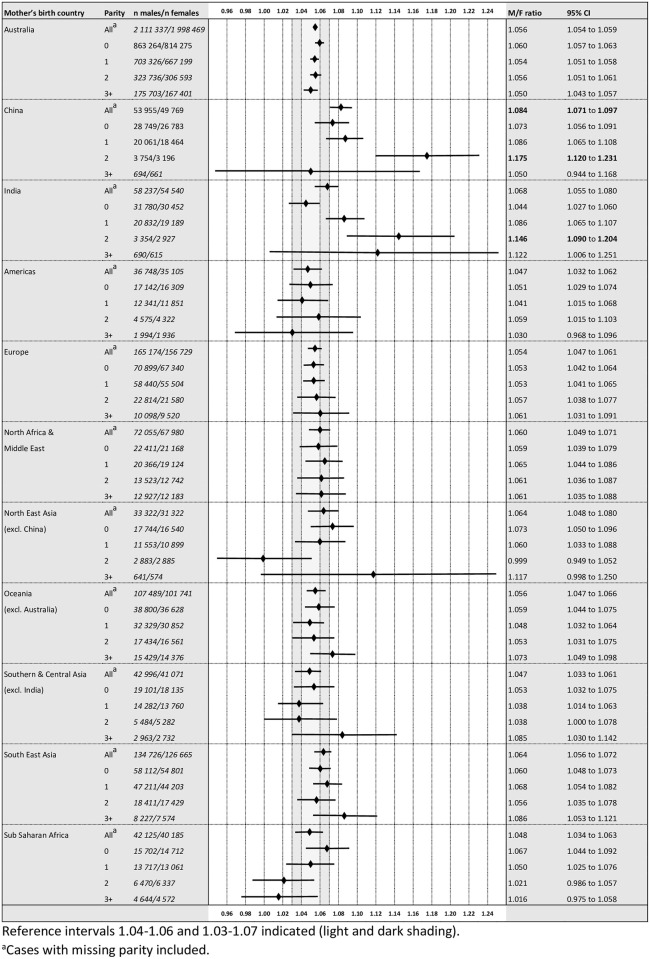
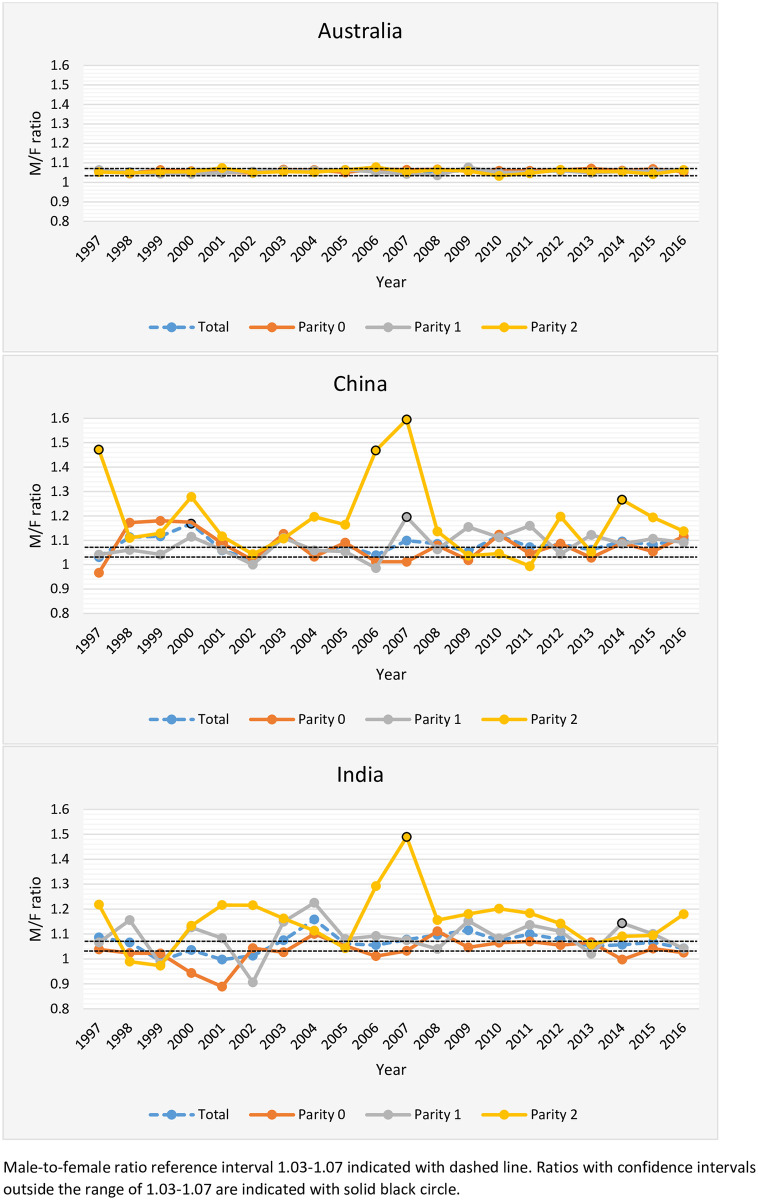
Results: The M/F ratio for births to Australian-born mothers was within the expected range (1.03-1.07) regardless of parity and time period. M/F ratios were elevated above the expected range for births to mothers born in China in the total sample (M/F ratio 1.084, 95% confidence interval 1.071-1.097) and at parity 2 (1.175, 1.120-1.231), and for births to mothers born in India at parity 2 (1.146, 1.090-1.204). Parity 2 births were the most consistently male-biased across time. Across states, elevated M/F ratios were identified for both groups in New South Wales (China parity 2: 1.182, 1.108-1.260; India parity 2: 1.182, 1.088-1.285), for births to Chinese-born mothers in Victoria (total births: 1.097, 1.072-1.123; parity 1: 1.115, 1.072-1.159) and Australian Capital Territory (total births: 1.189, 1.085-1.302) and births to Indian-born mothers Western Australia (parity 2: 1.307, 1.122-1.523).
Conclusions: Son preference persists in some immigrant communities after migration to Australia. The consistent pattern of elevated M/F ratios across the larger states indicates that sex imbalances at birth are largely independent of restrictiveness of local abortion laws. Drivers and consequences of son preference in Western high-income settings should be explored to further promote gender equality, and to strengthen support for women who may be vulnerable to reproductive coercion.
Conflict of interest statement
The authors have declared that no competing interests exist.
Figures
References
-
- UNFPA (United Nations Population Fund). Sex Imbalances at Birth: Current trends, consequences and policy implications. Bangkok: UNFPA Asia and the Pacific Regional Office; 2012.
-
- Bongaarts J, Guilmoto CZ. How many more missing women? Excess female mortality and prenatal sex selection, 1970–2050. Popul Dev Rev. 2015;41(2):241–69.
-
- Almond D, Edlund L, Milligan K. Son Preference and the Persistence of Culture: Evidence from South and East Asian Immigrants to Canada. Popul Dev Rev. 2013;39(1):75–95.
Publication types
MeSH terms
LinkOut - more resources
Full Text Sources
