


Maternal mortality ratio in Jiangsu Province, China: recent trends and associated factors
- PMID: 34172025
- PMCID: PMC8235612
- DOI: 10.1186/s12884-021-03897-0
Maternal mortality ratio in Jiangsu Province, China: recent trends and associated factors
Abstract
Background: In recent years, births to older mothers and multiparous mothers have increased rapidly with the change of birth policy in China. And mothers of advanced age are more likely to have maternal complications and poor birth outcomes. We aimed to estimate the recent trends and underlying risk factors of maternal mortality.
Methods: In this systematic assessment, we used data from the National Maternal and Child Health Routine Reporting System (2013-2018), Jiangsu Provincial Maternal Mortality Surveillance System (2017-2018), the Integrated National Mortality Surveillance System (2018), City Statistical Yearbooks (2018), City Health Statistical Yearbooks (2018). The factors associated with maternal mortality ratio (MMR) were explored using the stepwise regression analysis and cluster analysis.
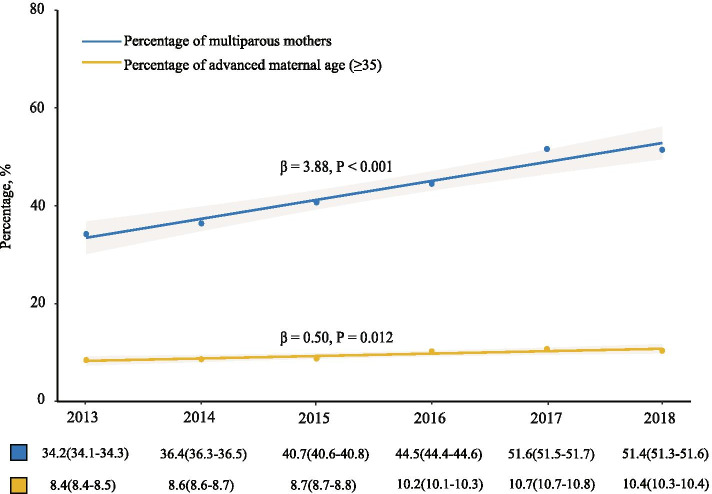
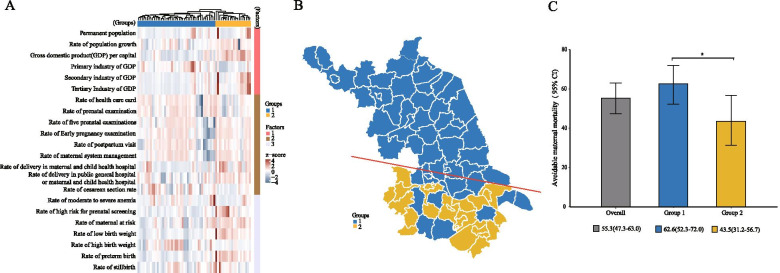
Results: The MMR maintained at low levels between 2013 and 2016 and there was a slight increase in maternal mortality after 2016 in Jiangsu province. With the implementation of the China's universal two child policies, the percentage of multiparous mothers ascended from 34.2% (95% confidence interval (CI) = 34.1-34.3%) in 2013 to 51.4% (95% CI = 51.3-51.6%) in 2018 (beta = 3.88, P < 0.001). Consistently, the percentage of advanced maternal age (≥ 35) increased from 8.4% (95% CI = 8.4-8.5%) in 2013 to 10.4% (95% CI = 10.3-10.4%) in 2018 (beta = 0.50, P = 0.012). And we found that the percentage of multiparous mothers and advanced maternal age among maternal deaths were higher than all pregnant women (P < 0.001). In the stepwise regression analysis, four risk factors were significantly associated with maternal mortality ratio (primary industry of gross domestic product (GDP), rate of delivery in maternal and child health hospital, rate of cesarean section and rate of low birth weight). As the results derived from cluster analysis, the relatively developed regions had lower preventable maternal mortality ratio (43.5% (95% CI = 31.2-56.7%) vs. 62.6% (95% CI = 52.3-72.0%), P = 0.027).
Conclusions: Since the universal two child policy has been associated with changes in health related birth characteristics: women giving birth have been more likely to be multiparous, and more likely to be aged 35 and over. This somewhat magnifies the impact of differences in economic development and obstetric services on MMR. The findings based on prefecture level data suggest that interventions must target economic development, the health system and maternal risk factors in synergy. These approaches will be of great benefit to control or diminish environmental factors associated with preventable deaths and will effectively reduce MMR and narrow the gap among the different regions.
Keywords: Maternal mortality ratio; Regional differences; Trends.
Conflict of interest statement
The authors declare no competing financial interest.
Figures
Similar articles
-
Preventable maternal mortality: geographic/rural-urban differences and associated factors from the population-based Maternal Mortality Surveillance System in China.BMC Public Health. 2011 Apr 19;11:243. doi: 10.1186/1471-2458-11-243. BMC Public Health. 2011. PMID: 21501529 Free PMC article.
-
Relaxation of the one child policy and trends in caesarean section rates and birth outcomes in China between 2012 and 2016: observational study of nearly seven million health facility births.BMJ. 2018 Mar 5;360:k817. doi: 10.1136/bmj.k817. BMJ. 2018. PMID: 29506980 Free PMC article.
-
Progress and challenges in maternal health in western China: a Countdown to 2015 national case study.Lancet Glob Health. 2017 May;5(5):e523-e536. doi: 10.1016/S2214-109X(17)30100-6. Epub 2017 Mar 21. Lancet Glob Health. 2017. PMID: 28341117 Free PMC article.
-
Impact of family planning programs in reducing high-risk births due to younger and older maternal age, short birth intervals, and high parity.Semin Perinatol. 2015 Aug;39(5):338-44. doi: 10.1053/j.semperi.2015.06.006. Epub 2015 Jul 10. Semin Perinatol. 2015. PMID: 26169538 Review.
-
Births by younger and older mothers in a population with late and regulated childbearing: Finland 1991.Acta Obstet Gynecol Scand. 1996 Jan;75(1):19-27. doi: 10.3109/00016349609033278. Acta Obstet Gynecol Scand. 1996. PMID: 8560992 Review.
Cited by
-
A systematic review of individual and ecological determinants of maternal mortality in the world based on the income level of countries.BMC Public Health. 2022 Dec 15;22(1):2354. doi: 10.1186/s12889-022-14686-5. BMC Public Health. 2022. PMID: 36522731 Free PMC article.
-
Predicting maternal risk level using machine learning models.BMC Pregnancy Childbirth. 2024 Dec 18;24(1):820. doi: 10.1186/s12884-024-07030-9. BMC Pregnancy Childbirth. 2024. PMID: 39695398 Free PMC article.
References
-
- Liang J, Li X, Kang C, Wang Y, Kulikoff XR, Coates MM, et al. Maternal mortality ratios in 2852 Chinese counties, 1996–2015, and achievement of Millennium Development Goal 5 in China: a subnational analysis of the Global Burden of Disease Study 2016. Lancet. 2019;393:241–252. doi: 10.1016/S0140-6736(18)31712-4. - DOI - PMC - PubMed
-
- United Nations. Implementation of the United Nations Millennium Declaration. Report of the Secretary General; 2002
MeSH terms
LinkOut - more resources
Full Text Sources
Research Materials
Miscellaneous
