Review
. 2020 Aug 21;3(2):166-172.
doi: 10.1016/j.oneear.2020.08.001.

Integrated Climate-Change Assessment Scenarios and Carbon Dioxide Removal

Affiliations
Review

Integrated Climate-Change Assessment Scenarios and Carbon Dioxide Removal

Vanessa J Schweizer et al. One Earth. .

Abstract

To halt climate change this century, we must reduce carbon dioxide (CO2) emissions from human activities to net zero. Any emission sources, such as in the energy or land-use sectors, must be balanced by natural or technological carbon sinks that facilitate CO2 removal (CDR) from the atmosphere. Projections of demand for large-scale CDR are based on an integrated scenario framework for emission scenarios composed of emission profiles as well as alternative socio-economic development trends and social values consistent with them. The framework, however, was developed years before systematic reviews of CDR entered the literature. This primer provides an overview of the purposes of scenarios in climate-change research and how they are used. It also introduces the integrated scenario framework and why it came about. CDR studies using the scenario framework, as well as its limitations, are discussed. Possible future developments for the scenario framework are highlighted, especially in relation to CDR.


Figures

Figure 1
Figure 1
Evolution and Break Down of Global Anthropogenic CO2 Emissions until 2100 The top-left panel shows global net CO2 emissions in Below-1.5°C, 1.5°C-low-overshoot (OS), and 1.5°C-high-OS pathways, with the four illustrative 1.5°C-consistent pathway archetypes of this chapter highlighted. Ranges at the bottom of the top-left panel show the 10th–90th percentile range (thin line) and interquartile range (thick line) of the time that global CO2 emissions reach net zero per pathway class, and for all pathways classes combined. The top-right panel provides a schematic legend explaining all CO2 emissions contributions to global CO2 emissions. The bottom row shows how various CO2 contributions are deployed and used in the four illustrative pathway archetypes (LED, S1, S2, S5, referred to as P1, P2, P3, and P4 in the Summary for Policymakers) used in this chapter (see Section 2.3.1.1). Note that the S5 scenario reports the building and industry sector emissions jointly. Green-blue areas hence show emissions from the transport sector and the joint building and industry demand sector, respectively. This figure and its title and legend are reprinted with permission from Figure 2.5 of the IPCC SR15, published by the World Meteorological Organization.
Figure 2
Figure 2
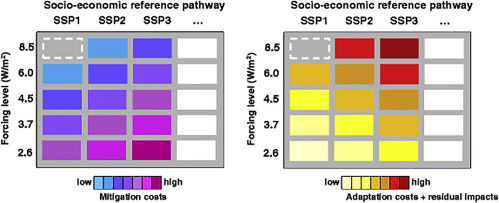
Conceptual Illustrations of How the Integrated Scenario Framework Can Be Used for Assessing the Cost and Benefits of Climate Policy Different categories of climate-policy costs and residual impacts are expected to vary across the cells of the matrix. The empty cells (dashed lines) illustrate that not all combinations of forcing levels and SSPs are consistent. Colors in the left-hand matrix illustrate how achievement of lower forcing levels imposes a greater mitigation cost for any given SSP but that this cost also requires the SSP to be followed. Colors in the right-hand matrix suggest how the costs of avoiding a certain amount of impact (not specified here) through adaptation, combined with the impact costs that remain, are greater under some SSPs than others and under higher levels of forcing. The 3.7 W/m2 level has been added to illustrate that levels of radiative forcing other than the original four RCPs can also be explored. Reproduced in accordance with the Creative Commons Attribution 4.0 International License (https://creativecommons.org/licenses/by/4.0/legalcode) from van Vuuren et al. (2014). No changes were made to the figure.
Figure 3
Figure 3
Range of Assumptions about Socio-economic Drivers and Projections for Energy and Food Demand in the Pathways Available to This Assessment 1.5°C-consistent pathways are blue, other pathways grey. Trajectories for the illustrative 1.5°C-consistent archetypes used in this Chapter (LED, S1, S2, S5; referred to as P1, P2, P3, and P4 in the Summary for Policymakers.) are highlighted. S1 is a sustainability oriented scenario, S2 is a middle-of-the-road scenario, and S5 is a fossil-fuel intensive and high energy demand scenario. LED is a scenario with particularly low energy demand. Population assumptions in S2 and LED are identical. Panels show (a) world population, (b) gross world product in purchasing power parity values, (c) final energy demand, and (d) food demand. This figure and its title and legend are reprinted with permission from Figure 2.4 of the IPCC SR15, published by the World Meteorological Organization.

References

    1. Edmonds J., Luckow P., Calvin K., Wise M., Dooley J., Kyle P., Kim S.H., Patel P., Clarke L. Can radiative forcing be limited to 2.6 Wm−2 without negative emissions from bioenergy and CO2 capture and storage? Clim. Change. 2013;118:29–43.
    1. Masson-Delmotte V., Zhai P., Pörtner H.O., Roberts D., Skea J., Shukla P.R., et al., editors. Global Warming of 1.5°C. An IPCC Special Report on the Impacts of Global Warming of 1.5°C above Pre-industrial Levels and Related Global Greenhouse Gas Emission Pathways, in the Context of Strengthening the Global Response to the Threat of Climate Change, Sustainable Development, and Efforts to Eradicate Poverty. Intergovernmental Panel on Climate Change; 2018. https://www.ipcc.ch/sr15/
    1. Minx J.C., Lamb W.F., Callaghan M.W., Fuss S., Hilaire J., Creutzig F., Amann T., Beringer T., Garcia W. de O., Hartmann J., et al. Negative emissions—part 1: research landscape and synthesis. Environ. Res. Lett. 2018;13:063001.
    1. Muratori M., Bauer N., Rose S.K., Wise M., Diaoglu V., Cui Y., Kato E., Gidden M., Strefler J., Fujimori S., et al. EMF-33 insights on bioenergy with carbon capture and storage (BECCS) Clim. Change. 2020 doi: 10.1007/s10584-020-02784-5. - DOI
    1. National Academies of Sciences, Engineering, and Medicine . The National Academies Press; 2019. Negative Emissions Technologies and Reliable Sequestration: A Research Agenda. - DOI - PubMed

LinkOut - more resources