


Decline in independence after three years and its association with dietary patterns and IADL-related factors in community-dwelling older people: an analysis by age stage and sex
- PMID: 34174828
- PMCID: PMC8235254
- DOI: 10.1186/s12877-021-02332-5
Decline in independence after three years and its association with dietary patterns and IADL-related factors in community-dwelling older people: an analysis by age stage and sex
Erratum in
-
Correction to: Decline in independence after three years and its association with dietary patterns and IADL-related factors in community-dwelling older people: an analysis by age stage and sex.BMC Geriatr. 2021 Sep 21;21(1):501. doi: 10.1186/s12877-021-02384-7. BMC Geriatr. 2021. PMID: 34548023 Free PMC article. No abstract available.
Abstract
Background: Few studies have shown age stage and sex differences in the association among dietary patterns and various health factors related to disability in older people. This study aimed to reveal the differences of characteristics, including several dietary patterns, associated with a decline in independence over 3 years in community-dwelling independent older people. Specifically, we examined data by age stage, for people between 65 and 75 years (earlier-stage) and people aged 75 years or above (later-stage), and sex.
Methods: We conducted a nationwide longitudinal study of 25 Japanese prefectures from 2013 to 2016; 2250 participants' complete data (1294 men and 956 women) were analyzed. Independence was evaluated based on instrumental activities of daily living (IADL) scores (maximum = 12). Dietary patterns were derived from a principal component analysis of the seven food groups. Baseline IADL-related factors linked to independence 3 years later were selected. Multiple logistic regression analysis for having low independence-without a full score of IADL 3 years after baseline-was conducted, adjusted for baseline IADL scores. Finally, to compare differences among age stage and sex groups, we used Multiple-Group Path Analysis.
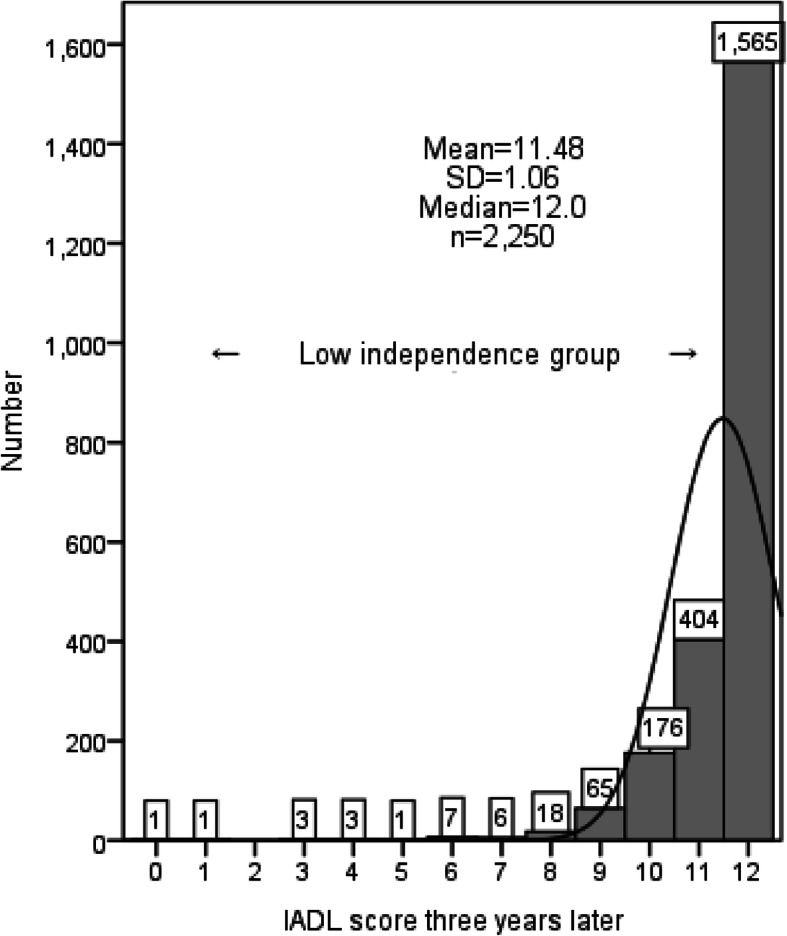
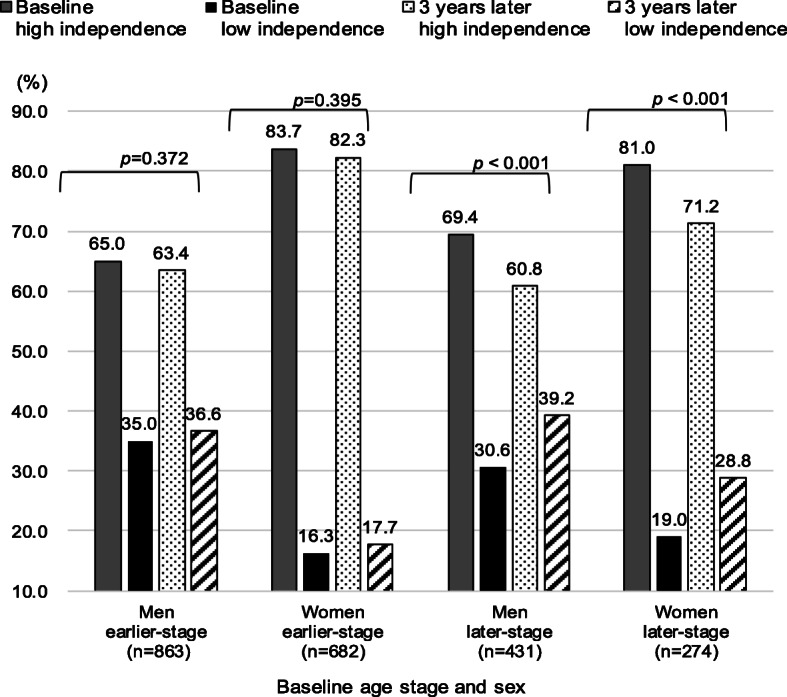
Results: Participants with a full IADL score 3 years later were classified as high independence (69.6%), and those without the full score were classified as low independence (30.4%). Only the later-stage older peoples' proportion of low independence 3 years later was significantly higher than those at baseline. A high meat frequency pattern was associated with a significantly higher risk of decline in independence 3 years later in later-stage older women. The earlier-stage older people showed that 18.5 ≤ BMI < 25 was associated with a lower risk, referring to BMI < 18.5. In the later-stage, exercising three or more times a week with enjoyment and fulfillment was associated with a significantly lower risk.
Conclusions: The IADL disability in older people aged 75 and over showed a rapid change. The different characteristics associated with the risk of decline in independence among age stage and sex were revealed. Targeting age stage and sex separately for community-based comprehensive supportive strategies would be necessary for a long life globally.
Keywords: Cohort study; Dietary pattern; Independence; Instrumental activities of daily living (IADL).
Conflict of interest statement
The authors declare no competing interests.
Figures
References
-
- Cabinet Office Japan . Annual report on the ageing society [summary] FY 2019. 2019.
-
- Ministry of Health, Labour and Welfare. Health insurance, an outline of the Japanese Medical System. https://www.mhlw.go.jp/bunya/iryouhoken/iryouhoken01/dl/01_eng.pdf. Accessed May 3, 2021.
-
- Arai H, Ouchi Y, Toba K, Endo T, Shimokado K, Tsubota K, Matsuo S, Mori H, Yumura W, Yokode M, Rakugi H, Ohshima S. Japan as the front-runner of super-aged societies: perspectives from medicine and medical care in Japan. Geriatr Gerontol Int. 2015;15(6):673–687. doi: 10.1111/ggi.12450. - DOI - PubMed
-
- Ministry of Health, Labour and Welfare . Guidelines on public health service for latter-stage older people. 2 2019.
Publication types
MeSH terms
LinkOut - more resources
Full Text Sources
Medical
