


Preparing for a pandemic: spending dynamics and panic buying during the COVID-19 first wave
- PMID: 34176997
- PMCID: PMC8209877
- DOI: 10.1111/1475-5890.12271
Preparing for a pandemic: spending dynamics and panic buying during the COVID-19 first wave
Abstract
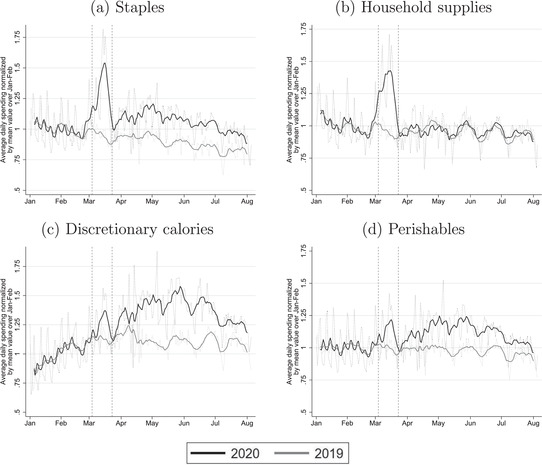
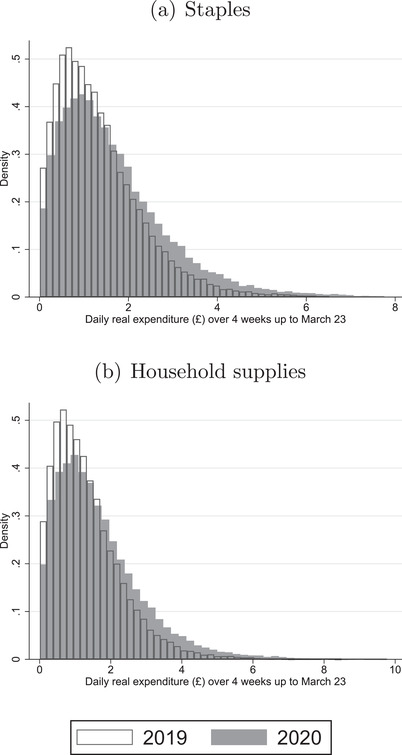
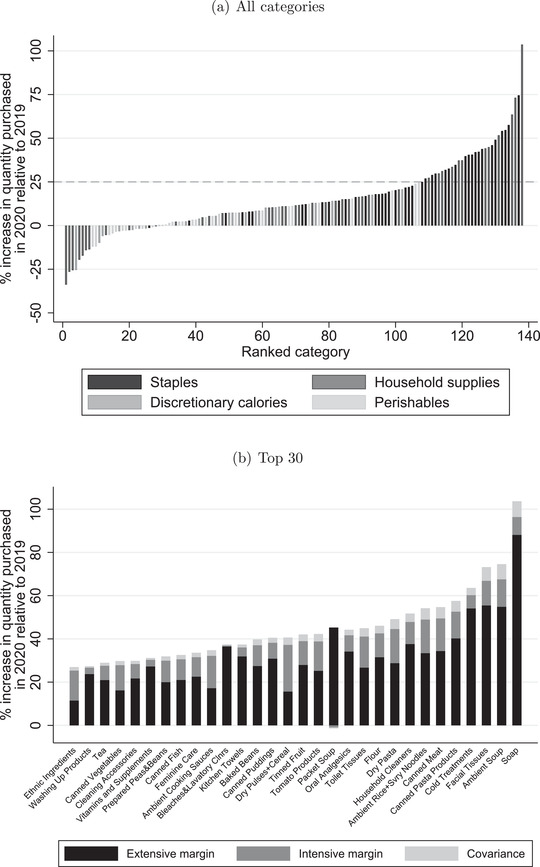
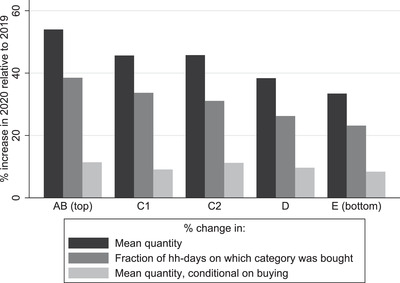
In times of heightened uncertainty, consumers face incentives to build up precautionary stocks of essential supplies. We study consumer spending dynamics during one such time, the first infection wave of the COVID-19 pandemic, using household scanner data covering fast-moving consumer goods in the United Kingdom. We document large increases in demand for storable products, such as food staples and household supplies, in the days before lockdown. Households in all socio-economic groups exhibit unusually high demand pre-lockdown, but there is a clear gradient, with the largest demand spikes for wealthier households. Although stories of people purchasing extreme amounts received a lot of attention, higher aggregate demand was mainly driven by more households than usual choosing to buy storable products, with only small increases in average quantities bought on a given trip. Temporary limits on the number of units per transaction, introduced following the demand spike, are therefore unlikely to lead to the avoidance of stock-outs.
Keywords: coronavirus; hoarding; panic buying.
© 2021 The Authors. Fiscal Studies published by John Wiley & Sons Ltd. on behalf of Institute for Fiscal Studies.
Figures
References
-
- Alexander, D. & Karger, E. (2020), Do stay‐at‐home orders cause people to stay at home? Effects of stay‐at‐home orders on consumer behavior. Federal Reserve Bank of Chicago, Working Paper WP 2020‐12.
-
- Baker, S. R. , Farrokhnia, R. A. , Meyer, S. , Pagel, M. & Yannelis, C. (2020a), How does household spending respond to an epidemic? Consumption during the 2020 COVID‐19 pandemic. Review of Asset Pricing Studies, 10, 834–62.
-
- Baker, S. R. , Farrokhnia, R. A. , Meyer, S. , Pagel, M. & Yannelis, C. (2020b), Income, liquidity, and the consumption response to the 2020 economic stimulus payments. National Bureau of Economic Research (NBER), Working Paper 27097.
LinkOut - more resources
Full Text Sources