


The rs12617336 and rs17574 Dipeptidyl Peptidase-4 Polymorphisms Are Associated With Hypoalphalipoproteinemia and Dipeptidyl Peptidase-4 Serum Levels: A Case-Control Study of the Genetics of Atherosclerotic Disease (GEA) Cohort
- PMID: 34178021
- PMCID: PMC8226230
- DOI: 10.3389/fgene.2021.592646
The rs12617336 and rs17574 Dipeptidyl Peptidase-4 Polymorphisms Are Associated With Hypoalphalipoproteinemia and Dipeptidyl Peptidase-4 Serum Levels: A Case-Control Study of the Genetics of Atherosclerotic Disease (GEA) Cohort
Abstract
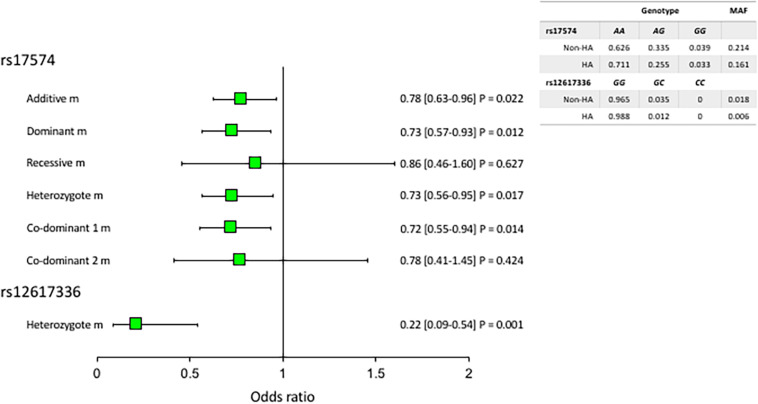
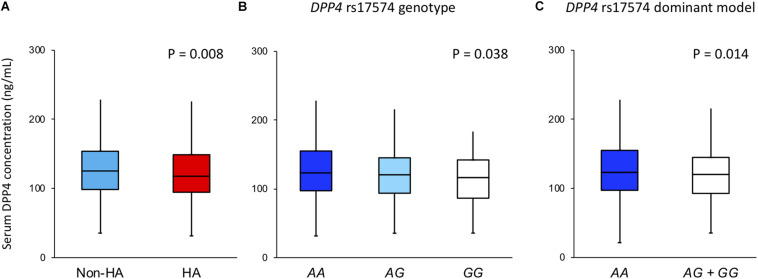
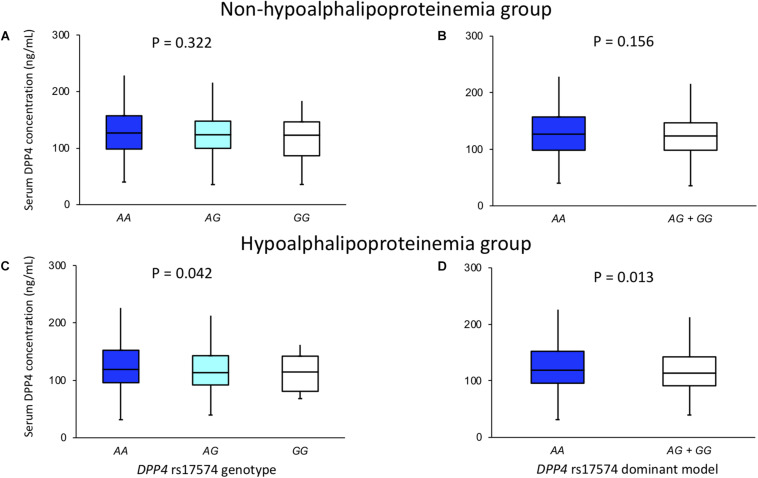
Dipeptidyl peptidase-4 (DPP4) can influence lipid homeostasis and atherosclerosis progression. We aimed to assess the association of DPP4 gene polymorphisms with hypoalphalipoproteinemia and DPP4 serum levels, in a cohort of Mexican individuals. Five DPP4 polymorphisms (rs12617336, rs12617656, rs1558957, and rs3788979, and rs17574) were genotyped in 748 participants with and 745 without hypoalphalipoproteinemia. The associations were evaluated using logistic regression analyses. Under inheritance models adjusted for confounding variables, the rs12617336 (OR = 0.22, P heterozygote = 0.001) and rs17574 (OR = 0.78, P additive = 0.022; OR = 0.73, P dominant = 0.012; OR = 0.73, P heterozygote = 0.017; OR = 0.72, P codominant 1 = 0.014) minor alleles were associated with a low risk of hypoalphalipoproteinemia. After the correction for multiple comparisons, the associations were marginal except the association of the rs12617336 that remaining significant. Additionally, both DPP4 minor alleles were associated with protection for the presence of insulin resistance (IR) (OR = 0.17, P heterozygote = 0.019 for rs12617336 and OR = 0.75, P additive = 0.049 for rs17574). The rs12617336 minor allele was also associated with a low risk of hyperinsulinemia (OR = 0.11, P heterozygote = 0.006). Differences in DPP4 levels were observed in individuals with rs17574 genotypes, the rs17574 GG genotype individuals had the lowest levels. Our data suggest that rs12617336 and rs17574 DPP4 minor alleles could be envisaged as protective genetic markers for hypoalphalipoproteinemia, IR, and hyperinsulinemia. The rs17574 GG genotype was associated with the lowest DPP4 levels.
Keywords: DPP4 serum levels; Dipeptidyl peptidase-4; hyperinsulinemia; hypoalphalipoproteinemia; insulin resistance; polymorphism.
Copyright © 2021 Vargas-Alarcón, González-Salazar, Vázquez-Vázquez, Hernández-Díaz Couder, Sánchez-Muñoz, Reyes-Barrera, Criales-Vera, Sánchez-Guerra, Osorio-Yáñez and Posadas-Sánchez.
Conflict of interest statement
The authors declare that the research was conducted in the absence of any commercial or financial relationships that could be construed as a potential conflict of interest.
Figures
Similar articles
-
Association of the rs17574 DPP4 Polymorphism with Premature Coronary Artery Disease in Diabetic Patients: Results from the Cohort of the GEA Mexican Study.Diagnostics (Basel). 2022 Jul 15;12(7):1716. doi: 10.3390/diagnostics12071716. Diagnostics (Basel). 2022. PMID: 35885620 Free PMC article.
-
Association of the rs12617656 C/T genetic variant of the DPP4 gene with in-stent restenosis in Mexican population: a cohort study.Arch Cardiol Mex. 2024 Oct 16;95(1):34-41. doi: 10.24875/ACM.24000065. Arch Cardiol Mex. 2024. PMID: 39413436 Free PMC article.
-
Dipeptidylpeptidase-4 levels and DPP4 gene polymorphisms in patients with COVID-19. Association with disease and with severity.Life Sci. 2021 Jul 1;276:119410. doi: 10.1016/j.lfs.2021.119410. Epub 2021 Mar 24. Life Sci. 2021. PMID: 33774023 Free PMC article.
-
DPP4 Activity, Hyperinsulinemia, and Atherosclerosis.J Clin Endocrinol Metab. 2021 May 13;106(6):1553-1565. doi: 10.1210/clinem/dgab078. J Clin Endocrinol Metab. 2021. PMID: 33570554 Free PMC article. Review.
-
Influence of Dipeptidyl Peptidase-4 (DPP4) on Mesenchymal Stem-Cell (MSC) Biology: Implications for Regenerative Medicine - Review.Stem Cell Rev Rep. 2022 Jan;18(1):56-76. doi: 10.1007/s12015-021-10285-w. Epub 2021 Oct 22. Stem Cell Rev Rep. 2022. PMID: 34677817 Review.
Cited by
-
Increased carotid intima-media thickness and cardiometabolic risk factors are associated with IL-6 gene polymorphisms in Mexican individuals: The Genetics of Atherosclerotic Disease Mexican study.Biomol Biomed. 2024 Mar 11;24(2):315-322. doi: 10.17305/bb.2023.9495. Biomol Biomed. 2024. PMID: 37838929 Free PMC article.
-
Association of the rs17574 DPP4 Polymorphism with Premature Coronary Artery Disease in Diabetic Patients: Results from the Cohort of the GEA Mexican Study.Diagnostics (Basel). 2022 Jul 15;12(7):1716. doi: 10.3390/diagnostics12071716. Diagnostics (Basel). 2022. PMID: 35885620 Free PMC article.
-
Low levels of soluble DPP4 among Saudis may have constituted a risk factor for MERS endemicity.PLoS One. 2022 Apr 12;17(4):e0266603. doi: 10.1371/journal.pone.0266603. eCollection 2022. PLoS One. 2022. PMID: 35413090 Free PMC article.
-
Sweet Taste Receptors' Genetic Variability in Advanced Potential Targets of Obesity.Nutrients. 2025 May 18;17(10):1712. doi: 10.3390/nu17101712. Nutrients. 2025. PMID: 40431452 Free PMC article.
-
Glycemic Control and Cardiometabolic Risk in Black Zimbabweans with Type 2 Diabetes Mellitus.Diabetes Metab Syndr Obes. 2024 Aug 27;17:3187-3196. doi: 10.2147/DMSO.S473042. eCollection 2024. Diabetes Metab Syndr Obes. 2024. PMID: 39220799 Free PMC article.
References
-
- Aghili N., Devaney J. M., Alderman L. O., Zukowska Z., Epstein S. E., Burnett M. S., et al. (2012). Polymorphisms in dipeptidyl peptidase IV gene are associated with the risk of myocardial infarction in patients with atherosclerosis. Neuropeptides 46 367–371. 10.1016/j.npep.2012.10.001 - DOI - PubMed
LinkOut - more resources
Full Text Sources
Miscellaneous
