


Fractional Model with Social Distancing Parameter for Early Estimation of COVID-19 Spread
- PMID: 34178570
- PMCID: PMC8220443
- DOI: 10.1007/s13369-021-05827-w
Fractional Model with Social Distancing Parameter for Early Estimation of COVID-19 Spread
Abstract
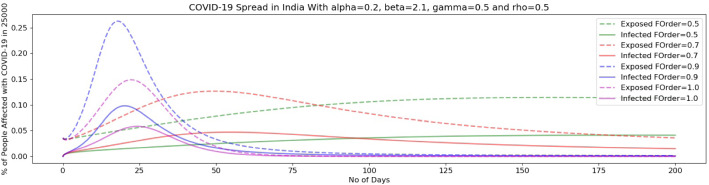
COVID-19 disease has come up as a life-threatening outbreak at end of 2019. It has impacted almost all countries in the world. The major source of COVID-19 is a novel beta coronavirus. COVID-19 had a great impact on world throughout the year 2020. Now, the situation is becoming normal due to the invention of the vaccine. All major countries started large vaccination drives. Mathematical models are used to study the impact of different measures used to decrease pandemics. Mathematical models such as susceptible-infected-removed model and susceptible-exposed-infected-removed are used to predict the spread of diseases. But these models are not suitable to predict COVID-19 spread due to various preventive measures (social distancing and quarantine) applied to reduce spread. Hence, in the present manuscript, a novel fractional mathematical model with a social distancing parameter has been proposed to provide early COVID-19 spread estimation. Fractional calculus provides flexibility in choosing arbitrary order of derivative which controls data sensitivity. The model has been validated with real data set. It has been observed that the proposed model is highly accurate in spread estimation.
Keywords: COVID-19; Coronavirus; Mathematical modeling; Pandemic modeling.
© King Fahd University of Petroleum & Minerals 2021.
Figures







References
-
- Williamson G. Covid-19 epidemic editorial. The Open Nursing J. 2020;14:37–38. doi: 10.2174/1874434602014010037. - DOI
LinkOut - more resources
Full Text Sources