


Using crowd-sourced data for real-time monitoring of food prices during the COVID-19 pandemic: Insights from a pilot project in northern Nigeria
- PMID: 34178595
- PMCID: PMC8204685
- DOI: 10.1016/j.gfs.2021.100523
Using crowd-sourced data for real-time monitoring of food prices during the COVID-19 pandemic: Insights from a pilot project in northern Nigeria
Abstract
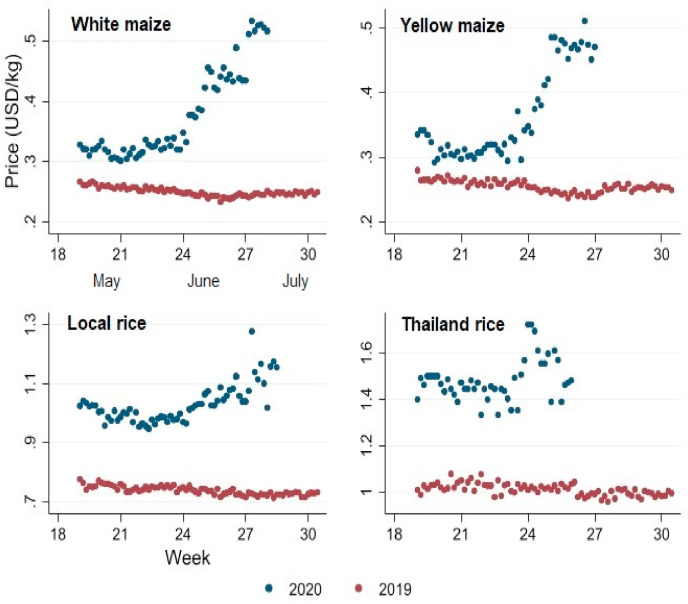
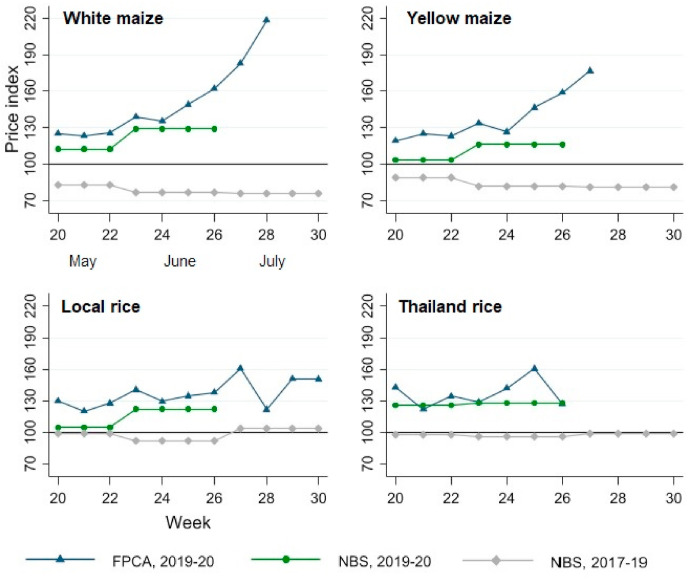
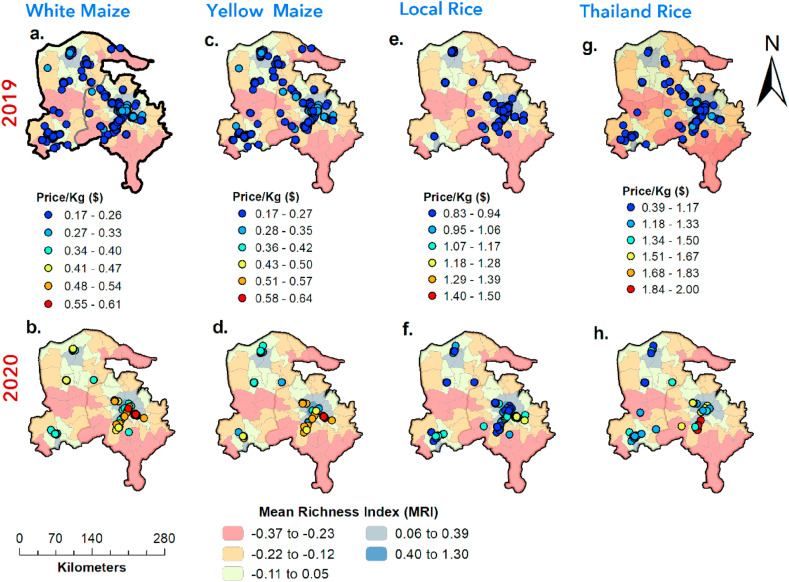
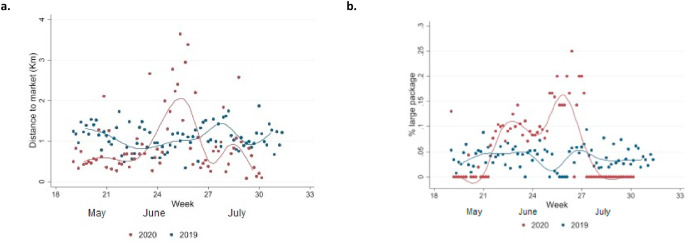
The COVID-19 pandemic and related lockdown measures have disrupted food supply chains globally and caused threats to food security, especially in Sub-Saharan Africa. Yet detailed, localized, and timely data on food security threats are rarely available to guide targeted policy interventions. Based on real-time evidence from a pilot project in northern Nigeria, where food insecurity is severe, we illustrate how a digital crowdsourcing platform can provide validated real-time, high frequency, and spatially rich information on the evolution of commodity prices. Daily georeferenced price data of major food commodities were submitted by active volunteer citizens through a mobile phone data collection app and filtered through a stepwise quality control algorithm. We analyzed a total of 23,961 spatially distributed datapoints, contributed by 236 active volunteers, on the price of four commodities (local rice, Thailand rice, white maize and yellow maize) to assess the magnitude of price change over eleven weeks (week 20 to week 30) during and after the first COVID-related lockdown (year 2020), relative to the preceding year (2019). Results show that the retail price of maize (yellow and white) and rice (local and Thailand rice) increased on average by respectively 26% and 44% during this COVID-related period, compared to prices reported in the same period in 2019. GPS-tracked data showed that mobility and market access of active volunteers were reduced, travel-distance to market being 54% less in 2020 compared to 2019, and illustrates potential limitations on consumers who often seek lower pricing by accessing broader markets. Combining the price data with a spatial richness index grid derived from UN-FAO, this study shows the viability of a contactless data crowdsourcing system, backed by an automated quality control process, as a decision-support tool for rapid assessment of price-induced food insecurity risks, and to target interventions (e.g. COVID relief support) at the right time and location(s).
Keywords: COVID-19; Commodity; Crowdsourcing; Food prices; Price increase; Real-time.
© 2021 The Authors.
Conflict of interest statement
The authors declare that they have no known competing financial interests or personal relationships that could have appeared to influence the work reported in this paper.
Figures
References
-
- Agwu N.M., Nwachukwu I.N., Okoye B.C. Worsening food crisis in Nigeria: a discourse on bail-out options. Sacha J. Environ. Stud. 2011;1(1):64–68.
-
- Alliance for Affordable Internet . Web Foundation; 2020. From Luxury to Lifeline: Reducing the Cost of Mobile Devices to Reach Universal Internet Access.https://a4ai.org/research/from-luxury-to-lifeline-reducing-the-cost-of-m... [Last Accessed: 08/13/2020; Available at.
-
- Alper C.E., Hobdari N., Uppal A. IMF Working Paper; 2016. Food Inflation in Sub-saharan Africa: Causes and Policy Implications.https://www.imf.org/external/pubs/ft/wp/2016/wp16247.pdf WP/16/247 [Last Accessed 08/25/2020; Available at:
-
- Arbia G., Solano-Hermosilla G., Micale F., Nardelli V., Genovese G. Post-sampling crowdsourced data to allow reliable statistical inference: the case of food price indices in Nigeria. 2018. http://meetings3.sis-statistica.org/index.php/sis2018/49th/paper/viewFil... [Last Accessed: 08/27/2020; Available at.
-
- Arbia G., Solano-Hermosilla G., Micale F., Nardelli V., Genovese G. 2020. From Mobile App-Based Crowdsourcing to Crowd-Trusted Food Price Estimates in Nigeria: A Post-Sampling Strategy for Optimal Statistical Inference. submitted for publication.
LinkOut - more resources
Full Text Sources