


Remote home monitoring (virtual wards) for confirmed or suspected COVID-19 patients: a rapid systematic review
- PMID: 34179736
- PMCID: PMC8219406
- DOI: 10.1016/j.eclinm.2021.100965
Remote home monitoring (virtual wards) for confirmed or suspected COVID-19 patients: a rapid systematic review
Abstract
Background: the aim of this review was to analyze the implementation and impact of remote home monitoring models (virtual wards) for confirmed or suspected COVID-19 patients, identifying their main components, processes of implementation, target patient populations, impact on outcomes, costs and lessons learnt.
Methods: we carried out a rapid systematic review on models led by primary and secondary care across seven countries (US, Australia, Canada, The Netherlands, Ireland, China, UK). The main outcomes included in the review were: impact of remote home monitoring on virtual length of stay, escalation, emergency department attendance/reattendance, admission/readmission and mortality. The search was updated on February 2021. We used the PRISMA statement and the review was registered on PROSPERO (CRD: 42020202888).
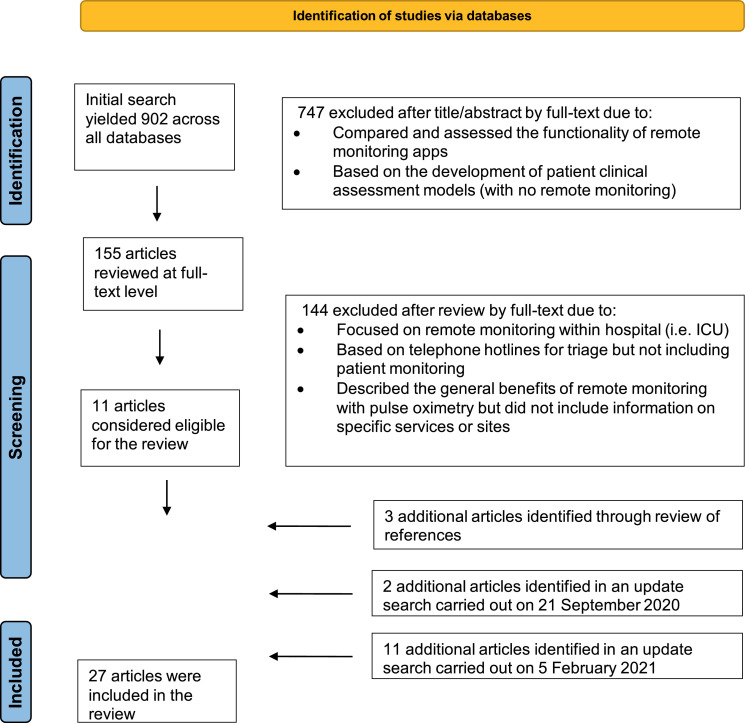
Findings: the review included 27 articles. The aim of the models was to maintain patients safe in the appropriate setting. Most models were led by secondary care and confirmation of COVID-19 was not required (in most cases). Monitoring was carried via online platforms, paper-based systems with telephone calls or (less frequently) through wearable sensors. Models based on phone calls were considered more inclusive. Patient/career training was identified as a determining factor of success. We could not reach substantive conclusions regarding patient safety and the identification of early deterioration due to lack of standardized reporting and missing data. Economic analysis was not reported for most of the models and did not go beyond reporting resources used and the amount spent per patient monitored.
Interpretation: future research should focus on staff and patient experiences of care and inequalities in patients' access to care. Attention needs to be paid to the cost-effectiveness of the models and their sustainability, evaluation of their impact on patient outcomes by using comparators, and the use of risk-stratification tools.
Keywords: COVID-19; Rapid systematic review; Remote home monitoring; SARS-CoV-2; Silent hypoxia; Virtual wards.
© 2021 The Author(s).
Conflict of interest statement
Mr Georghiou reports grants from National Institute for Health Research, NIHR, during the conduct of the study. All the other authors declare no conflict of interests.
References
-
- NHS. Pulse oximetry to detect early deterioration of patients with COVID-19 in primary and community care settings, 2020.
-
- Margolius D., Hennekes M., Yao J., Einstadter D., Gunzler D., Chehade N., Sehgal A.R., Tarabichi Y., Perzynski A.T. On the front (phone) lines: results of a COVID-19 hotline. J Am Board Family Med. 2021;34(Supplement):S95–102. Feb 1. - PubMed
LinkOut - more resources
Full Text Sources
Medical
Miscellaneous
