Incidence and Mortality of Proximal and Distal Colorectal Cancer in Germany—Trends in the Era of Screening Colonoscopy
- PMID: 34180790
- PMCID: PMC8287758
- DOI: 10.3238/arztebl.m2021.0111
Incidence and Mortality of Proximal and Distal Colorectal Cancer in Germany—Trends in the Era of Screening Colonoscopy
Abstract
Background: The use of colonoscopy has increased and colorectal cancer (CRC) incidence has decreased after the introduction of screening colonoscopy in Germany. However, it remains unknown to what extent progress has been achieved in the prevention of cancer in the proximal colon, distal colon, and rectum.
Methods: We analyzed trends in CRC incidence (2000-2016) and mortality (2000-2018) in Germany by sex, age, and tumor location.
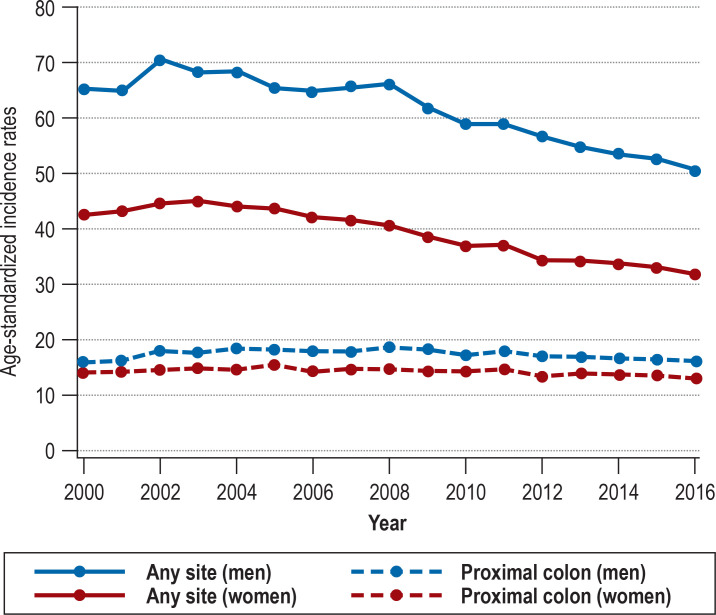
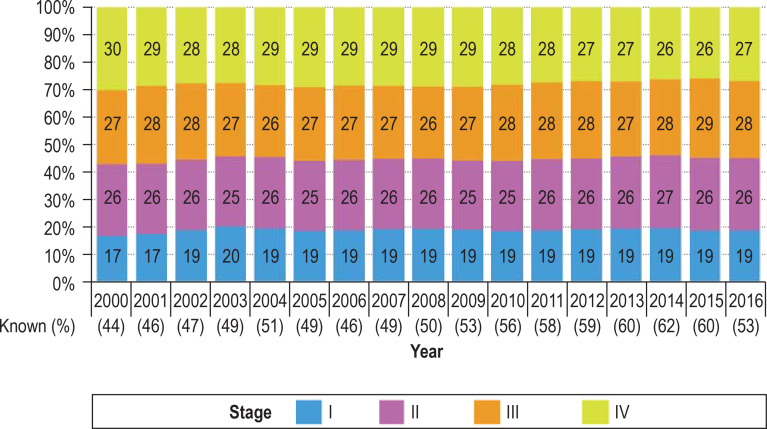
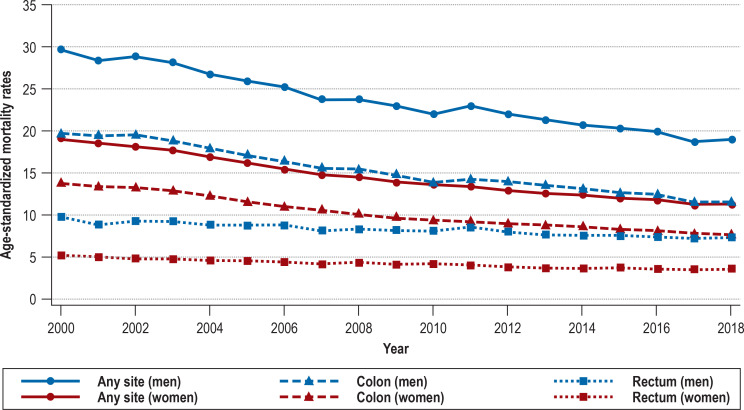
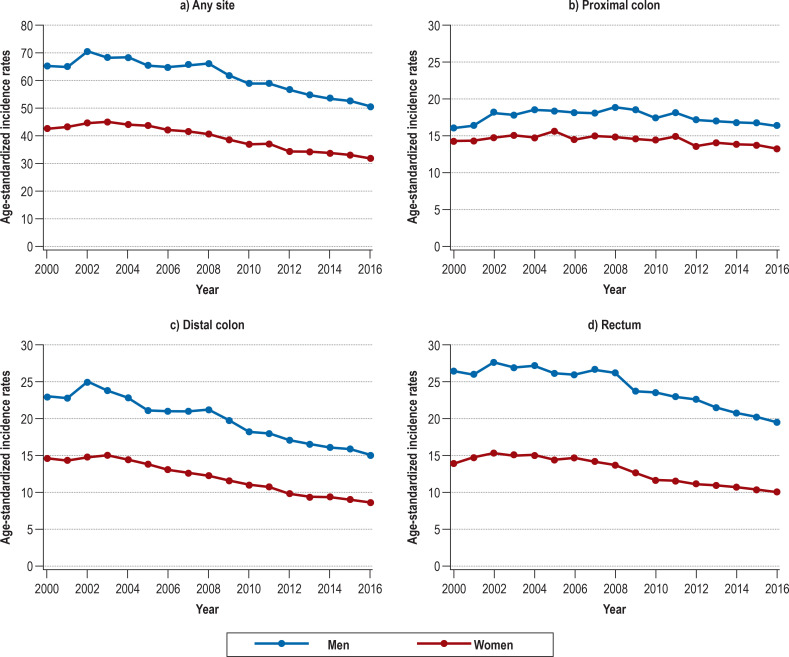
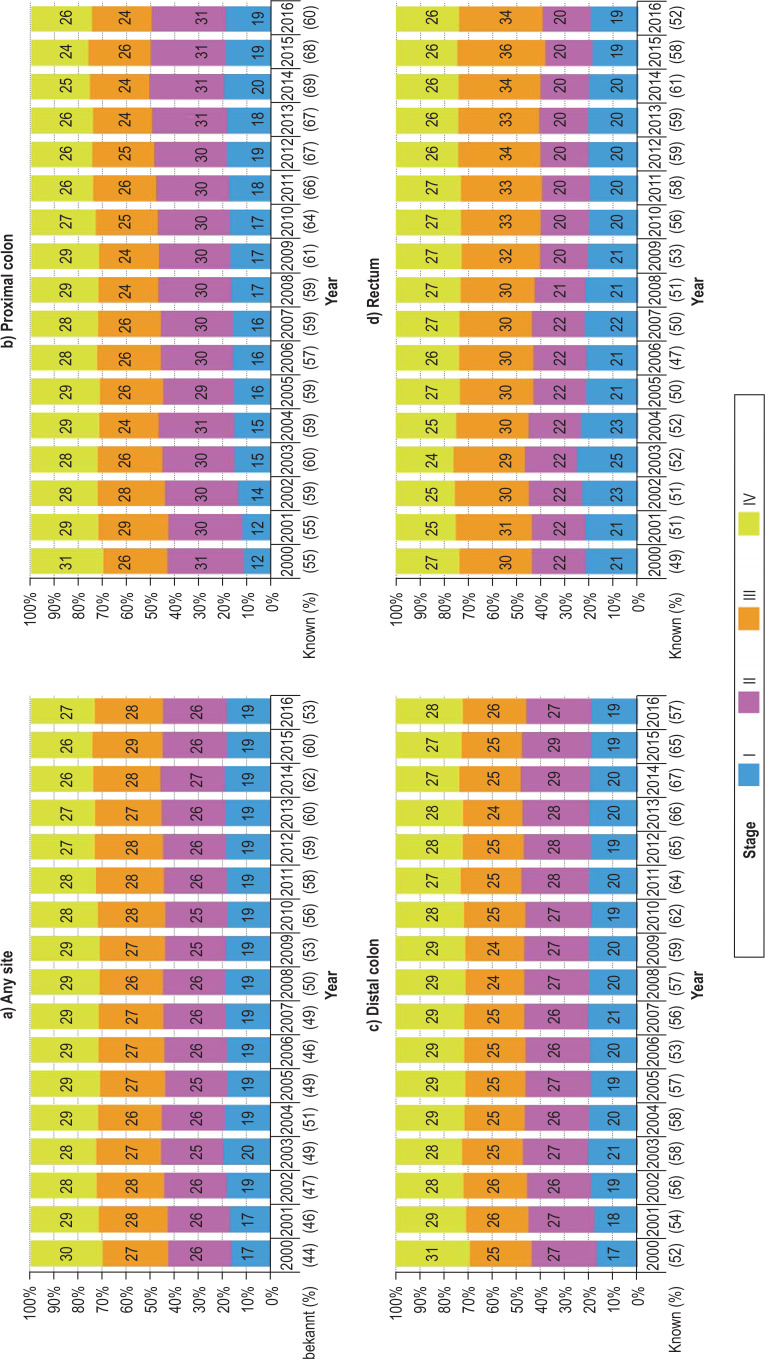
Results: The age-standardized incidence of CRC declined by 22.4% (from 65.3 to 50.7 per 100 000) in men and by 25.5% (from 42.7 to 31.8 per 100 000) in women. CRC mortality declined by 35.8% (from 29.6 to 19.0 per 100 000) in men and by 40.5% (19.0 to 11.3 per 100 000) in women. Despite demographic changes, the annual numbers of CRC cases and deaths still decreased from about 60 400 to 58 300 and from around 28 700 to 24 200, respectively. The decline in incidence was greatest in groups aged ≥ 55 years. While the incidence of cancer in the distal colon and rectum decreased by 34.5% and 26.2%, respectively, in men and by 41.0% and 27.9% in women, the incidence of proximal colon cancer remained stable in men and decreased by only 7.0% in women. However, a major shift towards earlier stages was observed for the proximal cancers.
Conclusion: The results support the assumption that the increased use of colo - noscopy has contributed to substantial reductions in the incidence of distal CRC incidence and the mortality from cancers in the entire colon and rectum.
Figures
Comment in
-
Falling Mortality Thanks to Improved Treatment for Colorectal Cancer.Dtsch Arztebl Int. 2021 Oct 1;118(39):664. doi: 10.3238/arztebl.m2021.0259. Dtsch Arztebl Int. 2021. PMID: 34919049 Free PMC article. No abstract available.
-
In Reply.Dtsch Arztebl Int. 2021 Oct 1;118(39):664. doi: 10.3238/arztebl.m2021.0260. Dtsch Arztebl Int. 2021. PMID: 34919050 Free PMC article. No abstract available.
References
-
- Bray F, Ferlay J, Soerjomataram I, Siegel RL, Torre LA, Jemal A. Global cancer statistics 2018: GLOBOCAN estimates of incidence and mortality worldwide for 36 cancers in 185 countries. CA Cancer J Clin. 2019;68:394–424. - PubMed
-
- Robert Koch-Institut and Gesellschaft der epidemiologischen Krebsregister in Deutschland e.V. (eds.) Krebs in Deutschland 2015/2016. Berlin, www.krebsdaten.de and www.gekid.(last accessed on 25 January 2021) 2018
-
- Scholefield JH, Moss SM, Mangham CM, Whynes DK, Hardcastle JD. Nottingham trial of faecal occult blood testing for colorectal cancer: a 20-year follow-up. Gut. 2012;61:1036–1040. - PubMed
-
- Shaukat A, Mongin SJ, Geisser MS, et al. Long-term mortality after screening for colorectal cancer. N Engl J Med. 2013;369:1106–1114. - PubMed
-
- Hewitson P, Glasziou P, Watson E, Towler B, Irwig L. Cochrane systematic review of colorectal cancer screening using the fecal occult blood test (hemoccult): an update. Am J Gastroenterol. 2008;103:1541–1549. - PubMed
MeSH terms
LinkOut - more resources
Full Text Sources
Medical