


Comparing the impact on COVID-19 mortality of self-imposed behavior change and of government regulations across 13 countries
- PMID: 34182593
- PMCID: PMC8441808
- DOI: 10.1111/1475-6773.13688
Comparing the impact on COVID-19 mortality of self-imposed behavior change and of government regulations across 13 countries
Abstract
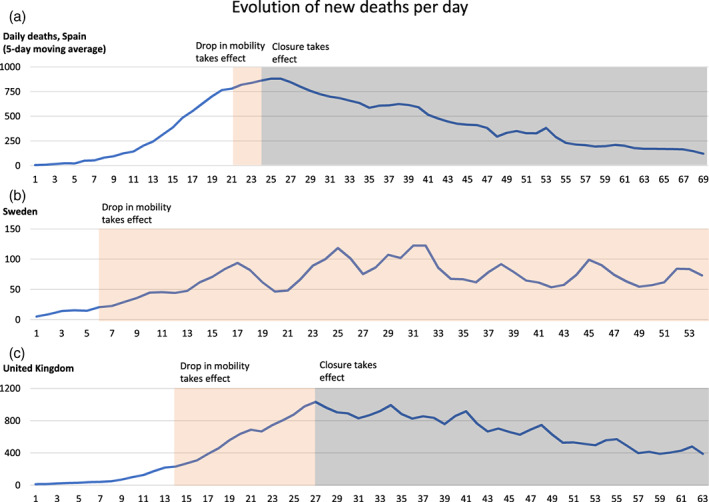
Objective: Countries have adopted different approaches, at different times, to reduce the transmission of coronavirus disease 2019 (COVID-19). Cross-country comparison could indicate the relative efficacy of these approaches. We assess various nonpharmaceutical interventions (NPIs), comparing the effects of voluntary behavior change and of changes enforced via official regulations, by examining their impacts on subsequent death rates.
Data sources: Secondary data on COVID-19 deaths from 13 European countries, over March-May 2020.
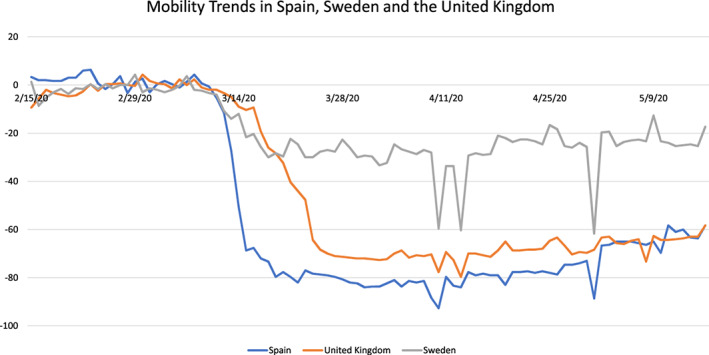
Study design: We examine two types of NPI: the introduction of government-enforced closure policies and self-imposed alteration of individual behaviors in the period prior to regulations. Our proxy for the latter is Google mobility data, which captures voluntary behavior change when disease salience is sufficiently high. The primary outcome variable is the rate of change in COVID-19 fatalities per day, 16-20 days after interventions take place. Linear multivariate regression analysis is used to evaluate impacts.
Data collection/extraction methods: publicly available.
Principal findings: Voluntarily reduced mobility, occurring prior to government policies, decreases the percent change in deaths per day by 9.2 percentage points (pp) (95% confidence interval [CI] 4.5-14.0 pp). Government closure policies decrease the percent change in deaths per day by 14.0 pp (95% CI 10.8-17.2 pp). Disaggregating government policies, the most beneficial for reducing fatality, are intercity travel restrictions, canceling public events, requiring face masks in some situations, and closing nonessential workplaces. Other sub-components, such as closing schools and imposing stay-at-home rules, show smaller and statistically insignificant impacts.
Conclusions: NPIs have substantially reduced fatalities arising from COVID-19. Importantly, the effect of voluntary behavior change is of the same order of magnitude as government-mandated regulations. These findings, including the substantial variation across dimensions of closure, have implications for the optimal targeted mix of government policies as the pandemic waxes and wanes, especially given the economic and human welfare consequences of strict regulations.
Keywords: SARS-CoV-2; Western Europe; lockdown; nonpharmaceutical interventions; salience; voluntary behavior change.
© 2021 The Authors. Health Services Research published by Wiley Periodicals LLC on behalf of Health Research and Educational Trust.
Figures
References
-
- Johns Hopkins University & Medicine . Coronavirus Resource Center. https://coronavirus.jhu.edu/map.html. Accessed June 19, 2021.
-
- UNESCO . Global education coalition. https://en.unesco.org/covid19/educationresponse/globalcoalition. Accessed August 2, 2020.
MeSH terms
LinkOut - more resources
Full Text Sources
Medical
Miscellaneous
