Proposal for capturing patient experience through extended value frameworks of health technologies
- PMID: 34185553
- PMCID: PMC10390902
- DOI: 10.18553/jmcp.2021.27.7.936
Proposal for capturing patient experience through extended value frameworks of health technologies
Abstract
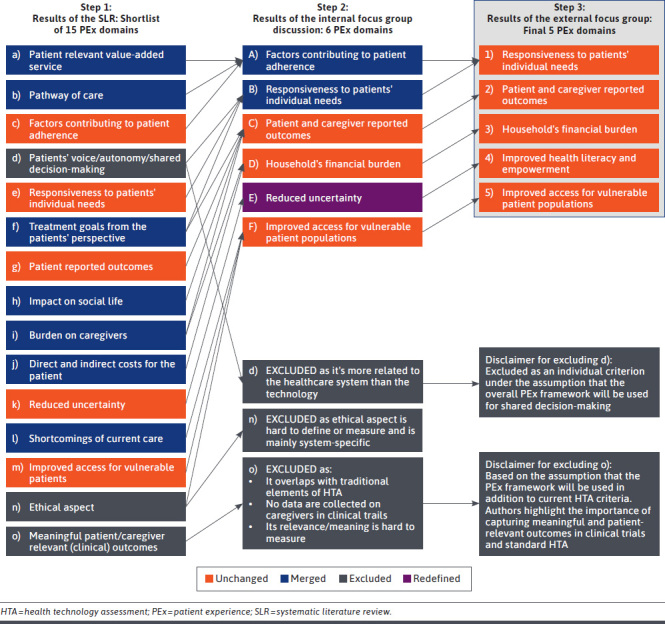
BACKGROUND: Inclusion of patient experience (PEx) in health technology assessment (HTA) has become increasingly important; however, no harmonized approach exists to help manufacturers or decision makers ensure PEx considerations are fair, consistent, and thorough within global HTA frameworks. OBJECTIVE: To develop a proposal for including PEx in the HTA frameworks of health technologies. METHODS: A systematic literature review (SLR) on existing value frameworks (VFs) was conducted to capture how PEx-related value judgment is currently considered. Guided by the results of the SLR, a research group including HTA experts and patient representatives used an iterative process to develop potential value domains to capture PEx, in accordance with international guidelines. Subsequently, a panel of international payer experts was used to challenge the proposed PEx domains and provide recommendations for implementation. RESULTS: The SLR found 61 VFs and multi-criteria decision analyses (MCDAs) that considered PEx; however, PEx-related value elements were often referred to superficially, without clear definitions. Five potential PEx domains, with proposed measures for each, were developed and refined using expert feedback: (1) responsiveness to patient's individual needs, (2) improved health literacy and empowerment, (3) patient and caregiver reported outcomes, (4) household's financial burden, and (5) improved access for vulnerable patient populations. A flexible approach for framework implementation was proposed. CONCLUSIONS: Proposed PEx domains could be implemented at multiple levels of healthcare decision making to formalize consideration of PEx in the assessment of value, either through the extension of existing VFs or to create new PEx-focused VFs and more holistic decision making tools. DISCLOSURES: This study was funded and sponsored by UCB Pharma. The funding agreement ensured the authors' independence in designing the study, interpreting the data, writing, and publishing the report. Charokopou, Mountain, and Szegvari are employed by UCB Pharma. Inotai, Jakab, and Kalo are employed by Syreon Research Institute, which received funding from UCB Pharma for this research. Brixner has received fees from AbbVie, Elevar, Millcreek Outcomes Group, Novartis, Sanofi, UCB Pharma, and Xcenda. Campbell has received grants and contracts from the PhRMA Foundation and the Institute for Clinical and Economic Review. During a sabbatical leave, Campbell collaborated with Syreon Research Institute on research projects that included funding from UCB Pharma. Hawkins has received consultancy fees from UCB Pharma. Kristensen has received speakers bureau fees from Pfizer, AbbVie, Amgen, UCB Pharma, Celgene, Bristol-Myers Squibb, MSD, Novartis, Eli Lilly, and Janssen Pharmaceuticals and consultancy fees from UCB Pharma.
Conflict of interest statement
This study was funded and sponsored by UCB Pharma. The funding agreement ensured the authors’ independence in designing the study, interpreting the data, writing, and publishing the report. Charokopou, Mountain, and Szegvari are employed by UCB Pharma. Inotai, Jakab, and Kalo are employed by Syreon Research Institute, which received funding from UCB Pharma for this research.
Brixner has received fees from AbbVie, Elevar, Millcreek Outcomes Group, Novartis, Sanofi, UCB Pharma, and Xcenda. Campbell has received grants and contracts from the PhRMA Foundation and the Institute for Clinical and Economic Review. During a sabbatical leave, Campbell collaborated with Syreon Research Institute on research projects that included funding from UCB Pharma. Hawkins has received consultancy fees from UCB Pharma. Kristensen has received speakers bureau fees from Pfizer, AbbVie, Amgen, UCB Pharma, Celgene, Bristol-Myers Squibb, MSD, Novartis, Eli Lilly, and Janssen Pharmaceuticals and consultancy fees from UCB Pharma.
Figures

References
-
- Berger ML, Bingefors K, Hedblom EC, Pashos CL, Torrance GW, Smith MD. Health Care Cost, Quality, and Outcomes: ISPOR Book of Terms. ISPOR; 2003.
-
- Velasco-Garrido M, Busse R. Health Technology Assessment: An introduction of objectives, role of evidence, and structure in Europe. European Observatory on Health Systems and Policies. Published 2005. Accessed October 02, 2019. www.euro.who.int/__data/assets/pdf_file/0018/90432/E87866.pdf
-
- Food and Drug Administration. Guidance for Industry: Patient-Reported Outcomes Measures: Use in Medical Product Development to Support Label Claims. Published December 2009. Accessed January 12, 2021. https://www.fda.gov/media/77832/download
-
- Whitehead SJ, Ali S. Health outcomes in economic evaluation: the QALY and utilities. British Medical Bulletin. 2010;96:5-21. - PubMed
-
- Food and Drug Administration. Patient-Focused Drug Development: Collecting Comprehensive and Representative Input. Published 2018. Accessed January 14, 2021. https://www.fda.gov/regulatory-information/search-fda-guidance-documents...
Publication types
MeSH terms
LinkOut - more resources
Full Text Sources