Latin American Consensus on management of residual cardiometabolic risk. A consensus paper prepared by the Latin American Academy for the Study of Lipids and Cardiometabolic Risk (ALALIP) endorsed by the Inter-American Society of Cardiology (IASC), the International Atherosclerosis Society (IAS), and the Pan-American College of Endothelium (PACE)
- PMID: 34187049
- PMCID: PMC8771033
- DOI: 10.24875/ACM.21000005
Latin American Consensus on management of residual cardiometabolic risk. A consensus paper prepared by the Latin American Academy for the Study of Lipids and Cardiometabolic Risk (ALALIP) endorsed by the Inter-American Society of Cardiology (IASC), the International Atherosclerosis Society (IAS), and the Pan-American College of Endothelium (PACE)
Abstract
Background: Hypertension, hyperglycemia, dyslipidemia, overweight, obesity, and tobacco (smoking, chewing, and vaping), together with a pro-inflammatory and procoagulant state, are the main risk factors related to atherosclerotic cardiovascular disease.
Objective and methods: A group of experts from the Americas, based on their clinical expertise in cardiology, cardiovascular prevention, and cardiometabolic (CM) diseases, joined together to develop these practical recommendations for the optimal evaluation and treatment of residual CM risk factors in Latin America, using a modified Delphi methodology (details in electronic TSI) to generate a comprehensive CM risk reduction guideline, and through personalized medicine and patient-centered decision, considering the cost-benefit ratio The process was well defined to avoid conflicts of interest that could bias the discussion and recommendations.
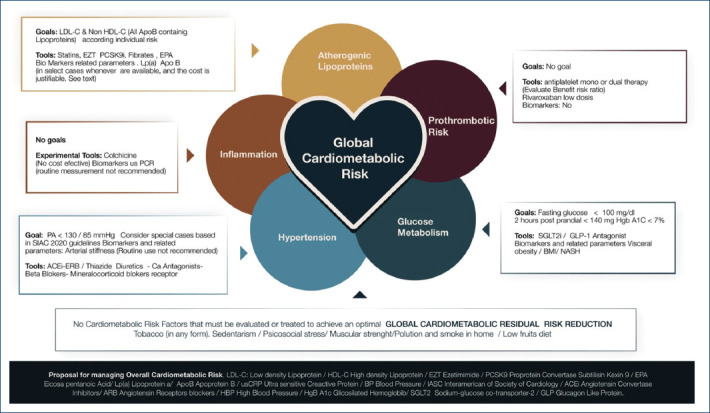
Results: Residual risk reduction should consider therapeutic options adapted to specific patient needs, based on five treatment objectives: triglyceride-rich lipoproteins, inflammation, impaired glucose metabolism, high blood pressure, and prothrombotic status. Comprehensive control of all CM risk factors should be a priority to deal with this important public health problem and prevent premature deaths. The recommendations in this paper address the evidence-based treatment of CM risk and are intended for clinical application in Latin American countries.
Antecedentes: Un grupo de factores de riesgo cardiometabólicos (hipertensión, hiperglucemia, dislipidemia, sobrepeso, obesidad y tabaco (fumado, masticado, vaporizado), junto con un estado proinflamatorio y procoagulante, son los principales factores de riesgo relacionados con la enfermedad cardiovascular aterosclerótica.
Objetivo y métodos: Basándose en su experiencia en cardiología, prevención cardiovascular y enfermedades cardiometabólicas, un grupo de expertos de las Américas se unió para desarrollar estas recomendaciones prácticas para la evaluación y tratamiento óptimos de los factores de riesgo cardiometabólicos residuales en América Latina, utilizando una metodología Delphi modificada con el objetivo de generar una guía integral de pautas para la reducción del riesgo cardiometabólico, mediante la medicina personalizada y la decisión centrada en el paciente teniendo en cuenta la relación costo-beneficio. El proceso fue bien definido para evitar conflictos de intereses que podrían sesgar la discusión y las recomendaciones.
Resultados: La reducción del riesgo residual debe considerar opciones terapéuticas adaptadas a las necesidades específicas del paciente, basadas en 5 objetivos de tratamiento: lipoproteínas ricas en triglicéridos inflamación, metabolismo de la glucosa, presión arterial alta y estado protrombótico. El Control integral de todos los factores de riesgo cardiometabólicos debe ser una prioridad para hacer frente a este importante problema de salud pública y prevenir las muertes prematuras. Las recomendaciones de este documento abordan el tratamiento basado en evidencia del riesgo cardiometabólico y están destinadas a la aplicación clínica en los países de América Latina.
Keywords: Residual risk; Cardiovascular risk; Cardiometabolic risk factors; Atherosclerotic cardiovascular disease; Inflammation; Thrombosis.
Conflict of interest statement
On behalf of all Co-Authors, I Carlos I. Ponte-Negretti the corresponding author do have the responsibility for the submission. All authors were requested to disclose any actual or potential conflict of interest including any financial, personal or other relationships with other people or organizations within 3 years of beginning the submitted work that could inappropriately influence, or be perceived to influence, their work.
Figures
References
-
- Januzzi JL Jr., Ahmad T, Binder LG, Hucker WJ, Kumbhani DJ, Maddox TM, et al. 2019 Methodology for creating expert consensus decision pathways:a report of the American college of cardiology. J Am Coll Cardiol. 2019;74:1138–50. - PubMed
-
- Crawford M, Wright G. Delphi method. In:Wiley StatsRef:statistics Reference Online. United States: Wiley; 2016. pp. 1–6.
-
- Averna M, Stroes E Alterations Beyond LDL Expert Working Group. How to assess and manage cardiovascular risk associated with lipid alterations beyond LDL. Atheroscler Suppl. 2017;26:16–24. - PubMed
MeSH terms
Substances
LinkOut - more resources
Full Text Sources
Medical