


No change in reoperation rates despite shifting treatment trends: a population-based study of 4,070 proximal humeral fractures
- PMID: 34190013
- PMCID: PMC8635647
- DOI: 10.1080/17453674.2021.1941629
No change in reoperation rates despite shifting treatment trends: a population-based study of 4,070 proximal humeral fractures
Abstract
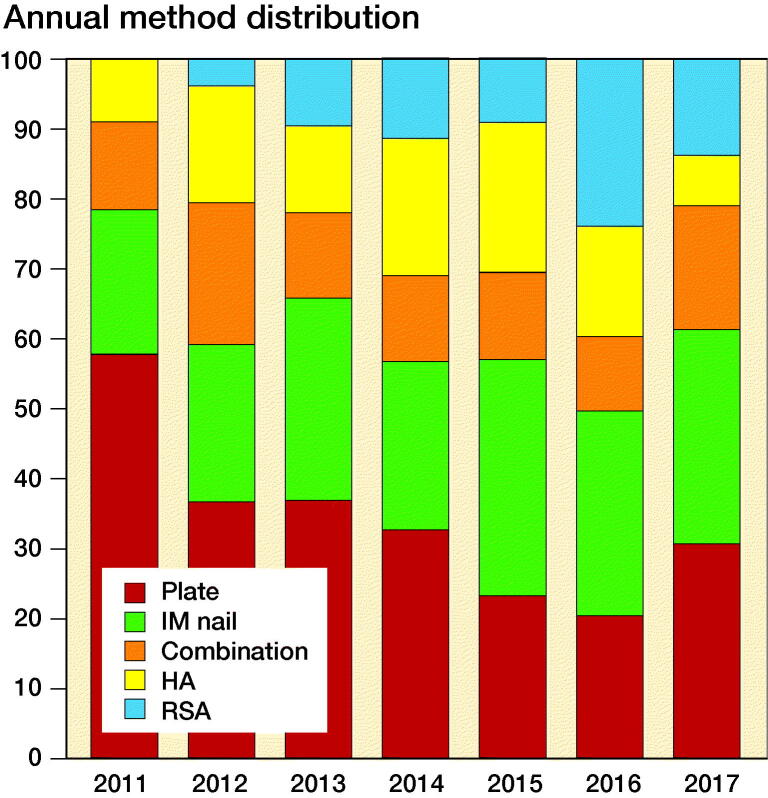
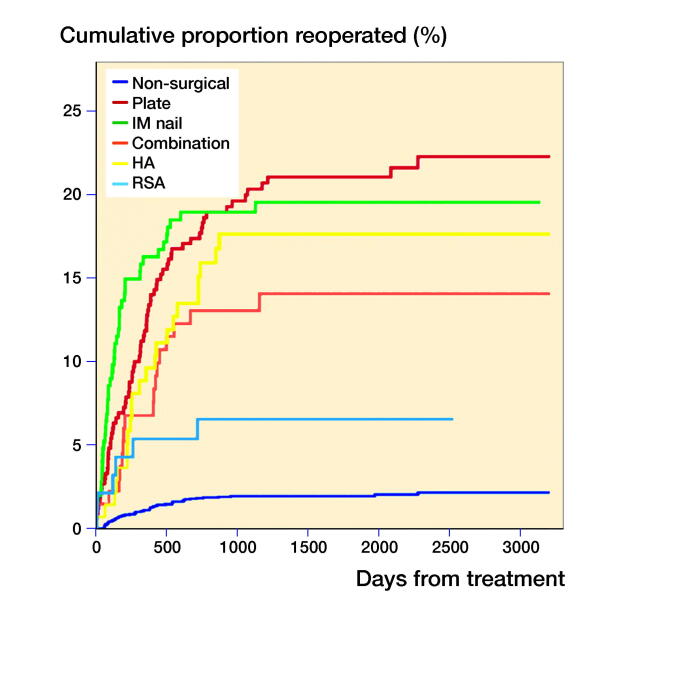
Background and purpose - Clear and acknowledged treatment algorithms for proximal humeral fractures (PHFs) are lacking. Nevertheless, a change in treatment trends, including a change towards more reversed shoulder arthroplasties (RSA), has been observed during recent years. We examined the effect of these changes on reoperation rates.Patients and methods - Between 2011 and 2017, 4,070 PHFs treated at Sahlgrenska University Hospital were registered prospectively in the Swedish Fracture Register (SFR) and followed up until 2019 (mean follow-up of 4.5 years). Data on all reoperations were gathered from the SFR and from medical records.Results - The majority of PHFs were treated non-surgically and the proportion increased slightly, but not statistically significantly, during the study period (from 76% to 79%). Of the surgically treated fractures, the proportion fixed with a plate decreased from 47% to 25%, while the use of RSA increased 9-fold (from 2.0% to 19%). 221 patients underwent 302 reoperations. For those primarily treated surgically, the reoperation rate was 17%. Among treatment modalities, plate fixation was associated with the highest reoperation rate (21%). Rate of reoperations remained constant during the study period, both for the entire study cohort and for the surgically treated patientsInterpretation - During the study period, treatment changes that are in accordance with recently published treatment recommendations were observed. However, these treatment changes did not affect the reoperation rate. Treatment with a plate, intramedullary nail, or hemiarthroplasty was associated with the highest reoperation rates. The fact that almost every 4th surgical procedure was a reoperation indicates a need for further improvement of modern treatment concepts for PHFs.
Figures
References
-
- Barlow J D, Logli A L, Steinmann S P, Sems S A, Cross W W, Yuan B J, Torchia M E, Sanchez-Sotelo J.. Locking plate fixation of proximal humerus fractures in patients older than 60 years continues to be associated with a high complication rate. J Shoulder Elbow Surg 2020; 29: 1689–94. - PubMed
-
- Bergdahl C, Wennergren D, Ekelund J, Möller M.. Mortality after a proximal humeral fracture. Bone Joint J 2020; 102-b: 1484–90. - PubMed
MeSH terms
LinkOut - more resources
Full Text Sources
Medical