


Glucose Patterns in Very Old Adults: A Pilot Study in a Community-Based Population
- PMID: 34191599
- PMCID: PMC8819510
- DOI: 10.1089/dia.2021.0156
Glucose Patterns in Very Old Adults: A Pilot Study in a Community-Based Population
Abstract
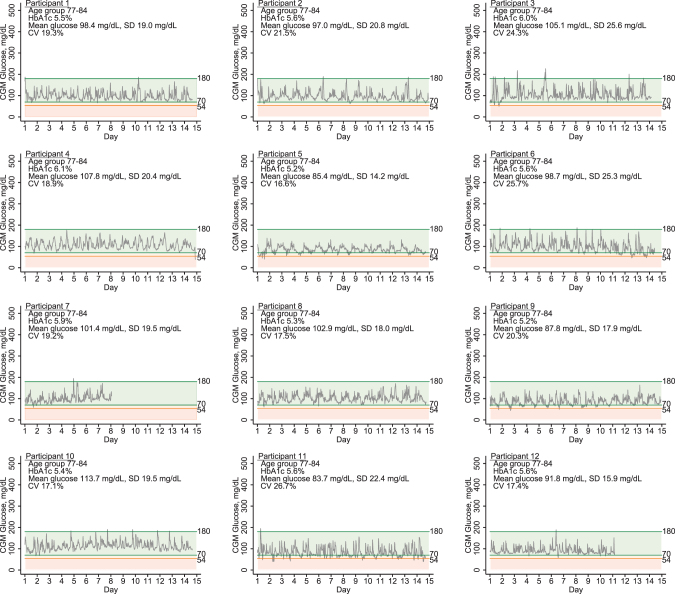
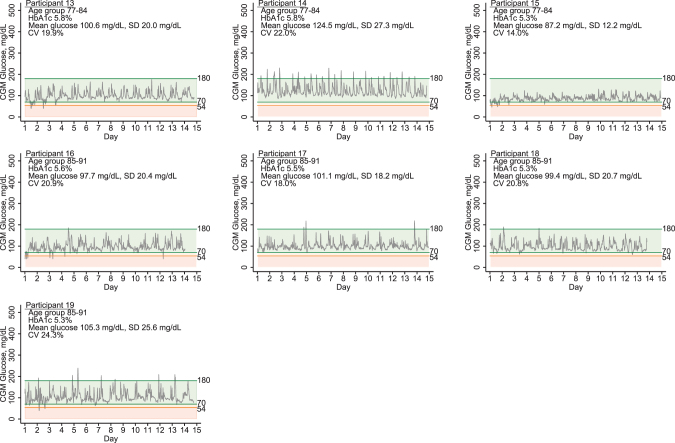
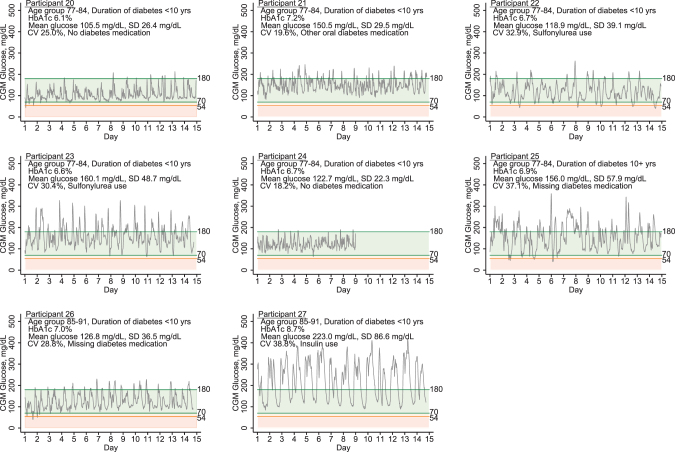
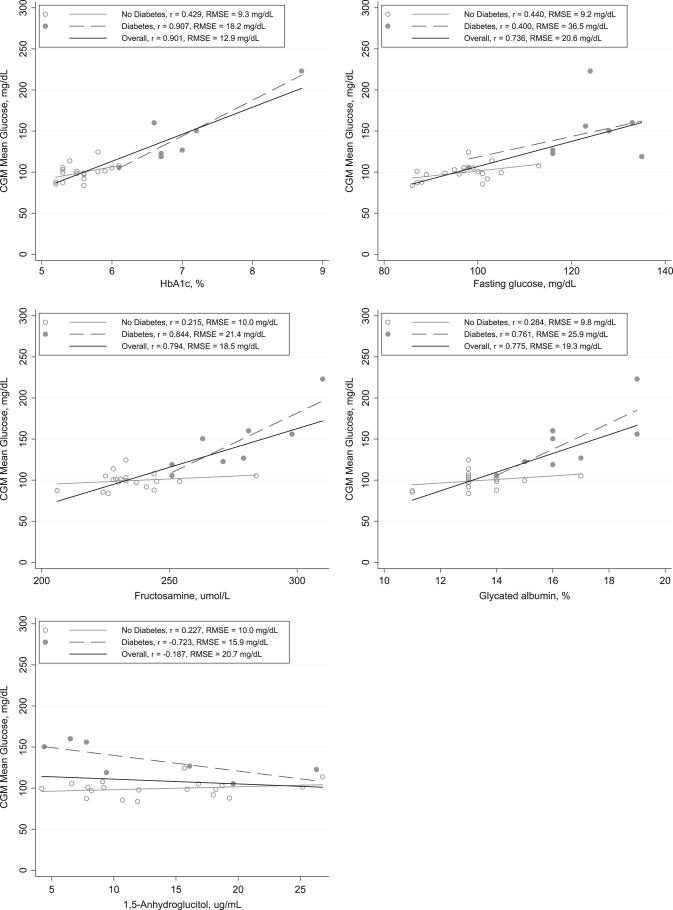
Context: Continuous glucose monitoring (CGM) provides nuanced information on glucose patterns, but data in very old adults are scarce. Objective: To evaluate CGM patterns in very old adults. Design: Pilot study. Setting: Participants recruited from one center during visit 7 (2019) of the community-based Atherosclerosis Risk in Communities (ARIC) Study. Participants: We enrolled 27 adults (8 with type 2 diabetes and 19 without diabetes) who wore a CGM sensor (Abbott Libre Pro) for up to 14 days. Clinical and laboratory measures, including hemoglobin A1c (HbA1c), were obtained. Main Outcomes: Mean CGM glucose, standard deviation (SD), coefficient of variation (CV), time-in-range (TIR) 70-180 mg/dL, and hypoglycemia. Results: Mean age was 81 (range 77-91 years) and mean CGM wear time was 13.2 days. In persons without diabetes, there was a wide range of CGM parameters: range of mean glucose, 83.7-124.5 mg/dL, SD 12.2-27.3 mg/dL, CV 14.0%-26.7%, and TIR 71.1%-99.5%. In persons with diabetes, the range of mean CGM glucose was 105.5-223.0 mg/dL, SD, 22.3-86.6 mg/dL, CV 18.2%-38.8%, TIR 38.7%-98.3%. The Pearson's correlation of mean glucose with HbA1c was high overall (0.90); but, for some participants with similar HbA1c, glucose patterns differed substantially. There was a high prevalence of hypoglycemia (glucose <70 or <54 mg/dL) in both persons with and without diabetes. Conclusions: There was high feasibility and acceptability of CGM in very old adults. Low readings on CGM are common, even in nondiabetic older adults; the clinical relevance of these low values is unclear. CGM may provide complementary information to HbA1c in some older adults.
Keywords: Biomarkers; Continuous glucose monitoring; Elderly; Glycemic variability; HbA1c; The ARIC study; Very old adults.
Conflict of interest statement
E.S. receives payments from Wolters Kluwer for chapters in UpToDate on measurements of glycemic control and screening tests for type 2 diabetes.
Figures
References
Publication types
MeSH terms
Substances
Grants and funding
- F30 DK120160/DK/NIDDK NIH HHS/United States
- R01 DK089174/DK/NIDDK NIH HHS/United States
- HHSN268201700001I/HL/NHLBI NIH HHS/United States
- HHSN268201700002I/HL/NHLBI NIH HHS/United States
- K24 DK106414/DK/NIDDK NIH HHS/United States
- HHSN268201700005I/HL/NHLBI NIH HHS/United States
- HHSN268201700003I/HL/NHLBI NIH HHS/United States
- RF1 AG074044/AG/NIA NIH HHS/United States
- K24 HL152440/HL/NHLBI NIH HHS/United States
- R01 DK128837/DK/NIDDK NIH HHS/United States
- R01 HL158022/HL/NHLBI NIH HHS/United States
- K23 HL153774/HL/NHLBI NIH HHS/United States
- T32 HL007024/HL/NHLBI NIH HHS/United States
- HHSN268201700004I/HL/NHLBI NIH HHS/United States
LinkOut - more resources
Full Text Sources
Medical
