. 2020 Aug 30;33(5):e100288.
doi: 10.1136/gpsych-2020-100288. eCollection 2020.

A psychological health support scheme for medical teams in COVID-19 outbreak and its effectiveness

Affiliations

A psychological health support scheme for medical teams in COVID-19 outbreak and its effectiveness

Wenhong Cheng et al. Gen Psychiatr. .

Abstract

Background: Medical staff fighting the COVID-19 pandemic are experiencing stress from high occupational risk, panic in the community and the extreme workload. Maintaining the psychological health of a medical team is essential for efficient functioning, but psychological intervention models for emergency medical teams are rare.

Aims: To design a systematic, full-coverage psychological health support scheme for medical teams serving large-scale emergent situations, and demonstrate its effectiveness in a real-world study in Leishenshan Hospital during the COVID-19 epidemic in Wuhan, China.

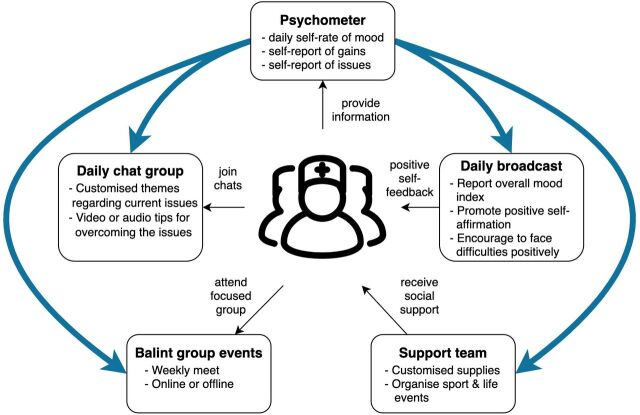
Methods: The scheme integrates onsite and online mental health resources and features team-based psychosocial support and evidence-based interventions. It contained five modules, including a daily measurement of mood, a daily mood broadcast that promotes positive affirmation, a daily online peer-group activity with themes based on the challenges reported by the team, Balint groups and an after-work support team. The daily mood measurement provides information to the other modules. The scheme also respects the special psychological characteristics of medical staff by promoting their strengths.

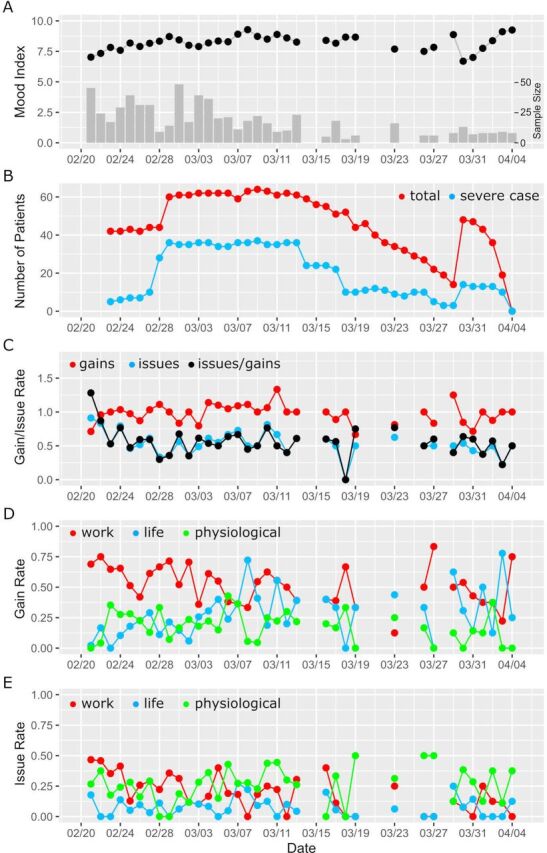
Results: The scheme economically supported a special medical team of 156 members with only one onsite psychiatrist. Our data reflected that the entire medical team maintained an overall positive outlook (7-9 out of 10 in a Daily Mood Index, DMI) for nearly 6 weeks of continuous working. Since the scheme promoted self-strengths and positive self-affirmation, the number of self-reports of life-related gains were high and played a significant effect on the DMI. Our follow-up investigations also revealed that multiple modules of the scheme received high attention and evaluation levels.

Conclusion: Our quantitative data from Leishenshan hospital, Wuhan, China, show that the programme is adequate to support the continuous high workload of medical teams. This scheme could be applied to medical teams dealing with emergent situations.

Keywords: crisis intervention; global burden of disease; psychology, medical.


Conflict of interest statement

Competing interests: None declared.

Figures
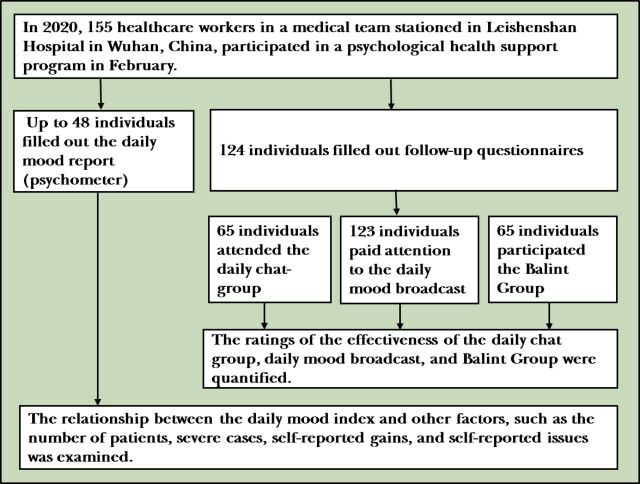
Figure 1
Figure 1
A flowchart for the enrolment and follow-up of participants.
Figure 2
Figure 2
Psychological health support programme in Leishenshan Hospital, Wuhan, China. The programme consists of five modules, as indicated using boxes. The blue curves mark the information flow inside the programme. The black arrows indicate the interactions between modules of the programme and the medical team members.
Figure 3
Figure 3
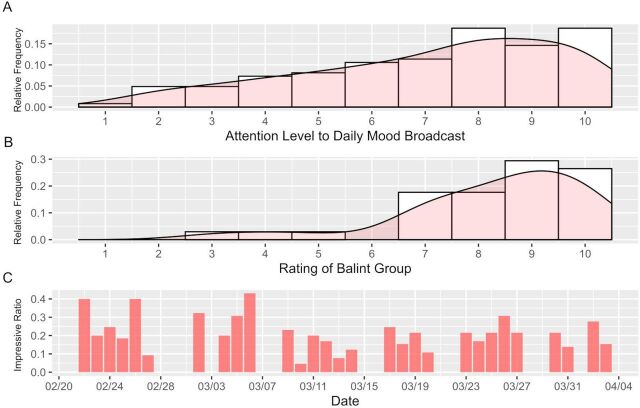
Results of the follow-up investigation on the effectiveness of the psychological health support programprogramme. (A) Histogram of ratings of attention level to the daily mood broadcast. The vertical axis indicates the ratio of a given level of attention among all responses; (B) Histogram of ratings of the Balint group activities. The vertical axis indicates the ratio of a given level of rating among all responses; (C) Ratios of respondents who felt ‘impressive’ with the daily group chat. The horizontal axis indicates the dates of the group chat activities, and the vertical axis indicates the ratio of participants who report impressiveness about the activity among all participants in a given day.
Figure 4
Figure 4
Data collected during the real application of the psychological health support programme. (A) The Daily Mood Index (DMI) and the corresponding sample sizes. The vertical axis on the right is for the sample size. (B) Number of patients (red) and severe cases (blue) during the working period. (C) The daily average of reported gains and issues. Red: daily averaged number of reported gains; blue: daily average of reported issues; black: the fraction of reported issues by gains. (D) Three categories of the daily reported gains. Red: daily average of gains related to work; blue: daily average of gains related to life; green: daily average of gains related to physiological factors. (E) Three categories of the daily reported issues. Red: daily average of issues related to working; blue: daily average of issues related to life; green: daily average of issues related to physiological factors.

References

    1. Zhao Q, Hu C, Feng R, et al. . Investigation of the mental health of patients with novel coronavirus pneumonia. Chin J Neurol 2020;53 in Chinese.
    1. Lai J, Ma S, Wang Y, et al. . Factors associated with mental health outcomes among health care workers exposed to coronavirus disease 2019. JAMA Netw Open 2020;3:e203976. 10.1001/jamanetworkopen.2020.3976 - DOI - PMC - PubMed
    1. Zhu J, Sun L, Zhang L, et al. . Prevalence and influencing factors of anxiety and depression symptoms in the first-line medical staff fighting against COVID-19 in Gansu. Front Psychiatry 2020;11:386. 10.3389/fpsyt.2020.00386 - DOI - PMC - PubMed
    1. Zhang C, Yang L, Liu S, et al. . Survey of insomnia and related social psychological factors among medical staff involved in the 2019 novel coronavirus disease outbreak. Front Psychiatry 2020;11:306. 10.3389/fpsyt.2020.00306 - DOI - PMC - PubMed
    1. Chen Q, Liang M, Li Y, et al. . Mental health care for medical staff in China during the COVID-19 outbreak. Lancet Psychiatry 2020;7:e15–16. 10.1016/S2215-0366(20)30078-X - DOI - PMC - PubMed

LinkOut - more resources