


Early individualized positive end-expiratory pressure guided by electrical impedance tomography in acute respiratory distress syndrome: a randomized controlled clinical trial
- PMID: 34193224
- PMCID: PMC8243615
- DOI: 10.1186/s13054-021-03645-y
Early individualized positive end-expiratory pressure guided by electrical impedance tomography in acute respiratory distress syndrome: a randomized controlled clinical trial
Abstract
Background: Individualized positive end-expiratory pressure (PEEP) by electrical impedance tomography (EIT) has potential interest in the optimization of ventilation distribution in acute respiratory distress syndrome (ARDS). The aim of the study was to determine whether early individualized titration of PEEP with EIT improved outcomes in patients with ARDS.
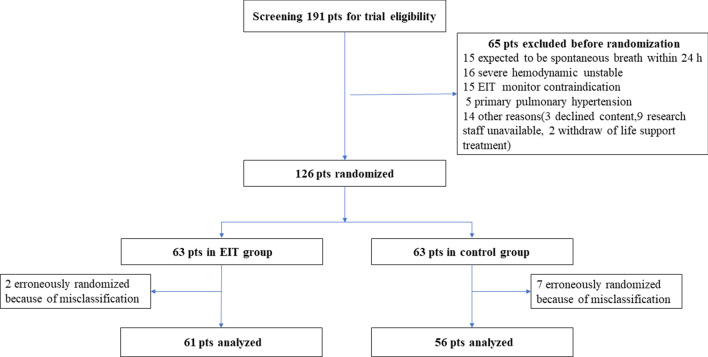
Methods: A total of 117 ARDS patients receiving mechanical ventilation were randomly assigned to EIT group (n = 61, PEEP adjusted based on ventilation distribution) or control group (n = 56, low PEEP/FiO2 table). The primary outcome was 28-day mortality. Secondary and exploratory outcomes were ventilator-free days, length of ICU stay, incidence of pneumothorax and barotrauma, and difference in Sequential Organ Failure Assessment (SOFA) score at day 1 (ΔD1-SOFA) and day 2 (ΔD2-SOFA) compared with baseline.
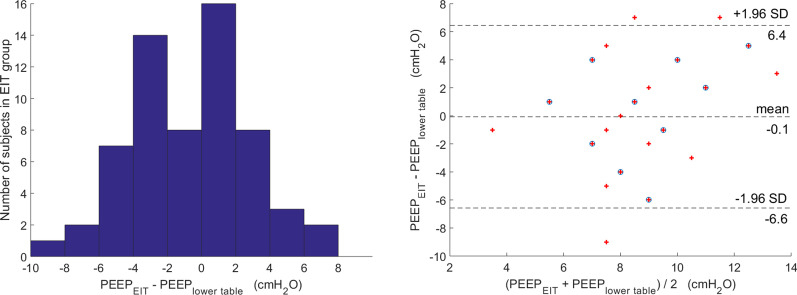
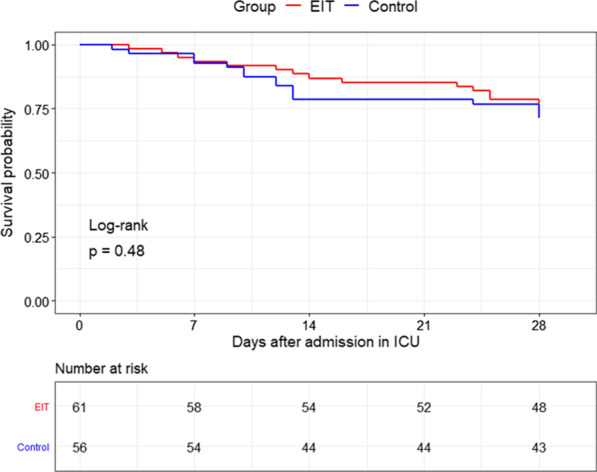
Measurements and main results: There was no statistical difference in the value of PEEP between the EIT group and control group, but the combination of PEEP and FiO2 was different between groups. In the control group, a significantly positive correlation was found between the PEEP value and the corresponding FiO2 (r = 0.47, p < 0.00001) since a given matched table was used for PEEP settings. Diverse combinations of PEEP and FiO2 were found in the EIT group (r = 0.05, p = 0.68). There was no significant difference in mortality rate (21% vs. 27%, EIT vs. control, p = 0.63), ICU length of stay (13.0 (7.0, 25.0) vs 10.0 (7.0, 14.8), median (25th-75th percentile); p = 0.17), and ventilator-free days at day 28 (14.0 (2.0, 23.0) vs 19.0 (0.0, 24.0), p = 0.55) between the two groups. The incidence of new barotrauma was zero. Compared with control group, significantly lower ΔD1-SOFA and ΔD2-SOFA were found in the EIT group (p < 0.001) in a post hoc comparison. Moreover, the EIT group exhibited a significant decrease of SOFA at day 2 compared with baseline (paired t-test, difference by - 1 (- 3.5, 0), p = 0.001). However, the control group did show a similar decrease (difference by 1 (- 2, 2), p = 0.131).
Conclusion: Our study showed a 6% absolute decrease in mortality in the EIT group: a statistically non-significant, but clinically non-negligible result. This result along with the showed improvement in organ function might justify further reserach to validate the beneficial effect of individualized EIT-guided PEEP setting on clinical outcomes of patients with ARDS.
Trial registration: ClinicalTrials, NCT02361398. Registered 11 February 2015-prospectively registered, https://clinicaltrials.gov/show/NCT02361398 .
Keywords: ARDS; Electrical impedance tomography; Organ function; PEEP titration.
Conflict of interest statement
Zhanqi Zhao receives a consulting fee from Dräger Medical. Inéz Frerichs reports funding from the European Union’s Framework Programme for Research and Innovation Horizon 2020 (WELMO, Grant No. 825572) and reimbursement of speaking fees, congress, and travel costs by Dräger Medical. Other authors declare no conflict of interest.
Figures
References
-
- Cavalcanti AB, Suzumura EA, Laranjeira LN, Paisani DM, Damiani LP, Guimaraes HP, Romano ER, Regenga MM, Taniguchi LNT, Teixeira C, et al. Effect of lung recruitment and titrated positive end-expiratory pressure (PEEP) vs low PEEP on mortality in patients with acute respiratory distress syndrome: a randomized clinical trial. JAMA. 2017;318(14):1335–1345. doi: 10.1001/jama.2017.14171. - DOI - PMC - PubMed
-
- Frerichs I, Amato MB, van Kaam AH, Tingay DG, Zhao Z, Grychtol B, Bodenstein M, Gagnon H, Bohm SH, Teschner E, et al. Chest electrical impedance tomography examination, data analysis, terminology, clinical use and recommendations: consensus statement of the TRanslational EIT developmeNt stuDy group. Thorax. 2017;72(1):83–93. doi: 10.1136/thoraxjnl-2016-208357. - DOI - PMC - PubMed
-
- Franchineau G, Brechot N, Lebreton G, Hekimian G, Nieszkowska A, Trouillet JL, Leprince P, Chastre J, Luyt CE, Combes A, et al. Bedside contribution of electrical impedance tomography to set positive end-expiratory pressure for ECMO-treated severe ARDS patients. Am J Respir Crit Care Med. 2017;196:447–457. doi: 10.1164/rccm.201605-1055OC. - DOI - PubMed
Publication types
MeSH terms
Associated data
LinkOut - more resources
Full Text Sources
Other Literature Sources
Medical
