doi: 10.3201/eid2709.211042.
Epub 2021 Jun 30.
Predictors of Nonseroconversion after SARS-CoV-2 Infection
- PMID: 34193339
- PMCID: PMC8386781
- DOI: 10.3201/eid2709.211042
Item in Clipboard
Predictors of Nonseroconversion after SARS-CoV-2 Infection
Emerg Infect Dis.
2021 Sep.
Abstract
Not all persons recovering from severe acute respiratory syndrome coronavirus 2 (SARS-CoV-2) infection develop SARS-CoV-2-specific antibodies. We show that nonseroconversion is associated with younger age and higher reverse transcription PCR cycle threshold values and identify SARS-CoV-2 viral loads in the nasopharynx as a major correlate of the systemic antibody response.
Keywords: COVID-19; RT-PCR; SARS-CoV-2; coronavirus disease; cycle threshold; humoral response; nasopharyngeal viral loads; nonseroconversion; respiratory infections; serological nonresponders; severe acute respiratory syndrome coronavirus 2; viruses; zoonoses.
Figures
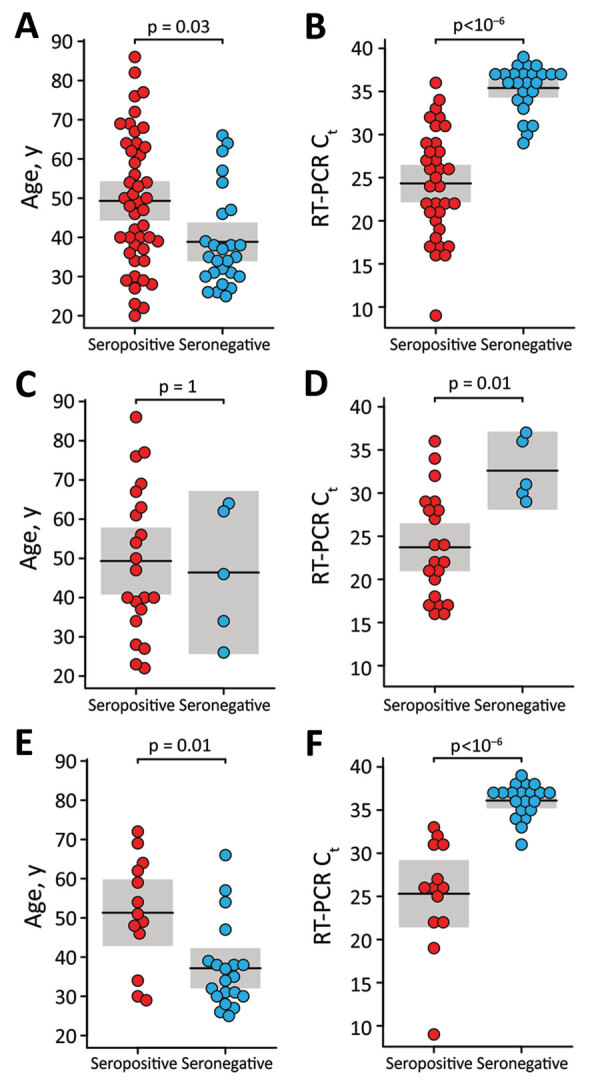
Relationship of age and nasopharyngeal viral loads with SARS-CoV-2 serostatus among convalescent persons after SARS-CoV-2 infection. Participants were a convenience sample of convalescent SARS-CoV-2–infected persons recruited at the University of Alabama at Birmingham, Birmingham, Alabama, USA, 2020. Age (panels A, C, and E) and RT-PCR Ct values (panels B, D, and F) are plotted for seropositive (red) and seronegative (blue) persons. Panels show comparisons of persons tested at all sites (panels A, B), the Assurance Scientific Laboratories site (panels B, C), and the University of Alabama at Birmingham Fungal Reference Laboratory and Children’s of Alabama Diagnostic Virology Laboratory sites (panels E, F). The mean (horizontal line) and corresponding 95% CI (shading) are shown; p-values indicate the results of a likelihood ratio test after Bonferroni correction for multiple comparisons. Ct, cycle threshold; RT-PCR, reverse transcription PCR; SARS-CoV-2, severe acute respiratory syndrome coronavirus 2.
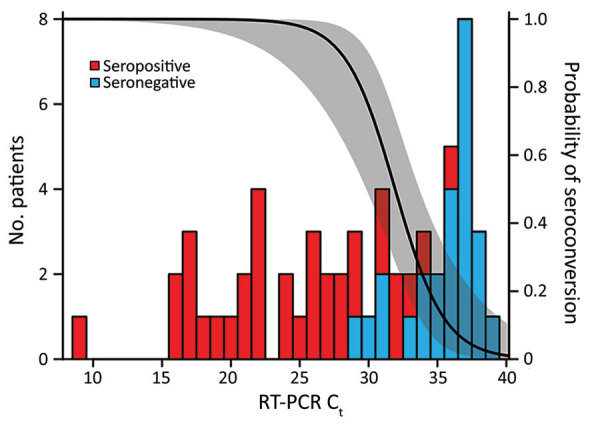
Decreasing probability of SARS-CoV-2 seroconversion with increasing RT-PCR Ct values among persons recovered from SARS-CoV-2 infection. Participants were a convenience sample of convalescent SARS-CoV-2–infected persons recruited at the University of Alabama at Birmingham, Birmingham, Alabama, USA, 2020. The number of serologic responders (red bars) and nonresponders (blue bars) is shown for varying RT-PCR Ct values. A logistic regression was used to estimate the probability of seroconversion for a given Ct (line) and its 95% CI (shaded). Ct, cycle threshold; RT-PCR, reverse transcription PCR; SARS-CoV-2, severe acute respiratory syndrome coronavirus 2.
Comment in
-
Predictors of Nonseroconversion after SARS-CoV-2 Infection.Emerg Infect Dis. 2022 Feb;28(2):492-493. doi: 10.3201/eid2802.211971. Emerg Infect Dis. 2022. PMID: 35076375 Free PMC article. No abstract available.
References
Publication types
MeSH terms
Grants and funding
LinkOut - more resources
Full Text Sources
Medical
Miscellaneous