Review
. 2021 May 31:2021:5581570.
doi: 10.1155/2021/5581570. eCollection 2021.

The Role of Oxidative Stress in Hypertensive Disorders of Pregnancy (Preeclampsia, Gestational Hypertension) and Metabolic Disorder of Pregnancy (Gestational Diabetes Mellitus)

Affiliations
Review

The Role of Oxidative Stress in Hypertensive Disorders of Pregnancy (Preeclampsia, Gestational Hypertension) and Metabolic Disorder of Pregnancy (Gestational Diabetes Mellitus)

Wendy N Phoswa et al. Oxid Med Cell Longev. .

Abstract

Purpose of the Review.To highlight the role of oxidative stress in hypertensive disorders of pregnancy (HDP) and metabolic disorders of pregnancy (gestational diabetes mellitus). Recent Findings. In both preeclampsia (PE) and gestational hypertension (GH), oxidative stress leads to inadequate placental perfusion thus resulting in a hypoxic placenta, which generally leads to the activation of maternal systemic inflammatory response. In PE, this causes inflammation in the kidneys and leads to proteinuria. A proteinuria marker known as urinary 8-oxoGuo excretion is expressed in preeclampsia. In GDM, oxidative stress plays a role in the pathogenesis of the disease, as a result of over secretion of insulin during pregnancy. This uncontrolled secretion of insulin results in the production of lipid peroxidation factors that also mask the secretion of antioxidants. Therefore, ROS becomes abundant at cellular level and prevents the cells from transporting glucose to body tissues. Summary. There is a need for more research investigating the role of oxidative stress, especially in obstetrics-related conditions. More studies are required in order to understand the difference between the pathogenesis and pathophysiology of PE versus GH since investigations on the differences in genetic aspects of each condition are lacking. Furthermore, research to improve diagnostic procedures for GDM in pregnancy is needed.


Conflict of interest statement

The authors declare that they have no competing interests.

Figures
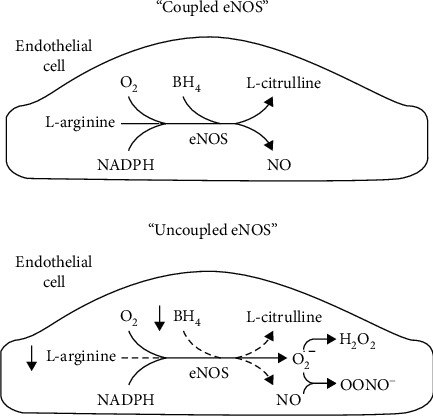
Figure 1
Figure 1
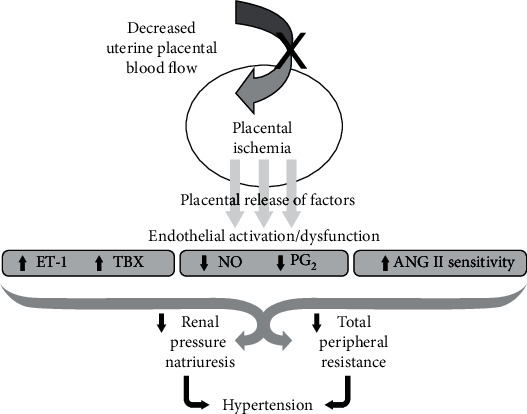
Pathophysiological mechanism of hypertension in preeclampsia, adapted from [37]. Inadequate uterine blood flow to the placenta leads to placental ischemia, which triggers the release of factors such as endothelin-1 (ET-1) and thromboxane (TBX). These factors interrupt endothelial activation factors, namely, nitric oxide (NO) and the prostaglandins (PG2), thus increasing angiotensin II sensitivity. This causes a reduction in renal pressure natriuresis and an increase in total peripheral resistance, thus leading to hypertension.
Figure 2
Figure 2
Schematic representation of “uncoupling” of nitric oxide (NO) synthesis, adapted from [70]. Suboptimal concentrations (↓) tetrahydrobiopterin (BH4) are required for “uncoupling.” Superoxide anion: O; hydrogen peroxide: H2O2; peroxynitrite anion: OONO; endothelial NO synthase: eNOS.
Figure 3
Figure 3
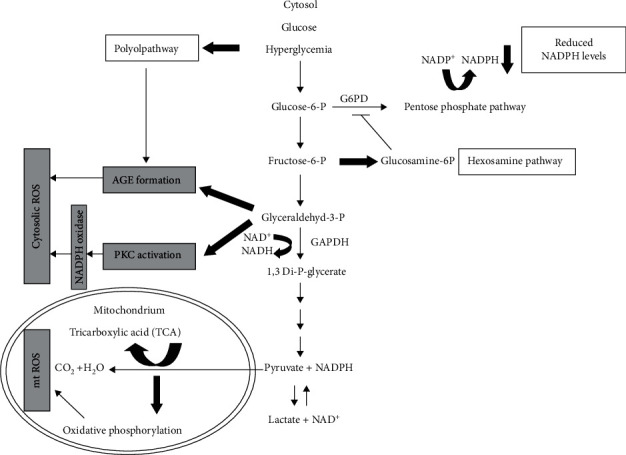
Schematic diagram showing how hyperglycaemia leads to oxidative stress, adapted from [102]. Hyperglycaemia is shown to be the prominent cause of oxidative stress in women with GDM. This occurs due to an increase in superoxide anion production in the mitochondria, caused increased pyruvate, and NADH formation, which activates various pathways. These include the polyol pathway, hexosamine pathway, activation of protein kinase C, and the activation of advanced glycation end products (AGE). All these pathways lead to an elevation in ROS.

References

    1. Duhig K., Chappell L. C., Shennan A. H. Oxidative stress in pregnancy and reproduction. Obstetric Medicine. 2016;9(3):113–116. doi: 10.1177/1753495X16648495. - DOI - PMC - PubMed
    1. Burton G. J., Jauniaux E. Oxidative stress. Best practice & Research Clinical Obstetrics & Gynaecology. 2011;25(3):287–299. doi: 10.1016/j.bpobgyn.2010.10.016. - DOI - PMC - PubMed
    1. Rani N., Dhingra R., Arya D. S., Kalaivani M., Bhatla N., Kumar R. Role of oxidative stress markers and antioxidants in the placenta of preeclamptic patients. Journal of Obstetrics and Gynaecology Research. 2010;36(6):1189–1194. doi: 10.1111/j.1447-0756.2010.01303.x. - DOI - PubMed
    1. Chiarello D. I., Abad C., Rojas D., et al. Oxidative stress: normal pregnancy versus preeclampsia. Biochimica et Biophysica Acta (BBA)-Molecular Basis of Disease. 2020;1866(2, article 165354) doi: 10.1016/j.bbadis.2018.12.005. - DOI - PubMed
    1. Duley L. The global impact of pre-eclampsia and eclampsia. Seminars in perinatology. Elsevier; 2009. - PubMed