. 2021 Jul 1;77(Pt 7):208-214.
doi: 10.1107/S2053230X2100635X. Epub 2021 Jun 29.

Structure of an H3N2 influenza virus nucleoprotein

Affiliations

Structure of an H3N2 influenza virus nucleoprotein

Michael L Knight et al. Acta Crystallogr F Struct Biol Commun. .

Abstract

Influenza A viruses of the H1N1 and H3N2 subtypes are responsible for seasonal epidemic events. The influenza nucleoprotein (NP) binds to the viral genomic RNA and is essential for its replication. Efforts are under way to produce therapeutics and vaccines targeting the NP. Despite this, no structure of an NP from an H3N2 virus has previously been determined. Here, the structure of the A/Northern Territory/60/1968 (H3N2) influenza virus NP is presented at 2.2 Å resolution. The structure is highly similar to those of the A/WSN/1933 (H1N1) and A/Hong Kong/483/97 (H5N1) NPs. Nonconserved amino acids are widely dispersed both at the sequence and structural levels. A movement of the 73-90 RNA-binding loop is observed to be the key difference between the structure determined here and previous structures. The data presented here increase the understanding of structural conservation amongst influenza NPs and may aid in the design of universal interventions against influenza.

Keywords: H3N2 influenza virus nucleoprotein; RNA-binding protein; X-ray crystallography; influenza; nucleoprotein.


Figures

Figure 1
Figure 1
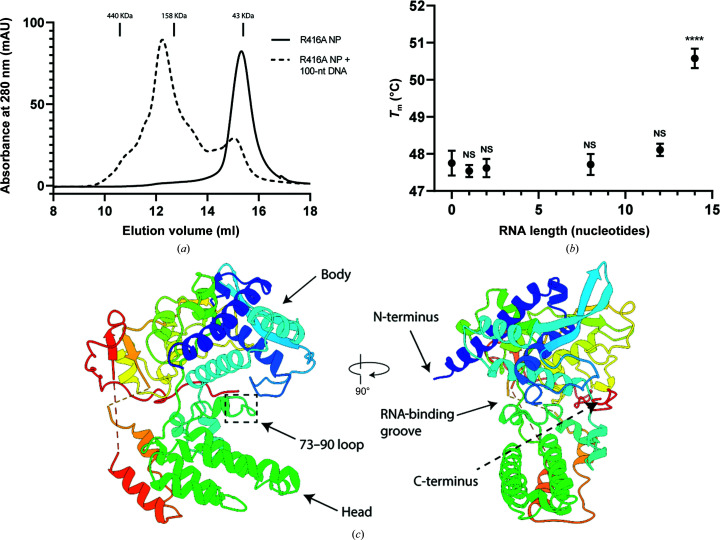
(a) The absorbance at 280 nm from SEC of the NT60 R416A NP either in the presence or absence of a 100-nucleotide DNA. (b) The melting temperature of the NT60 R416A NP in the presence of different lengths of nucleic acids. (c) The structure of the NT60 R416A NP in ribbon representation.
Figure 2
Figure 2
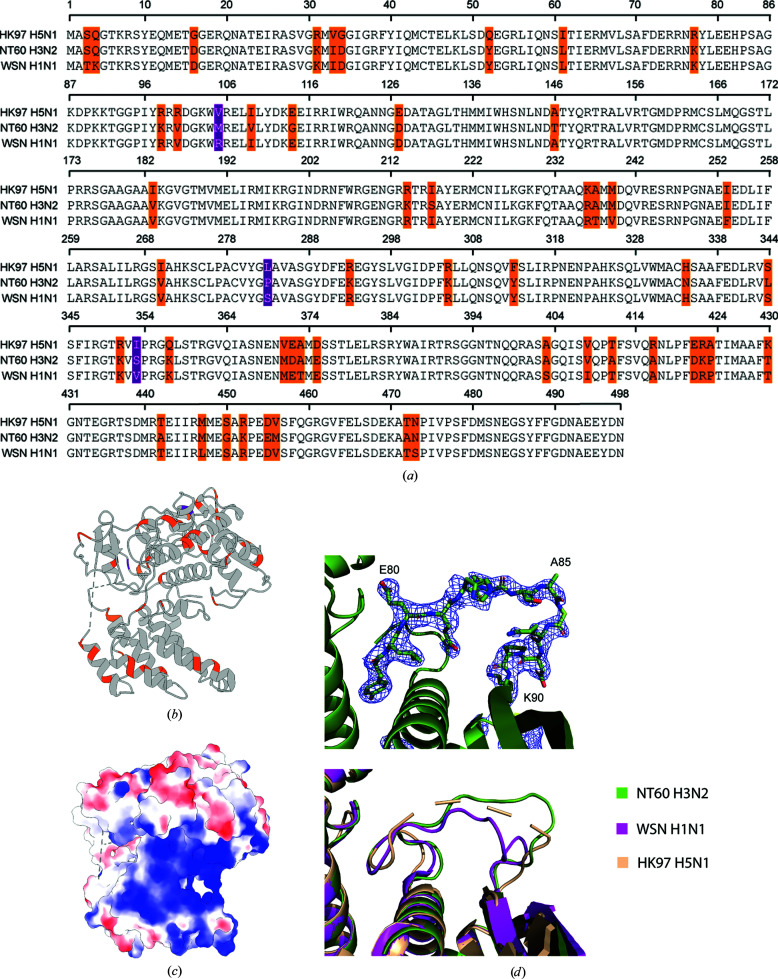
(a) Sequence alignment of the NT60 (H3N2), WSN (H1N1) and HK97 (H5N1) NP sequences. (b) Ribbon representation of the NT60 R416A NP showing amino-acid sequence conservation between the NT60, WSN and HK97 NPs (grey, conserved; orange, one sequence differs; purple, all three sequences differ). (c) Surface representation of the NT60 R416A NP showing the surface-charge distribution (blue, basic; red, acidic). (d) Top: the electron density (level 1.0) of residues 78–90 in the NT60 R416A H3N2 structure. Bottom: a comparison to the positioning of the 73–90 loop in the WSN R416A and HK97 NP structures.

References

    1. Afonine, P. V., Grosse-Kunstleve, R. W., Echols, N., Headd, J. J., Moriarty, N. W., Mustyakimov, M., Terwilliger, T. C., Urzhumtsev, A., Zwart, P. H. & Adams, P. D. (2012). Acta Cryst. D68, 352–367. - PMC - PubMed
    1. Bond, P. (2017). JTSA. http://paulsbond.co.uk/jtsa.
    1. Chenavas, S., Estrozi, L. F., Slama-Schwok, A., Delmas, B., Di Primo, C., Baudin, F., Li, X., Crépin, T. & Ruigrok, R. W. (2013). PLoS Pathog. 9, e1003275. - PMC - PubMed
    1. Dadonaite, B., Gilbertson, B., Knight, M. L., Trifkovic, S., Rockman, S., Laederach, A., Brown, L. E., Fodor, E. & Bauer, D. L. (2019). Nat. Microbiol. 4, 1781–1789. - PMC - PubMed
    1. Donchet, A., Oliva, J., Labaronne, A., Tengo, L., Miloudi, M. C. A., Gerard, F., Mas, C., Schoehn, G. W. H., Ruigrok, R., Ducatez, M. & Crépin, T. (2019). Sci. Rep. 9, 600. - PMC - PubMed

MeSH terms