


A decade post-HITECH: Critical access hospitals have electronic health records but struggle to keep up with other advanced functions
- PMID: 34198342
- PMCID: PMC8363800
- DOI: 10.1093/jamia/ocab102
A decade post-HITECH: Critical access hospitals have electronic health records but struggle to keep up with other advanced functions
Abstract
Objective: Despite broad electronic health record (EHR) adoption in U.S. hospitals, there is concern that an "advanced use" digital divide exists between critical access hospitals (CAHs) and non-CAHs. We measured EHR adoption and advanced use over time to analyzed changes in the divide.
Materials and methods: We used 2008 to 2018 American Hospital Association Information Technology survey data to update national EHR adoption statistics. We stratified EHR adoption by CAH status and measured advanced use for both patient engagement (PE) and clinical data analytics (CDA) domains. We used a linear probability regression for each domain with year-CAH interactions to measure temporal changes in the relationship between CAH status and advanced use.
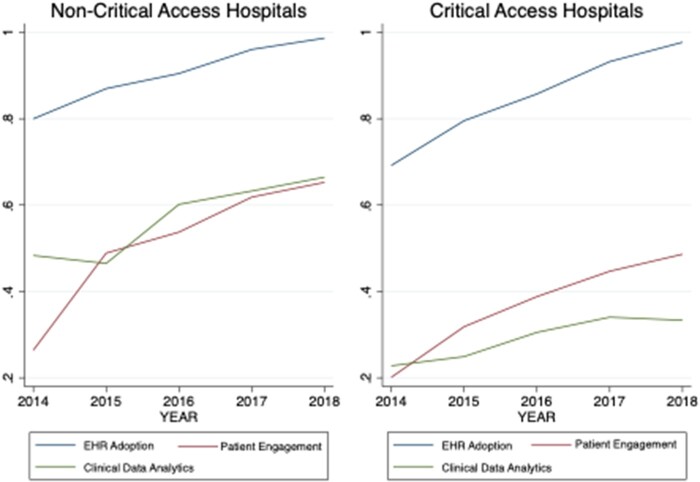
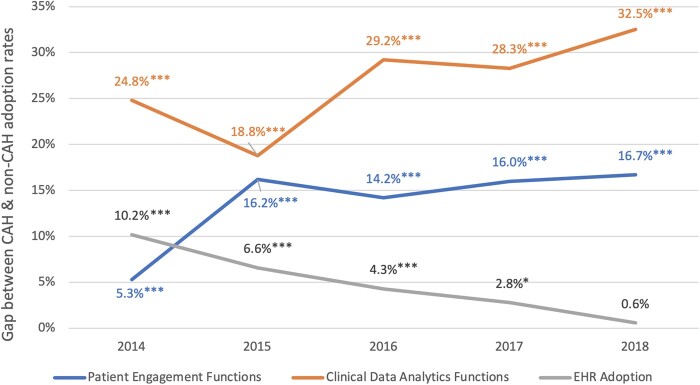
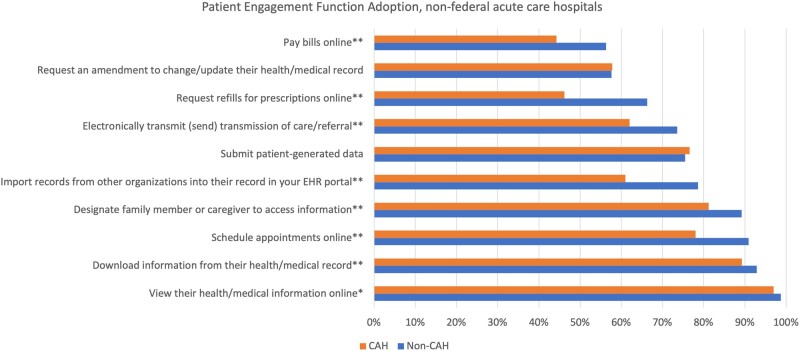
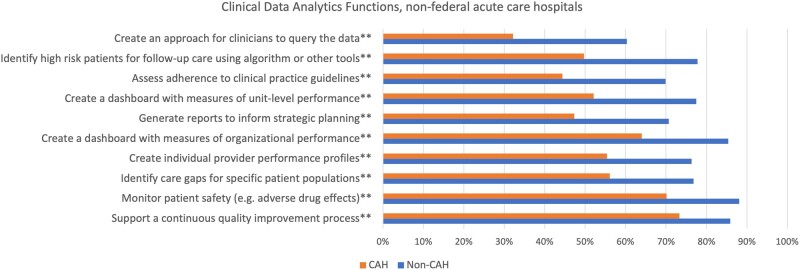
Results: In 2018, 98.3% of hospitals had adopted EHRs; there were no differences by CAH status. A total of 58.7% and 55.6% of hospitals adopted advanced PE and CDA functions, respectively. In both domains, CAHs were less likely to be advanced users: 46.6% demonstrated advanced use for PE and 32.0% for CDA. Since 2015, the advanced use divide has persisted for PE and widened for CDA.
Discussion: EHR adoption among hospitals is essentially ubiquitous; however, CAHs still lag behind in advanced use functions critical to improving care quality. This may be rooted in different advanced use needs among CAH patients and lack of access to technical expertise.
Conclusions: The advanced use divide prevents CAH patients from benefitting from a fully digitized healthcare system. To close the widening gap in CDA, policymakers should consider partnering with vendors to develop implementation guides and standards for functions like dashboards and high-risk patient identification algorithms to better support CAH adoption.
Keywords: EHR adoption; critical access hospitals; data analytics; digital divide; hospitals.
© The Author(s) 2021. Published by Oxford University Press on behalf of the American Medical Informatics Association. All rights reserved. For permissions, please email: journals.permissions@oup.com.
Figures
References
-
- Blumenthal D.Launching HITECH. N Engl J Med 2010; 362: 382–5. - PubMed
-
- Adler-Milstein J, Jha AK.. HITECH Act drove large gains in hospital electronic health record adoption. Health Aff (Millwood) 2017; 36 (8): 1416–22. - PubMed
-
- Office of the National Coordinator for Health Information Technology. Non-federal Acute Care Hospital Electronic Health Record Adoption. 2017. https://dashboard.healthit.gov/quickstats/pages/FIG-Hospital-EHR-Adoptio.... Accessed February 5, 2021.
-
- DesRoches CM, Worzala C, Joshi MS, et al.Small, nonteaching, and rural hospitals continue to be slow in adopting electronic health record systems. Health Aff (Millwood) 2012; 31: 1092–9. - PubMed
-
- Adler-Milstein J, DesRoches CM, Furukawa MF, et al.More than half of US hospitals have at least a basic EHR, but stage 2 criteria remain challenging for most. Health Aff (Millwood) 2014; 33: 1664–71. - PubMed
Publication types
MeSH terms
Grants and funding
LinkOut - more resources
Full Text Sources
Medical
Miscellaneous
