


Clinical Value of Virtual Reality versus 3D Printing in Congenital Heart Disease
- PMID: 34198642
- PMCID: PMC8232263
- DOI: 10.3390/biom11060884
Clinical Value of Virtual Reality versus 3D Printing in Congenital Heart Disease
Abstract
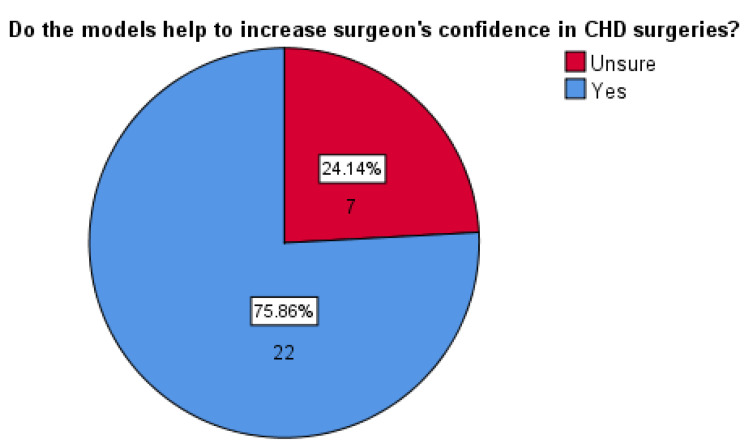
Both three-dimensional (3D) printing and virtual reality (VR) are reported as being superior to the current visualization techniques in conveying more comprehensive visualization of congenital heart disease (CHD). However, little is known in terms of their clinical value in diagnostic assessment, medical education, and preoperative planning of CHD. This cross-sectional study aims to address these by involving 35 medical practitioners to subjectively evaluate VR visualization of four selected CHD cases in comparison with the corresponding 3D printed heart models (3DPHM). Six questionnaires were excluded due to incomplete sections, hence a total of 29 records were included for the analysis. The results showed both VR and 3D printed heart models were comparable in terms of the degree of realism. VR was perceived as more useful in medical education and preoperative planning compared to 3D printed heart models, although there was no significant difference in the ratings (p = 0.54 and 0.35, respectively). Twenty-one participants (72%) indicated both the VR and 3DPHM provided additional benefits compared to the conventional medical imaging visualizations. This study concludes the similar clinical value of both VR and 3DPHM in CHD, although further research is needed to involve more cardiac specialists for their views on the usefulness of these tools.
Keywords: 3D printing; congenital heart disease; diagnosis; virtual reality; visualization.
Conflict of interest statement
The authors have no conflict of interest to declare.
Figures
References
-
- Bhatla P., Tretter J.T., Ludomirsky A., Argilla M., Latson L.A., Jr., Chakravarti S., Barker P.C., Yoo S.J., McElhinney D.B., Wake N., et al. Utility and scope of rapid prototyping in patients with complex muscular ventricular septal defects or double-outlet right ventricle: Does it alter management decisions? Pediatr. Cardiol. 2017;38:103–114. doi: 10.1007/s00246-016-1489-1. - DOI - PubMed
-
- Riesenkampff E., Rietdorf U., Wolf I., Schnackenburg B., Ewert P., Huebler M., Alexi-Meskishvili V., Anderson R.H., Engel N., Meinzer H.-P., et al. The practical clinical value of three-dimensional models of complex congenitally malformed hearts. J. Thorac. Cardiovasc. Surg. 2009;138:571–580. doi: 10.1016/j.jtcvs.2009.03.011. - DOI - PubMed
-
- Shiraishi I., Yamagishi M., Hamaoka K., Fukuzawa M., Yagihara T. Simulative operation on congenital heart disease using rubber-like urethane stereolithographic biomodels based on 3D datasets of multislice computed tomography. Eur. J. Cardiothorac. Surg. 2010;37:302–306. doi: 10.1016/j.ejcts.2009.07.046. - DOI - PubMed
MeSH terms
LinkOut - more resources
Full Text Sources
Medical
