


Hybrid Tele and In-Clinic Occupation Based Intervention to Improve Women's Daily Participation after Breast Cancer: A Pilot Randomized Controlled Trial
- PMID: 34199448
- PMCID: PMC8199623
- DOI: 10.3390/ijerph18115966
Hybrid Tele and In-Clinic Occupation Based Intervention to Improve Women's Daily Participation after Breast Cancer: A Pilot Randomized Controlled Trial
Abstract
Background: Women after breast cancer (BC) cope with decreased daily participation and quality of life (QOL) due to physical, cognitive, and emotional symptoms. This study examined a hybrid occupation-based intervention, Managing Participation with Breast Cancer (MaP-BC), to improve daily participation in their meaningful activities.
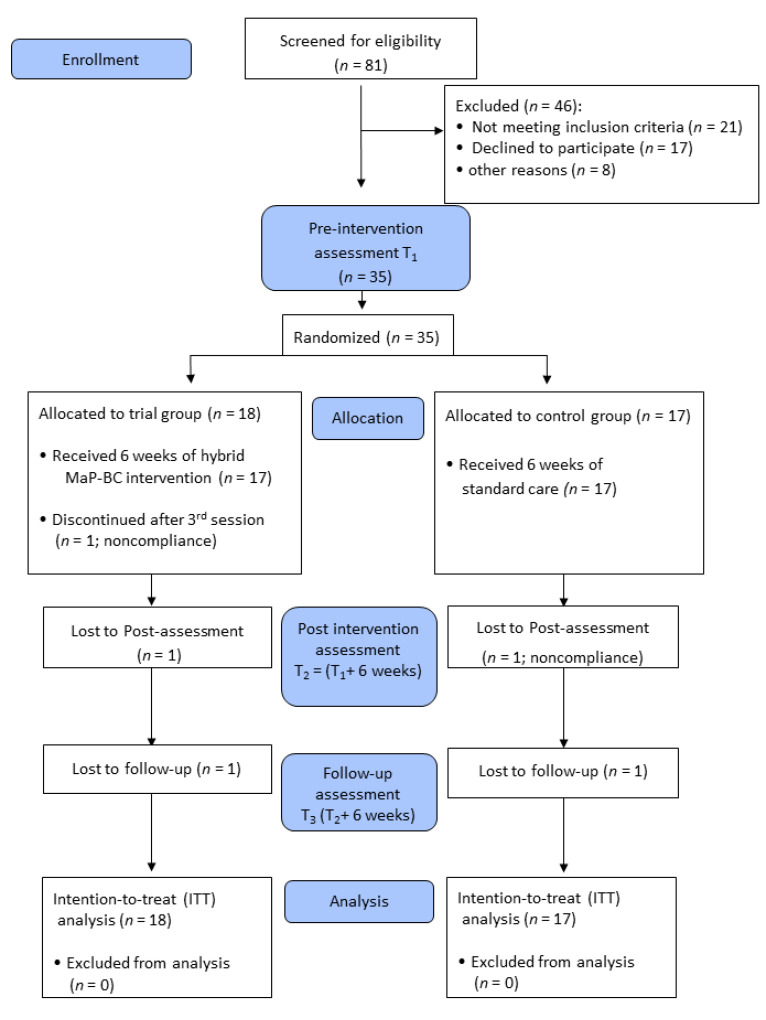
Methods: Thirty-five women after BC phase were randomly allocated to the MaP-BC intervention (n = 18) or control (n = 17) group (standard care only). Assessments were administered at baseline (T1), 6-week (T2), and 12-week (T3) post-T1.
Main outcome: perceived performance and performance-satisfaction with meaningful activities according to the Canadian Occupational Performance Measure.
Secondary outcomes: retained activity levels (Activity Card Sort), QOL (Functional Assessment of Cancer Therapy-Breast), cognitive abilities (Montreal Cognitive Assessment and Behavior Rating Inventory of Executive Function), and upper-extremity functioning (Disability of Arm, Shoulder, Hand). Results showed significant interaction (group x time) effects for the primary outcome in performance, F(2,66) = 29.54, p = 0.001, ɳP2 = 0.472, and satisfaction, F(2,66) = 37.15, p = 0.000, ɳP2 = 0.530. The intervention group improved more in performance, t = 5.51, p = 0.0001, d = 1.298, and satisfaction, t = -5.32, p = 0.0001, d = 1.254, than the control group between T1 and T2. Secondary outcomes demonstrated within-group improvements.
Conclusion: MaP-BC, a comprehensive occupation-based hybrid intervention tailored to women's functional daily needs after BC, improved participation in meaningful activities within a short period.
Keywords: activities of daily living; breast cancer; hybrid intervention; occupational therapy; self-management; tele-rehabilitation.
Conflict of interest statement
The authors declare no conflict of interest. The funders had no role in the design of the study; in the collection, analyses, or interpretation of data; in the writing of the manuscript, or in the decision to publish the results.
Figures
References
-
- Keesing S., Rosenwax L., McNamara B. Identifying the contribution of occupational therapy in meeting the needs of women survivors of breast cancer. Br. J. Occup. Ther. 2018;81:402–412. doi: 10.1177/0308022618762080. - DOI
-
- Loubani-Hawaita K., Schreuer N., Milman U. Participation in Daily Activities among Working Women Following Breast Cancer. Open J. Ther. Rehabil. 2016;4:150–162. doi: 10.4236/ojtr.2016.43014. - DOI
Publication types
MeSH terms
LinkOut - more resources
Full Text Sources
Medical
Miscellaneous
