Review
. 2021 Jun 2;10(6):1372.
doi: 10.3390/cells10061372.

Multifactorial Pathogenic Processes of Retinal Ganglion Cell Degeneration in Glaucoma towards Multi-Target Strategies for Broader Treatment Effects

Affiliations
Review

Multifactorial Pathogenic Processes of Retinal Ganglion Cell Degeneration in Glaucoma towards Multi-Target Strategies for Broader Treatment Effects

Gülgün Tezel. Cells. .

Abstract

Glaucoma is a chronic neurodegenerative disease characterized by apoptosis of retinal ganglion cell (RGC) somas, degeneration of axons, and loss of synapses at dendrites and axon terminals. Glaucomatous neurodegeneration encompasses multiple triggers, multiple cell types, and multiple molecular pathways through the etiological paths with biomechanical, vascular, metabolic, oxidative, and inflammatory components. As much as intrinsic responses of RGCs themselves, divergent responses and intricate interactions of the surrounding glia also play decisive roles for the cell fate. Seen from a broad perspective, multitarget treatment strategies have a compelling pathophysiological basis to more efficiently manipulate multiple pathogenic processes at multiple injury sites in such a multifactorial neurodegenerative disease. Despite distinct molecular programs for somatic and axonal degeneration, mitochondrial dysfunction and glia-driven neuroinflammation present interdependent processes with widespread impacts in the glaucomatous retina and optic nerve. Since dysfunctional mitochondria stimulate inflammatory responses and proinflammatory mediators impair mitochondria, mitochondrial restoration may be immunomodulatory, while anti-inflammatory treatments protect mitochondria. Manipulation of these converging routes may thus allow a unified treatment strategy to protect RGC axons, somas, and synapses. This review presents an overview of recent research advancements with emphasis on potential treatment targets to achieve the best treatment efficacy to preserve visual function in glaucoma.

Keywords: glaucoma; glia; immunomodulation; neurodegeneration; neuroinflammation; neuroprotection; retinal ganglion cell.


Conflict of interest statement

The author declares no conflict of interest.

Figures
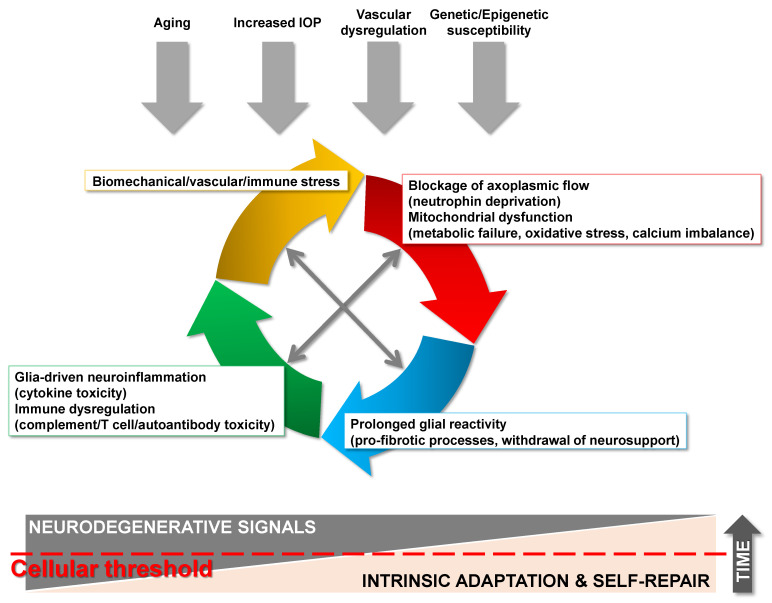
Figure 1
Figure 1
Glaucoma is a multifactorial neurodegenerative disease. The etiological framework of neurodegeneration in glaucoma encompasses multiple stressors, including increased intraocular pressure (IOP), aging, vascular dysfunction, and genetic/epigenetic factors. Interconnected pathogenic processes for glaucomatous neurodegeneration involves biomechanical, vascular, metabolic, oxidative, or inflammatory components. The asynchrony in RGC degeneration in glaucoma, along with the complexity of extrinsic triggers and intrinsic adaptive/reparative responses, suggest that a cellular stressor threshold determines the individual susceptibility of RGCs to injury in glaucoma.
Figure 2
Figure 2
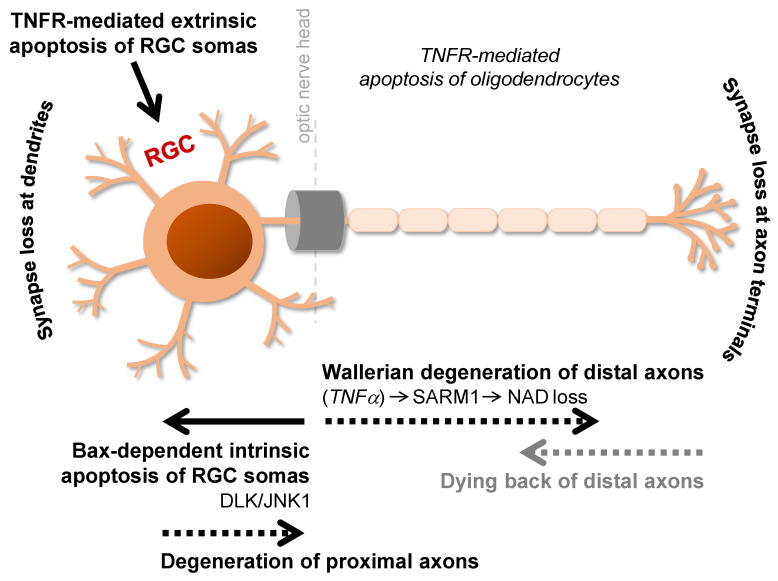
Distinct molecular programs regulate somatic and axonal degeneration of RGCs in glaucoma. Glaucomatous neurodegeneration involves RGC axons, somas, and synapses at dendrites and axon terminals. Optic nerve head is a critical site of injury, and early axonal insults may originate distal and proximal signals for axonal and somatic degeneration of RGCs. A distal axonopathy is processed through Wallerian degeneration and dying back, while degeneration of proximal axons is secondary to the apoptosis of RGC somas. The apoptotic death of RGCs is processed through intrinsic/mitochondrial and extrinsic/dead receptor-mediated pathways.
Figure 3
Figure 3
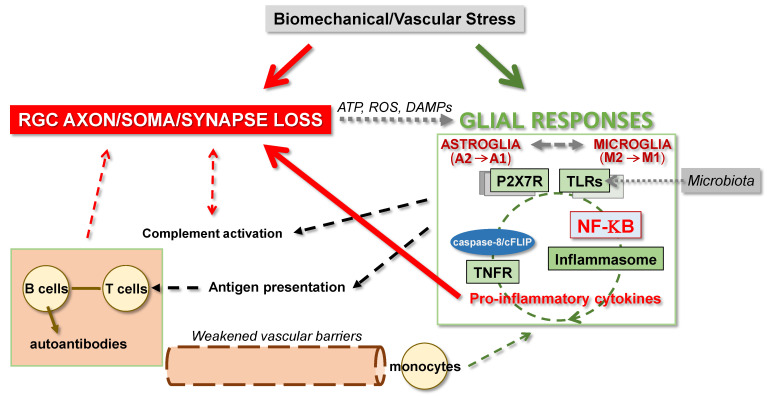
Glia-driven neuroinflammation can promote widespread injury to RGCs in glaucoma. Glial cells, including astroglia and microglia prominently respond to glaucoma-related tissue stress and injury. Glia can sense mechanical strain through mechanosensitive ion channels, and they can sense cellular stress by recognizing ATP, reactive oxygen species (ROS), and other damage-associated molecular patterns (DAMPs) released from RGCs. These signals stimulate inflammation through purinergic receptors (such as P2X7R), pattern-recognition receptors (such as TLRs), and inflammasome activation. Sustained release of proinflammatory neurotoxic cytokines, such as TNFα, contributes to RGC injury by activating dead receptor signaling that includes TNF receptors (TNFR). Evidently, multiple inflammation pathways activated in the glaucomatous glia are commonly regulated by the NF-κB-mediated transcriptional program. Glial reactivities also lead to complement-mediated and adaptive immune responses with neurodegenerative outcomes. A vicious cycle of these processes may intensify the inflammatory injury of RGCs at different subcellular regions.
Figure 4
Figure 4
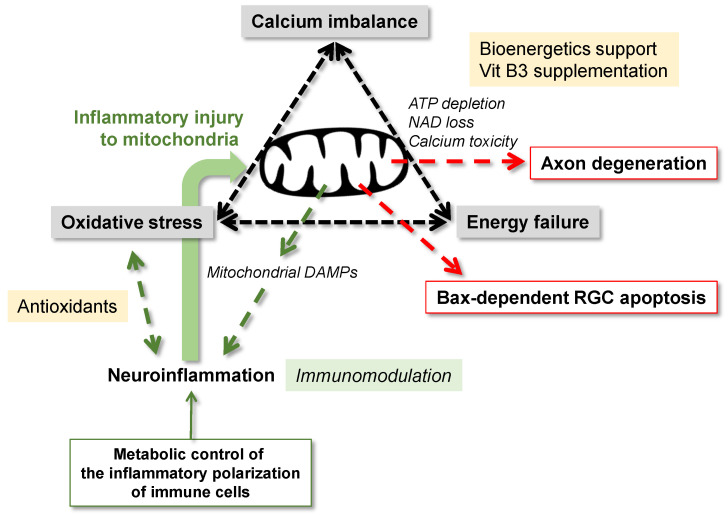
Interplay between mitochondrial dysfunction and neuroinflammation in glaucoma. Mitochondria through energy failure, oxidative stress, disturbed calcium homeostasis, and nicotinamide adenine dinucleotide (NAD) loss are critically involved in RGC degeneration and neuroinflammation. Mitochondria-generated oxidative stress and the mitochondrial constituents released after increased membrane permeability, including damage-associated molecular patterns (DAMPs), can induce glial inflammatory responses. Mitochondria’s role in neuroinflammation also includes the metabolic control of glial inflammatory polarization. While dysfunctional mitochondria induce neuroinflammation, proinflammatory cytokines may further impair mitochondria. Yellow boxes indicate the related treatment strategies that are being tested in clinical studies. As shown in the green box, immunomodulatory treatments are still explored in preclinical studies.

References

    1. Syc-Mazurek S.B., Libby R.T. Axon injury signaling and compartmentalized injury response in glaucoma. Prog. Retin. Eye Res. 2019;73:100769. doi: 10.1016/j.preteyeres.2019.07.002. - DOI - PMC - PubMed
    1. Tezel G. A broad perspective on the molecular regulation of retinal ganglion cell degeneration in glaucoma. Prog. Brain Res. 2020;256:49–77. - PMC - PubMed
    1. Libby R.T., Gould D.B., Anderson M.G., John S.W. Complex genetics of glaucoma susceptibility. Annu. Rev. Genom. Hum. Genet. 2005;6:15–44. doi: 10.1146/annurev.genom.6.080604.162209. - DOI - PubMed
    1. Wiggs J.L., Pasquale L.R. Genetics of glaucoma. Hum. Mol. Genet. 2017;26:R21–R27. doi: 10.1093/hmg/ddx184. - DOI - PMC - PubMed
    1. Quigley H.A., Broman A.T. The number of people with glaucoma worldwide in 2010 and 2020. Br. J. Ophthalmol. 2006;90:262–267. doi: 10.1136/bjo.2005.081224. - DOI - PMC - PubMed

Publication types