


Creatine for Exercise and Sports Performance, with Recovery Considerations for Healthy Populations
- PMID: 34199588
- PMCID: PMC8228369
- DOI: 10.3390/nu13061915
Creatine for Exercise and Sports Performance, with Recovery Considerations for Healthy Populations
Abstract
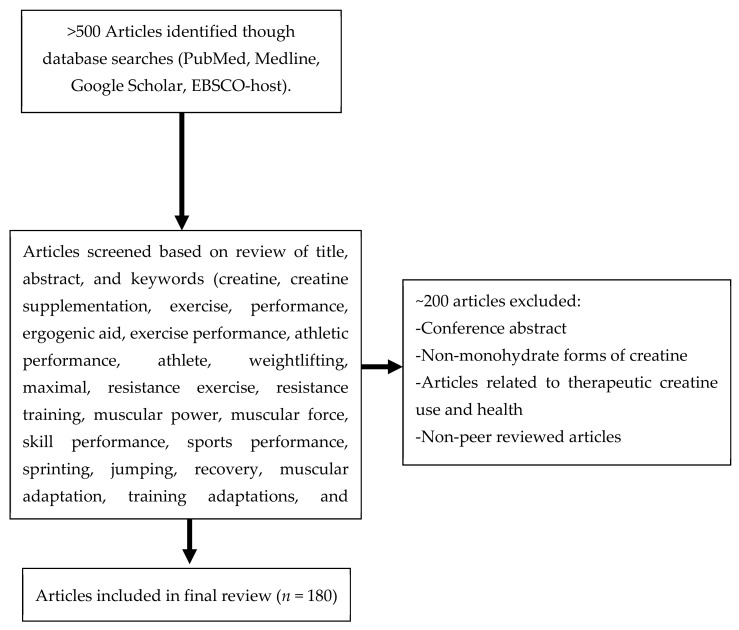
Creatine is one of the most studied and popular ergogenic aids for athletes and recreational weightlifters seeking to improve sport and exercise performance, augment exercise training adaptations, and mitigate recovery time. Studies consistently reveal that creatine supplementation exerts positive ergogenic effects on single and multiple bouts of short-duration, high-intensity exercise activities, in addition to potentiating exercise training adaptations. In this respect, supplementation consistently demonstrates the ability to enlarge the pool of intracellular creatine, leading to an amplification of the cell's ability to resynthesize adenosine triphosphate. This intracellular expansion is associated with several performance outcomes, including increases in maximal strength (low-speed strength), maximal work output, power production (high-speed strength), sprint performance, and fat-free mass. Additionally, creatine supplementation may speed up recovery time between bouts of intense exercise by mitigating muscle damage and promoting the faster recovery of lost force-production potential. Conversely, contradictory findings exist in the literature regarding the potential ergogenic benefits of creatine during intermittent and continuous endurance-type exercise, as well as in those athletic tasks where an increase in body mass may hinder enhanced performance. The purpose of this review was to summarize the existing literature surrounding the efficacy of creatine supplementation on exercise and sports performance, along with recovery factors in healthy populations.
Keywords: athletic performance; ergogenic aid; muscle damage; muscular adaptation; muscular power; recovery; resistance exercise; supplementation; training; weightlifting.
Conflict of interest statement
The authors of this manuscript received financial remuneration for preparing and reviewing this paper from the sponsor of the special issue, Alzchem. B.W., J.J.M., B.L., A.R.J., R.B.K., and C.M.K. have consulted with and received external funding from companies who sell certain dietary ingredients and have received remuneration from companies for delivering scientific presentations at conferences. A.R.J. and C.M.K. also write for online and other media outlets on topics related to exercise and nutrition. None of these entities had any role in the design of the paper, collection, analyses, or interpretation of data; in the writing of the manuscript, or in the decision to publish this paper. R.B.K. has conducted industry-sponsored research on creatine, received financial support for presenting on creatine at industry-sponsored scientific conferences (including the ISSN), and served as an expert witness on cases related to creatine. Additionally, he serves as Chair of the Scientific Advisory Board for Alzchem, which manufactures creatine monohydrate.
Figures
References
-
- Kerksick C.M., Wilborn C.D., Roberts M.D., Smith-Ryan A.E., Kleiner S.M., Jäger R., Collins R., Cooke M., Davis J.N., Galvan E., et al. ISSN exercise & sports nutrition review update: Research & recommendations. J. Int. Soc. Sports Nutr. 2018;15:38. doi: 10.1186/s12970-018-0242-y. - DOI - PMC - PubMed
-
- Kreider R.B., Kalman D.S., Antonio J., Ziegenfuss T.N., Wildman R., Collins R., Candow D.G., Kleiner S.M., Almada A.L., Lopez H.L. International Society of Sports Nutrition position stand: Safety and efficacy of creatine supplementation in exercise, sport, and medicine. J. Int. Soc. Sports Nutr. 2017;14:1–18. doi: 10.1186/s12970-017-0173-z. - DOI - PMC - PubMed
-
- Antonio J., Candow D.G., Forbes S.C., Gualano B., Jagim A.R., Kreider R.B., Rawson E.S., Smith-Ryan A.E., VanDusseldorp T.A., Willoughby D.S., et al. Common questions and misconceptions about creatine supplementation: What does the scientific evidence really show? J. Int. Soc. Sports Nutr. 2021;18:1–17. doi: 10.1186/s12970-021-00412-w. - DOI - PMC - PubMed
Publication types
MeSH terms
Substances
LinkOut - more resources
Full Text Sources
Other Literature Sources
Medical
