. 2021 Jun 2;9(6):634.
doi: 10.3390/biomedicines9060634.

Functional Characterization of the Dopaminergic Psychostimulant Sydnocarb as an Allosteric Modulator of the Human Dopamine Transporter

Affiliations

Functional Characterization of the Dopaminergic Psychostimulant Sydnocarb as an Allosteric Modulator of the Human Dopamine Transporter

Shaili Aggarwal et al. Biomedicines. .

Abstract

The dopamine transporter (DAT) serves a critical role in controlling dopamine (DA)-mediated neurotransmission by regulating the clearance of DA from the synapse and extrasynaptic regions and thereby modulating DA action at postsynaptic DA receptors. Major drugs of abuse such as amphetamine and cocaine interact with DATs to alter their actions resulting in an enhancement in extracellular DA concentrations. We previously identified a novel allosteric site in the DAT and the related human serotonin transporter that lies outside the central orthosteric substrate- and cocaine-binding pocket. Here, we demonstrate that the dopaminergic psychostimulant sydnocarb is a ligand of this novel allosteric site. We identified the molecular determinants of the interaction between sydnocarb and DAT at the allosteric site using molecular dynamics simulations. Biochemical-substituted cysteine scanning accessibility experiments have supported the computational predictions by demonstrating the occurrence of specific interactions between sydnocarb and amino acids within the allosteric site. Functional dopamine uptake studies have further shown that sydnocarb is a noncompetitive inhibitor of DAT in accord with the involvement of a site different from the orthosteric site in binding this psychostimulant. Finally, DA uptake studies also demonstrate that sydnocarb affects the interaction of DAT with both cocaine and amphetamine. In summary, these studies further strengthen the prospect that allosteric modulation of DAT activity could have therapeutic potential.

Keywords: allosteric modulation; dopamine transporter; transport activity.


Conflict of interest statement

The authors declare no conflict of interest.

Figures
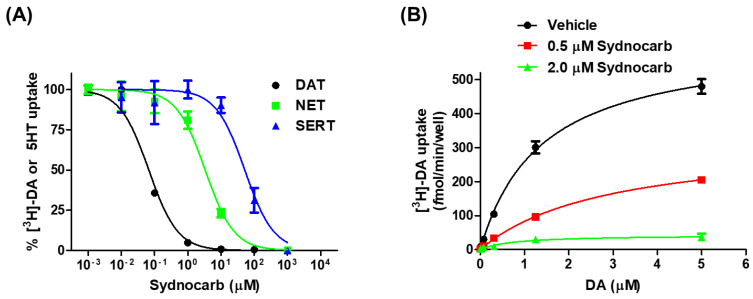
Figure 1
Figure 1
The pharmacology of sydnocarb. (A) Radioactive neurotransmitter transport inhibition assay of Sydnocarb against hDAT, hNET, and hSERT in transiently transfected COS-7 cells. Sydnocarb IC50 values for hDAT, hNET, and hSERT are 0.493 ± 0.14, 34.92 ± 14.09, and 494.87 ± 17.00 µM, respectively. The data were fitted using nonlinear regression, the figure was plotted using average of three independent experiments, and IC50 mean values and corresponding SEM are displayed. Results are normalized to percent of the highest response in each group. (B) [3H]-DA uptake kinetic assay of wild-type DAT transiently transfected COS-7 cells in the absence and presence of 0.5 µM and 2.0 µM Sydnocarb. Data were fitted to Michaelis-Menten equation using nonlinear regression to obtain Vmax = 634.8 ± 84.62 for the vehicle, 455.6 ± 89.6 femtomole/min/well in the presence of 0.5 µM Sydnocarb, and 195 ± 80.7 femtomole/min/well in the presence of 2.0 µM Sydnocarb, along with the respective KM values of 1.4 ± 0.21, 3.3 ± 0.78, and 1.7 ± 0.43 µM. The figure displays the average behavior from four independent experiments used to evaluate the Vmax and KM. For the Vmax, the vehicle versus 0.5 µM and 2.0 µM Sydnocarb showed significant differences (p < 0.05) when compared using one-way ANOVA with Dunnett’s post-hoc test. No statistical significance was found in the KM values.
Figure 2
Figure 2
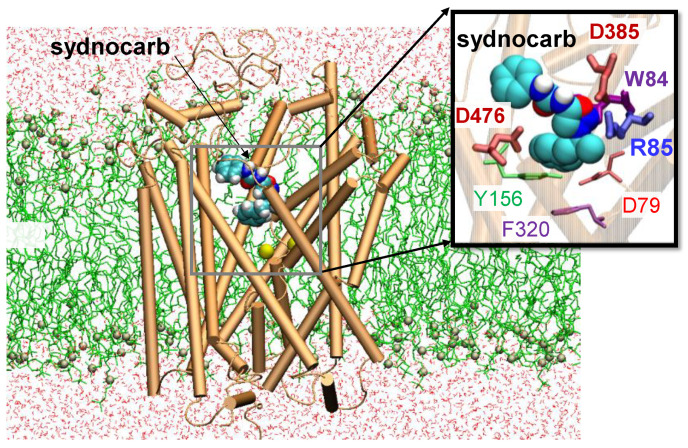
MD simulations of sydnocarb binding to the human dopamine transporter in the outward-facing open conformer. The hDAT OFo conformer (orange) was embedded into membrane lipids (lime licorice) and solvated by 0.15-M NaCl solution (not shown). A sydnocarb molecule (van der Waals (vdW) format) was initially docked near the EC vestibule, as predicted by AutoDock.
Figure 3
Figure 3
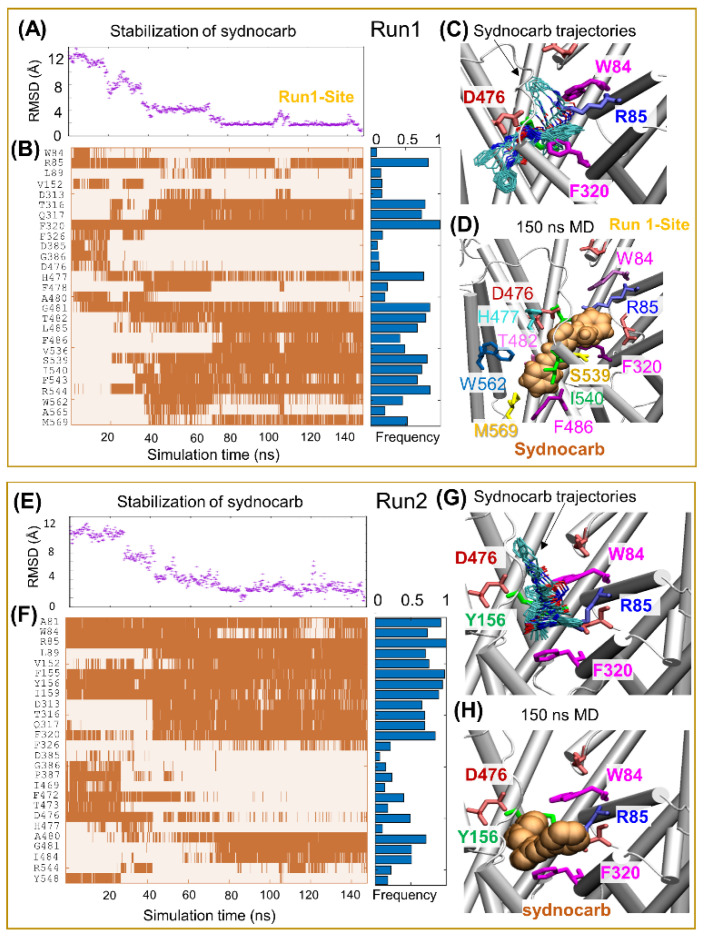
MD simulations reveal multiple binding poses of sydnocarb in hDAT. Left and right boxes display results from two independent runs: Run1 and Run2. (A,E) Sydnocarb diffusion as a function time estimated by the RMSD of sydnocarb atoms with respect to the final pose at 150 ns. (B,F) Time evolution of contacts (<4.0Å closest atom–atom distance) between DAT and sydnocarb (indicated by orange-shaded areas) with the binding frequency summarized by the horizontal blue bars on the right panel. (C,G) Sydnocarb-binding poses captured in simulations with a snapshot taken every 4 ns. The ligand conformations are shown in cyan sticks. (D,H) MD-resolved final poses of sydnocarb (light orange vDW) observed at the end of MD Run1 and Run2. Results for MD simulation Run3 and Run4 can be found in Supplementary Information Figure S3.
Figure 4
Figure 4
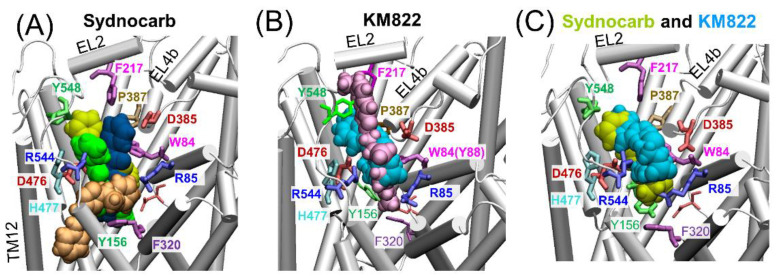
Comparison of MD-resolved ligand binding poses. (A) Sydnocarb-binding poses captured by four independent MD runs. Light orange, green, yellow, and dark blue vDW balls display representative poses, stabilized in MD simulations Run1, Run2, Run3, and Run4. Detailed results are shown in Figure 3 (Run1 and Run2) and Figure S3 (Run3 and Run4). Note that three MD runs (Run2, Run3, and Run4) converged on a similar site. The binding pose resolved by Run1 differed significantly. (B) KM822-binding poses captured by two independent MD runs. Cyan and mauve vDW balls showed representative KM822-binding poses, stabilized in MD simulations KM822-Run1 and KM822-Run2, respectively. Detailed simulation results are shown in Figure S4. (C) Resemblance of sydnocarb and KM822 binding. Yellow and cyan vDW balls showed a representative sydnocarb-binding pose stabilized in MD simulation Run3 (Figure S3A–D) and KM822-binding pose captured in KM822-Run1 (Figure S4A–C). Representative binding poses were taken at the end of the MD simulations.
Figure 5
Figure 5
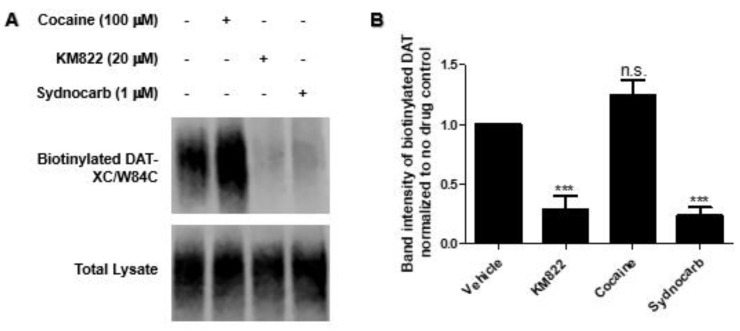
Analysis of the substituted cysteine scanning mutagenesis results. (A). Representative immunoblots of biotinylated DAT-XC/W84C mutant and total DAT protein in the presence of the vehicle, cocaine (100 µM), KM822 (20 µM), and sydnocarb (1 µM). (B). Quantification of the biotinylation data. The biotinylated DAT is normalized to the total DAT protein and then, the drug-treated biotinylated DAT band intensity is normalized to the untreated band intensity. The data represents four independent experiments. Statistical analysis was performed using one-way ANOVA with Dunnett’s multiple comparison to determine the significance between drug-treated and untreated samples. ***, p < 0.001; n.s., no significance.
Figure 6
Figure 6
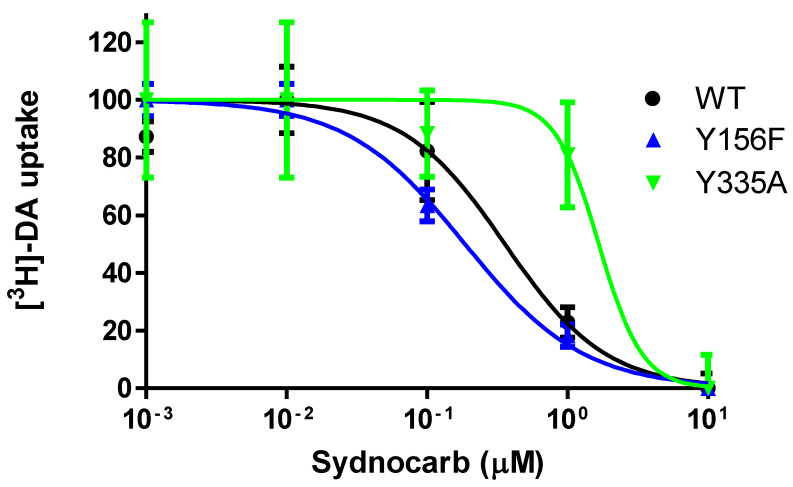
Dose-response assay of sydnocarb against DAT mutants Y156F and Y335A versus WT-DAT. Nonlinear regression analysis of the normalized response gave sydnocarb IC50 as 0.439 ± 0.135, 0.262 ± 0.118, and 1.419 ± 0.201 µM in WT-DAT, Y156F-DAT, and Y335A-DAT-transfected COS-7 cells, respectively. Averages and SEM were calculated from three independent experiments.
Figure 7
Figure 7
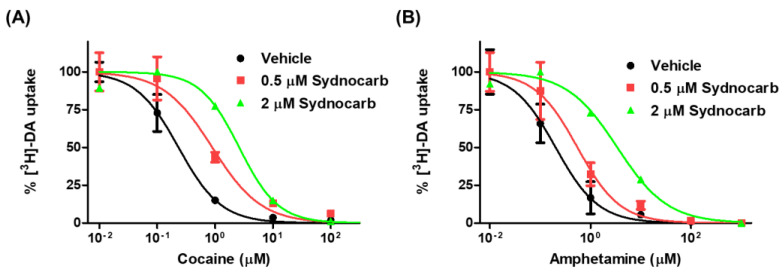
(A) Dopamine transport inhibition assay of cocaine in the absence and presence of 0.5 µM and 2.0 µM sydnocarb in hDAT-transfected COS-7 cells. IC50 values of cocaine are 0.177 ± 0.034 µM for the vehicle, 1.38 ± 0.24 µM in the presence of 0.5 µM sydnocarb (*), and 8.40 ± 0.99 µM in the presence of 2.0 µM sydnocarb (***). (B) Dopamine transport inhibition assay of amphetamine in the absence and presence of 0.5 µM and 2.0 µM sydnocarb in hDAT-transfected COS-7 cells. IC50 values of amphetamine are 0.166 ± 0.020 µM for the vehicle, 0.642 ± 0.094 µM in the presence of 0.5 µM sydnocarb (*), and 2.60 ± 1.3 µM in the presence of 2.0 µM sydnocarb (***). The figures were plotted using the average of three independent experiments, and IC50 mean and SEM was calculated using the same experiments. Results were normalized to the percent of the highest response in each group. One-way ANOVA with Dunnett’s post-hoc test was performed to determine the significance: * p < 0.05 and *** p < 0.001 when compared to vehicle.

References

    1. Kristensen A.S., Andersen J., Jorgensen T.N., Sorensen L., Eriksen J., Loland C.J., Stromgaard K., Gether U. SLC6 neurotransmitter transporters: Structure, function, and regulation. Pharmacol. Rev. 2011;63:585–640. doi: 10.1124/pr.108.000869. - DOI - PubMed
    1. Lin Z., Canales J.J., Bjorgvinsson T., Thomsen M., Qu H., Liu Q.R., Torres G.E., Caine S.B. Monoamine transporters: Vulnerable and vital doorkeepers. Prog. Mol. Biol. Transl. Sci. 2011;98:1–46. doi: 10.1016/B978-0-12-385506-0.00001-6. - DOI - PMC - PubMed
    1. Davidson C. Developing Treatments for Stimulant Abuse: A Brief Overview. East Asian Arch. Psychiatry. 2016;26:52–59. - PubMed
    1. Aggarwal S., Mortensen O.V. Overview of Monoamine Transporters. Curr. Protoc. Pharmacol. 2017;79:12.16.1–12.16.17. doi: 10.1002/cpph.32. - DOI - PMC - PubMed
    1. Schmitt K.C., Reith M.E. The atypical stimulant and nootropic modafinil interacts with the dopamine transporter in a different manner than classical cocaine-like inhibitors. PLoS ONE. 2011;6:e25790. doi: 10.1371/journal.pone.0025790. - DOI - PMC - PubMed

LinkOut - more resources