Review
. 2021 Jun 4;22(11):6059.
doi: 10.3390/ijms22116059.

BET Protein-Mediated Transcriptional Regulation in Heart Failure

Affiliations
Review

BET Protein-Mediated Transcriptional Regulation in Heart Failure

Talha Ijaz et al. Int J Mol Sci. .

Abstract

Heart failure is a complex disease process with underlying aberrations in neurohormonal systems that promote dysregulated cellular signaling and gene transcription. Over the past 10 years, the advent of small-molecule inhibitors that target transcriptional machinery has demonstrated the importance of the bromodomain and extraterminal (BET) family of epigenetic reader proteins in regulating gene transcription in multiple mouse models of cardiomyopathy. BETs bind to acetylated histone tails and transcription factors to integrate disparate stress signaling networks into a defined gene expression program. Under myocardial stress, BRD4, a BET family member, is recruited to superenhancers and promoter regions of inflammatory and profibrotic genes to promote transcription elongation. Whole-transcriptome analysis of BET-dependent gene networks suggests a major role of nuclear-factor kappa b and transforming growth factor-beta in the development of cardiac fibrosis and systolic dysfunction. Recent investigations also suggest a prominent role of BRD4 in maintaining cardiomyocyte mitochondrial respiration under basal conditions. In this review, we summarize the data from preclinical heart failure studies that explore the role of BET-regulated transcriptional mechanisms and delve into landmark studies that define BET bromodomain-independent processes involved in cardiac homeostasis.

Keywords: BET; BRD4; chromatin remodeling; dilated cardiomyopathy; heart failure; phospholamban; superenhancer; transcription regulation.


Conflict of interest statement

The authors declare no conflict of interest.

Figures
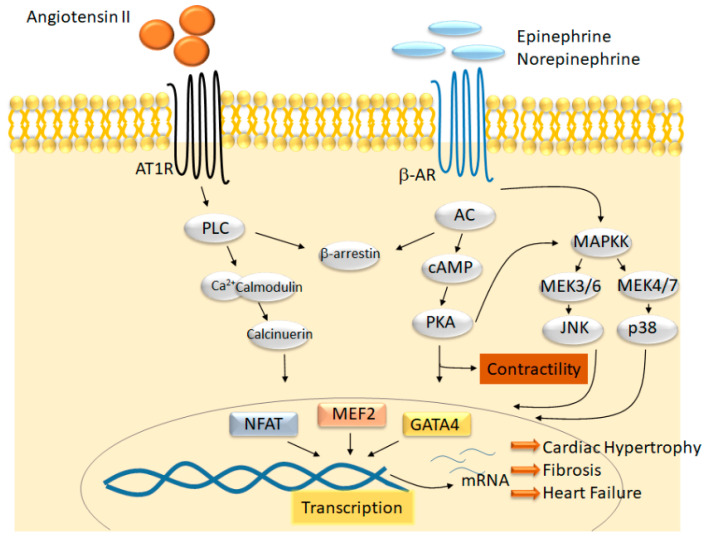
Figure 1
Figure 1
Neurohormonal signaling cascades converge on gene transcription to promote HF. Diagram of cardiac stress signaling pathways and their downstream effectors that converge on the transcriptional machinery to promote the development of cardiac hypertrophy and fibrosis, leading to HF. Signaling cascades activate well-known transcription factors, including the nuclear factor of activated T-cells (NFAT), myocyte enhancer factor 2 (MEF2), and GATA-binding protein 4 (GATA4), which are involved in pathological gene expression changes. AC, adenylyl cyclase; AT1R, angiotensin II receptor type 1; β-AR, beta-adrenergic receptor; phospholipase C; PKA, protein kinase A.
Figure 2
Figure 2
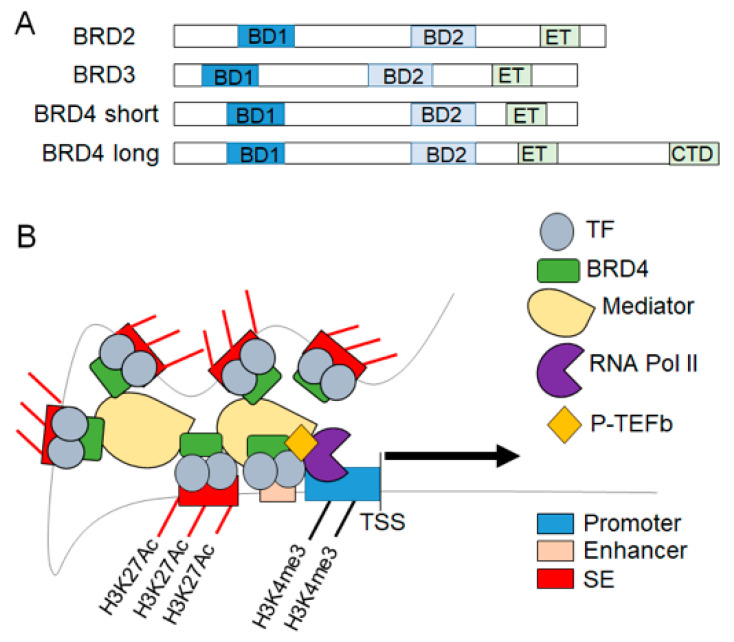
BET protein mediated transcription elongation. (A) The BET family of proteins contain two bromodomains (BD1, BD2). BRD4 is expressed as both a long and short isoform. BRD4 long contains a unique c-terminal domain (CTD) that interacts with P-TEFb, whereas BRD4 short lacks the CTD. (B) Schematic representation of the role of BRD4 in assembly of the transcriptional machinery involved in stress-induced transcription elongation of target genes in the heart. TF, transcription factor; P-TEFb, positive transcription elongation factor b; SE, superenhancer; TSS, transcription start site; red-line, H3K27Ac marks on the SE.
Figure 3
Figure 3
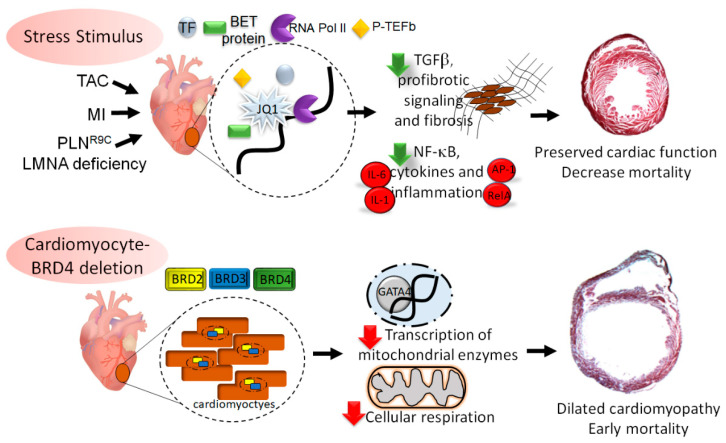
BRD4 is essential for cardiomyocyte homeostasis. Multiple forms of cardiac stress, including transverse aortic constriction (TAC), myocardial infarction (MI), and genetic defects PLNR9C or LMNA deficiency could be blunted by BD inhibitor JQ1. Recent evidence also suggests that BET protein BRD4 is involved in maintaining mitochondrial homeostasis in cardiomyocyte via a BD-independent mechanism and complete deletion leads to DCM and HF.

References

    1. van Berlo J.H., Maillet M., Molkentin J.D. Signaling effectors underlying pathologic growth and remodeling of the heart. J. Clin. Investig. 2013;123:37–45. doi: 10.1172/JCI62839. - DOI - PMC - PubMed
    1. Burke M.A., Cook S.A., Seidman J.G., Seidman C.E. Clinical and Mechanistic Insights into the Genetics of Cardiomyopathy. J. Am. Coll. Cardiol. 2016;68:2871–2886. doi: 10.1016/j.jacc.2016.08.079. - DOI - PMC - PubMed
    1. Bacmeister L., Schwarzl M., Warnke S., Stoffers B., Blankenberg S., Westermann D., Lindner D. Inflammation and fibrosis in murine models of heart failure. Basic Res. Cardiol. 2019;114:19. doi: 10.1007/s00395-019-0722-5. - DOI - PubMed
    1. Hartupee J., Mann J.H.D.L. Neurohormonal activation in heart failure with reduced ejection fraction. Nat. Rev. Cardiol. 2017;14:30–38. doi: 10.1038/nrcardio.2016.163. - DOI - PMC - PubMed
    1. Spitz F., Furlong E.E.M. Transcription factors: From enhancer binding to developmental control. Nat. Rev. Genet. 2012;13:613–626. doi: 10.1038/nrg3207. - DOI - PubMed

Substances