


Neonatal Hyperglycemia Related to Parenteral Nutrition Affects Long-Term Neurodevelopment in Preterm Newborn: A Prospective Cohort Study
- PMID: 34199741
- PMCID: PMC8227040
- DOI: 10.3390/nu13061930
Neonatal Hyperglycemia Related to Parenteral Nutrition Affects Long-Term Neurodevelopment in Preterm Newborn: A Prospective Cohort Study
Abstract
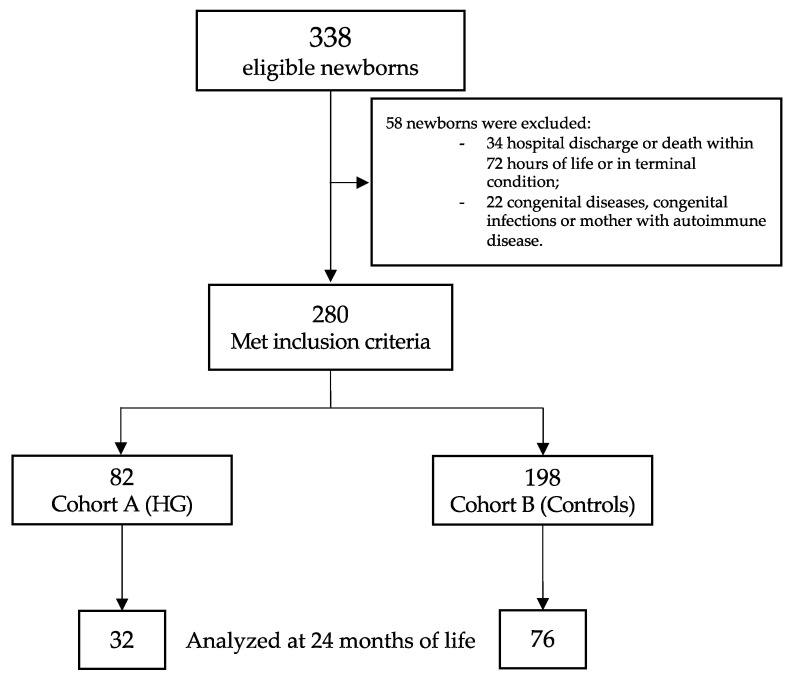
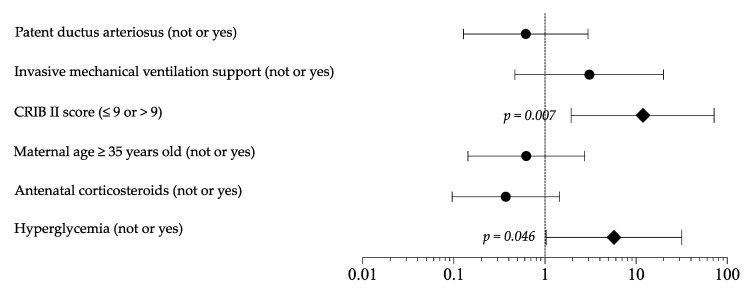
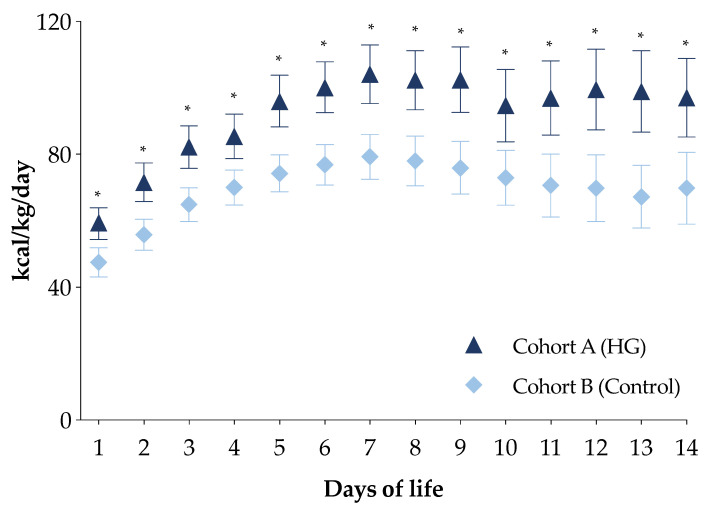
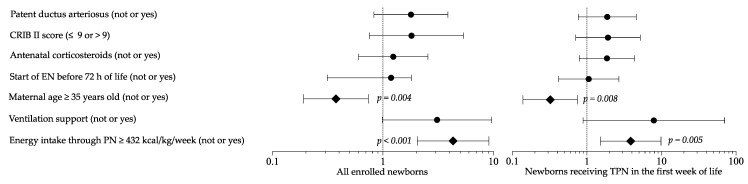
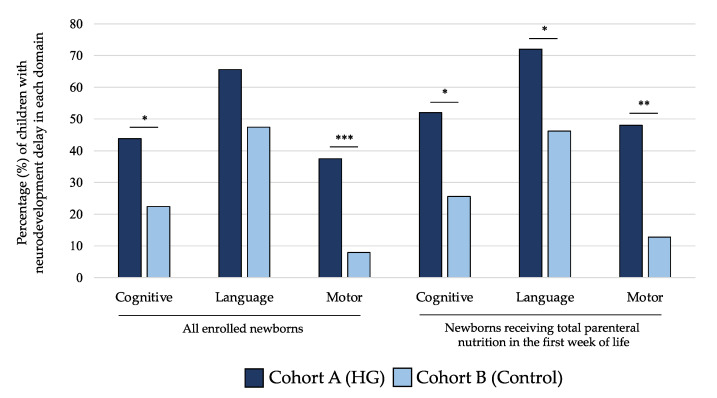
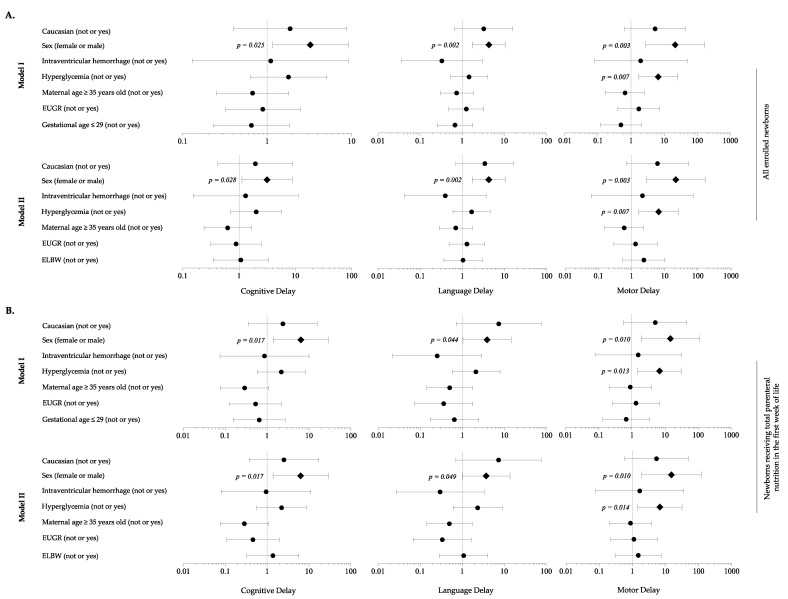
(1) Background: Recent evidence reported a reduced tolerance of macronutrient parenteral intakes in subjects in critically ill conditions. We designed a prospective cohort study to evaluate the effects of hyperglycemia (HG) related to parenteral nutrition (PN) on neurodevelopment (NDV) in survived preterm newborns. (2) Methods: Enrolled newborns with gestational age < 32 weeks or birth weight < 1500 g, were divided in two cohorts: (A) exposed to moderate or severe HG (glucose blood level > 180 mg/dL) in the first week of life; (B) not exposed to HG. We considered as the primary outcome the rate of preterm newborns survived without NDV delay at 24 months of life, evaluated with Bayley Scales of Infants Development III edition. (3) Results: We analyzed 108 (A 32 vs. B 76) at 24 months of life. Newborns in cohort A showed a higher rate of cognitive and motor delay (A 44% vs. B 22 %, p = 0.024; A 38% vs. B 8%, p < 0.001). When adjusting for background characteristics, HG remained a risk factor for motor delay. (4) Conclusions: High nutritional intakes through PN soon after birth increase the risk of HG. The consequences of this severe metabolic complication affect long-term NDV and survival in preterm newborns.
Keywords: Bayley Scales of Infants Development; VLBW; maternal age; metabolic complication; mortality; neurodevelopment.
Conflict of interest statement
The authors declare no conflict of interest.
Figures
References
-
- Maiocco G., Migliaretti G., Cresi F., Peila C., DeAntoni S., Trapani B., Giuliani F., Bertino E., Coscia A. Evaluation of Extrauterine Head Growth From 14–21 days to Discharge With Longitudinal Intergrowth-21st Charts: A New Approach to Identify Very Preterm Infants at Risk of Long-Term Neurodevelopmental Impairment. Front. Pediatr. 2020;8:572930. doi: 10.3389/fped.2020.572930. - DOI - PMC - PubMed
-
- Terrin G., Coscia A., Boscarino G., Faccioli F., Di Chiara M., Greco C., Onestà E., Oliva S., Aloi M., Dito L., et al. Long-term effects on growth of an energy-enhanced parenteral nutrition in preterm newborn: A quasi-experimental study. PLoS ONE. 2020;15:e0235540. doi: 10.1371/journal.pone.0235540. - DOI - PMC - PubMed
MeSH terms
Substances
LinkOut - more resources
Full Text Sources
Medical
