Meta-Analysis
. 2021 Jun 7;13(6):1959.
doi: 10.3390/nu13061959.

Magnesium Metabolism in Chronic Alcohol-Use Disorder: Meta-Analysis and Systematic Review

Affiliations
Meta-Analysis

Magnesium Metabolism in Chronic Alcohol-Use Disorder: Meta-Analysis and Systematic Review

Flora O Vanoni et al. Nutrients. .

Abstract

Chronic alcohol-use disorder has been imputed as a possible cause of dietary magnesium depletion. The purpose of this study was to assess the prevalence of hypomagnesemia in chronic alcohol-use disorder, and to provide information on intracellular magnesium and on its renal handling. We carried out a structured literature search up to November 2020, which returned 2719 potentially relevant records. After excluding non-significant records, 25 were retained for the final analysis. The meta-analysis disclosed that both total and ionized circulating magnesium are markedly reduced in chronic alcohol-use disorder. The funnel plot and the Egger's test did not disclose significant publication bias. The I2-test demonstrated significant statistical heterogeneity between studies. We also found that the skeletal muscle magnesium content is reduced and the kidney's normal response to hypomagnesemia is blunted. In conclusion, magnesium depletion is common in chronic alcohol-use disorder. Furthermore, the kidney plays a crucial role in the development of magnesium depletion.

Keywords: alcohol-use; depletion; diet; electrolytes; hypomagnesemia; kidney; magnesium.


Conflict of interest statement

The authors declare no conflict of interest.

Figures
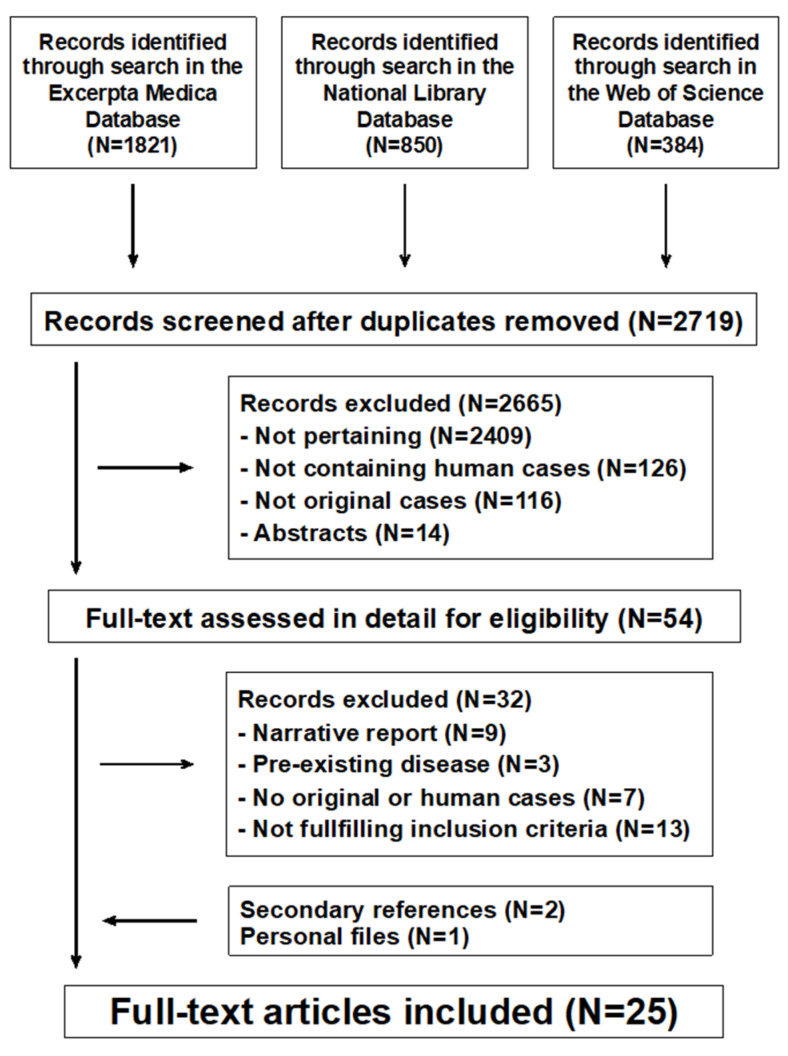
Figure 1
Figure 1
Magnesium metabolism in chronic alcohol-use disorder. Flowchart of the literature search process.
Figure 2
Figure 2
Forest plot of individual studies and pooled mean difference of magnesemia between alcohol group and controls, including 95% confidence intervals (95%-CI). The size of the squares is related to the weight of each study. Number of patients and control subjects in each study: Cohen [23]: controls n = 5, patients n = 5; De Marchi [25]: controls n = 42, patients n = 30; Hristova [29]: controls n = 40, patients n = 31; Lim [22]: controls n = 87, patients n = 9; Mendelson [11]: controls n = 18, patients n = 50; Nielsen [15]: controls n = 157, patients n = 48; Ordak [34]: controls n = 50, patients n = 100; Princi [30]: controls n = 14, patients n = 10; Rahelic [33]: controls n = 50, patients n = 105; Saha [32]: controls n = 75, patients n = 40; Smith [12]: controls n = 13, patients n = 12; Wolfe [21]: controls n = 12, patients n = 18; Wu [28]: controls n = 97, patients n = 88.
Figure 3
Figure 3
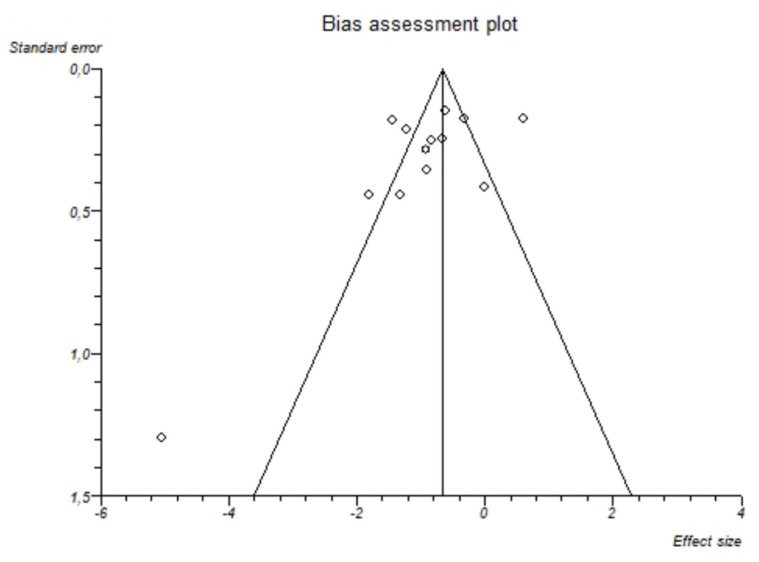
Bias assessment plot (funnel plot) about the pooled mean difference of magnesemia between alcohol group and controls. The visual analysis does not show a significant asymmetry and the presence of a publication bias is not demonstrated.
Figure 4
Figure 4
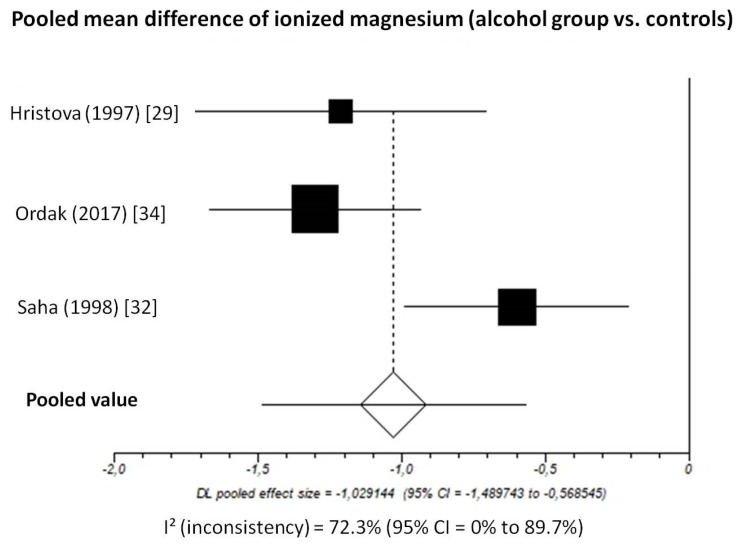
Forest plot of individual studies and pooled mean difference of ionized magnesium between alcohol group and controls, including 95% confidence intervals (95%-CI). The size of the squares is related to the weight of each study. Number of patients and control subjects in each study: Hristova [29]: controls n = 40, patients n = 31; Ordak [34]: controls n = 50, patients n = 100; Saha [32]: controls n = 75, patients n = 40.
Figure 5
Figure 5
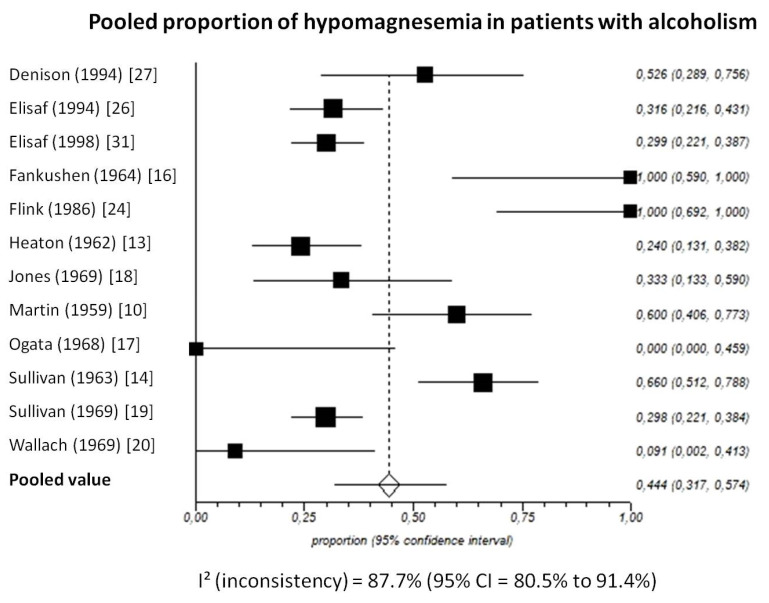
Forest plot of individual studies and pooled proportion of hypomagnesemia in patients with alcoholism, including 95% confidence intervals (95%-CI). The size of the squares is related to the weight of each study. Number of subjects in each study: Denison [27]: n = 19; Elisaf [26]: n = 79; Elisaf [31]: n = 127; Fankushen [16]: n = 7; Flink [24]: n = 10; Heaton [13]: n = 50; Jones [18]: n = 18; Martin [10]: n = 30; Ogata [17]: n = 6; Sullivan [14]: n = 50; Sullivan [19]: n = 131; Wallach [20]: n = 11.
Figure 6
Figure 6
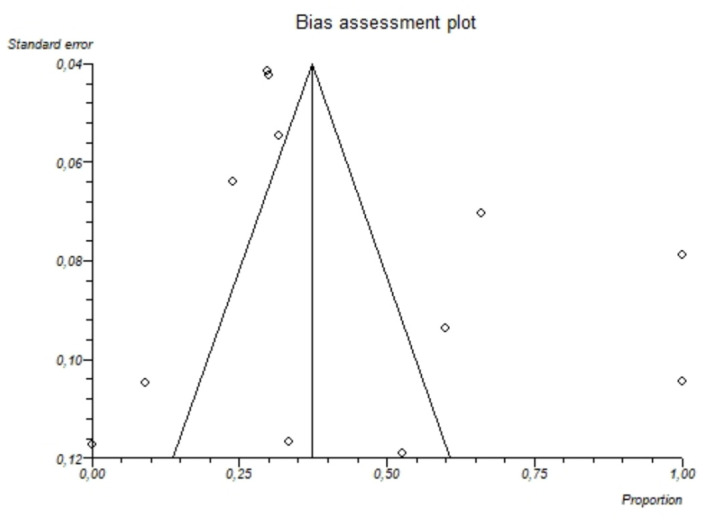
Bias assessment plot (funnel plot) showing the pooled proportion of hypomagnesemia in patients with alcoholism. The visual analysis does not show significant asymmetry and the presence of a publication bias is not demonstrated.

References

    1. Spanagel R. Alcoholism: A systems approach from molecular physiology to addictive behavior. Physiol. Rev. 2009;89:649–705. doi: 10.1152/physrev.00013.2008. - DOI - PubMed
    1. Palmer B.F., Clegg D.J. Electrolyte disturbances in patients with chronic alcohol-use disorder. N. Engl. J. Med. 2017;377:1368–1377. doi: 10.1056/NEJMra1704724. - DOI - PubMed
    1. Elin R.J. Magnesium metabolism in health and disease. Dis. Mon. 1988;34:161–218. doi: 10.1016/0011-5029(88)90013-2. - DOI - PubMed
    1. Agus Z.S. Mechanisms and causes of hypomagnesemia. Curr. Opin. Nephrol. Hypertens. 2016;25:301–307. doi: 10.1097/MNH.0000000000000238. - DOI - PubMed
    1. Liberati A., Altman D.G., Tetzlaff J., Mulrow C., Gøtzsche P.C., Ioannidis J.P., Clarke M., Devereaux P.J., Kleijnen J., Moher D. The PRISMA statement for reporting systematic reviews and meta-analyses of studies that evaluate health care interventions: Explanation and elaboration. Ann. Intern. Med. 2009;151:W65–W94. doi: 10.7326/0003-4819-151-4-200908180-00136. - DOI - PubMed