


The Multiple Functions of Rho GTPases in Fission Yeasts
- PMID: 34200466
- PMCID: PMC8228308
- DOI: 10.3390/cells10061422
The Multiple Functions of Rho GTPases in Fission Yeasts
Abstract
The Rho family of GTPases represents highly conserved molecular switches involved in a plethora of physiological processes. Fission yeast Schizosaccharomyces pombe has become a fundamental model organism to study the functions of Rho GTPases over the past few decades. In recent years, another fission yeast species, Schizosaccharomyces japonicus, has come into focus offering insight into evolutionary changes within the genus. Both fission yeasts contain only six Rho-type GTPases that are spatiotemporally controlled by multiple guanine-nucleotide exchange factors (GEFs) and GTPase-activating proteins (GAPs), and whose intricate regulation in response to external cues is starting to be uncovered. In the present review, we will outline and discuss the current knowledge and recent advances on how the fission yeasts Rho family GTPases regulate essential physiological processes such as morphogenesis and polarity, cellular integrity, cytokinesis and cellular differentiation.
Keywords: Cdc42; GTPase-activating protein (GAP); Rho GTPases; Rho1; cellular integrity; crosstalk; cytokinesis; cytoskeleton; fission yeasts; guanine–nucleotide exchange factor (GEF); phosphorylation; polarity; sexual differentiation; signaling.
Conflict of interest statement
The authors declare no conflict of interest. The funders had no role in the design of the study; in the collection, analyses, or interpretation of data; in the writing of the manuscript, or in the decision to publish the results.
Figures
 ,
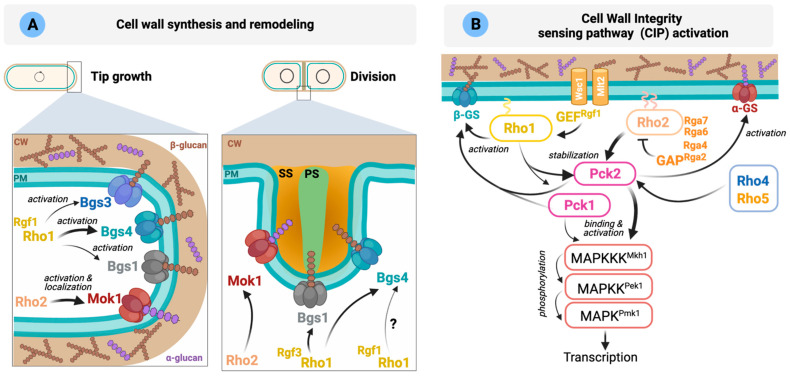
, ); PS: primary septum; SS: secondary septum. (B) Schematic representation of S. pombe CIP activation. Wsc1 and Mtl2 activate Rho1 through the GEF Rgf1. Rho1 activates the β-GS and stabilizes Pck1 and Pck2. After activation by the phospholipid-dependent kinase Ksg1, both kinases activate the GS. Rho2 regulates Mok1 via Pck2. Rho2-Pck2 are the main activators of the CIP. Please see main text for more details.
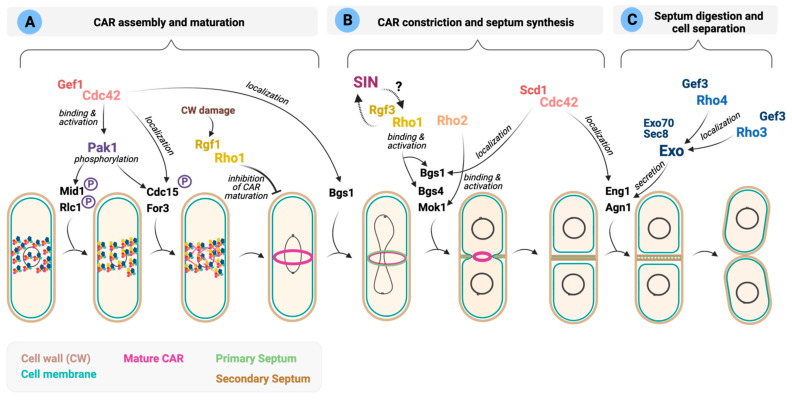
 ) composed of multiple proteins localized into the cell middle by anillin-like protein Mid1. After synthesis of the F-actin network by formins Cdc12 and For3, nodes condense into the CAR through actomyosin interactions. The fully formed ring matures by recruitment of additional cytokinesis proteins (mature car is indicated in magenta). Cdc42 effector Pak1 promotes phosphorylation of CAR components Mid1, Cdc15 and Rlc1. Cdc42 mediates Bgs1 recruitment at the ring during anaphase. Rho1 GTPase participates in a cytokinetic checkpoint that delays CAR maturation after cell wall damage. (B) CAR maturation is followed by constriction and cell wall deposition (primary septum, in green, and secondary septum, in brown), which facilitates proper ring closure. Rho1 and Rho2 bind and activate the enzymes involved in septum synthesis. Question mark denotes that the molecular mechanism by which SIN might activate Rho1 remains unsolved. (C) Cells separation occurs by digestion of the primary septum and the surrounding cell wall by Agn1 (endo-α-1,3 glucanase) and Eng1 (endo-β-1,3 glucanase). Secretion of Agn1 and Eng1 depends on the activity of Rho4 (activated by Gef3). Both enzymes are targeted to the septum by the exocyst subunits Sec8 and Exo70 regulated by Rho4 and Rho3. Agn1 and Eng1 distribution at the ring is influenced by Cdc42. Please see main text for more details.
References
Publication types
MeSH terms
Substances
Grants and funding
LinkOut - more resources
Full Text Sources
Miscellaneous
