


Ensemble Method of Convolutional Neural Networks with Directed Acyclic Graph Using Dermoscopic Images: Melanoma Detection Application
- PMID: 34200521
- PMCID: PMC8229112
- DOI: 10.3390/s21123999
Ensemble Method of Convolutional Neural Networks with Directed Acyclic Graph Using Dermoscopic Images: Melanoma Detection Application
Abstract
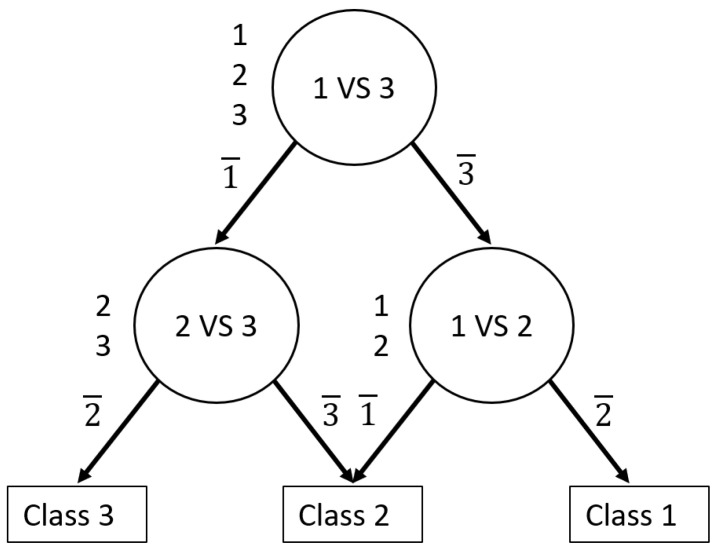
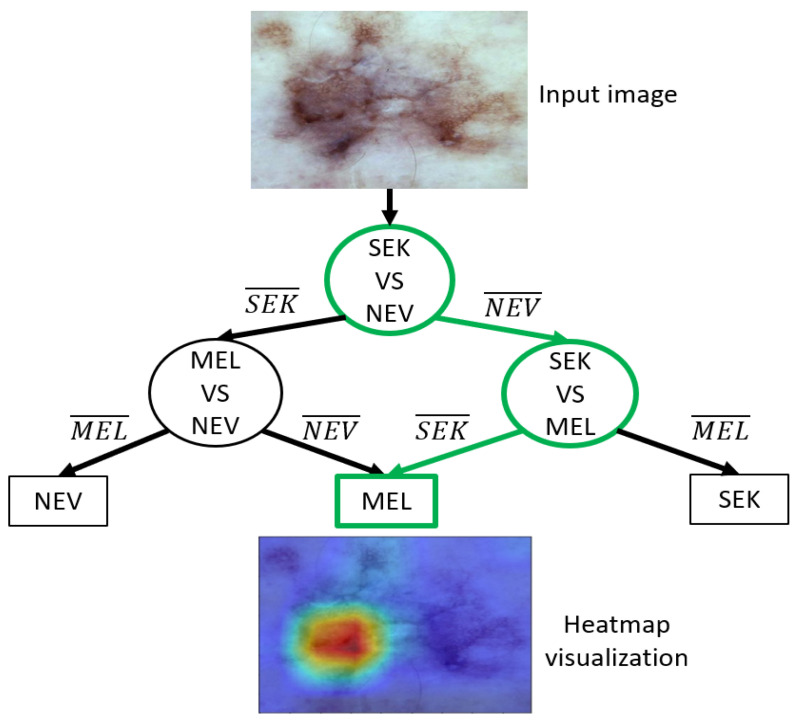
The early detection of melanoma is the most efficient way to reduce its mortality rate. Dermatologists achieve this task with the help of dermoscopy, a non-invasive tool allowing the visualization of patterns of skin lesions. Computer-aided diagnosis (CAD) systems developed on dermoscopic images are needed to assist dermatologists. These systems rely mainly on multiclass classification approaches. However, the multiclass classification of skin lesions by an automated system remains a challenging task. Decomposing a multiclass problem into a binary problem can reduce the complexity of the initial problem and increase the overall performance. This paper proposes a CAD system to classify dermoscopic images into three diagnosis classes: melanoma, nevi, and seborrheic keratosis. We introduce a novel ensemble scheme of convolutional neural networks (CNNs), inspired by decomposition and ensemble methods, to improve the performance of the CAD system. Unlike conventional ensemble methods, we use a directed acyclic graph to aggregate binary CNNs for the melanoma detection task. On the ISIC 2018 public dataset, our method achieves the best balanced accuracy (76.6%) among multiclass CNNs, an ensemble of multiclass CNNs with classical aggregation methods, and other related works. Our results reveal that the directed acyclic graph is a meaningful approach to develop a reliable and robust automated diagnosis system for the multiclass classification of dermoscopic images.
Keywords: computer-aided system; deep learning; dermoscopic images; directed acyclic graph; ensemble method; fusion-based model; melanoma detection; multiclass classification; skin cancer.
Conflict of interest statement
The authors declare no conflict of interest.
Figures
References
-
- Leiter U., Keim U., Garbe C. Sunlight, Vitamin D and Skin Cancer. Springer; Cham, Switzerland: 2020. Epidemiology of skin cancer: Update 2019; pp. 123–139. - PubMed
-
- Grob J.J., Gaudy C. Early detection of melanoma. Discussing a new approach. Rev. Prat. 2007;57:1397–1400. - PubMed
-
- Codella N., Rotemberg V., Tschandl P., Celebi M.E., Dusza S., Gutman D., Helba B., Kalloo A., Liopyris K., Marchetti M., et al. Skin lesion analysis toward melanoma detection 2018: A challenge hosted by the international skin imaging collaboration (isic) arXiv. 20191902.03368
MeSH terms
LinkOut - more resources
Full Text Sources
Other Literature Sources
Medical
Miscellaneous
