


Asynchrony of Gambierdiscus spp. Abundance and Toxicity in the U.S. Virgin Islands: Implications for Monitoring and Management of Ciguatera
- PMID: 34200870
- PMCID: PMC8230442
- DOI: 10.3390/toxins13060413
Asynchrony of Gambierdiscus spp. Abundance and Toxicity in the U.S. Virgin Islands: Implications for Monitoring and Management of Ciguatera
Abstract
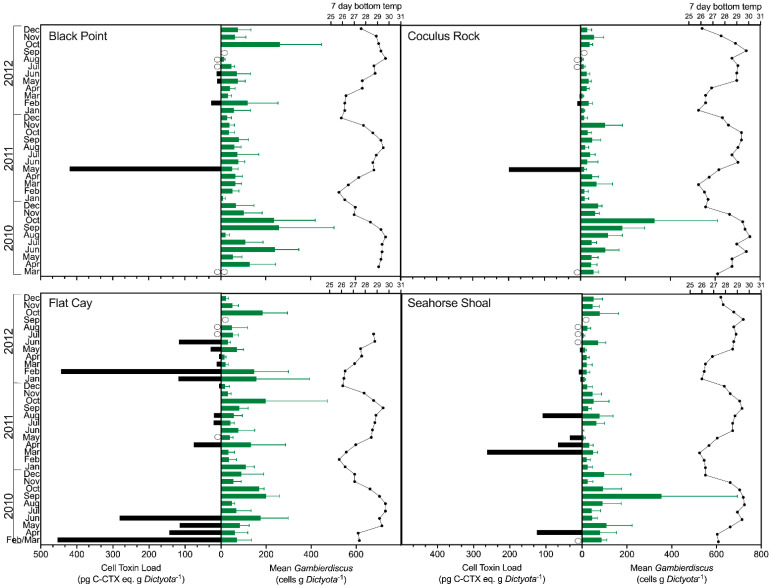
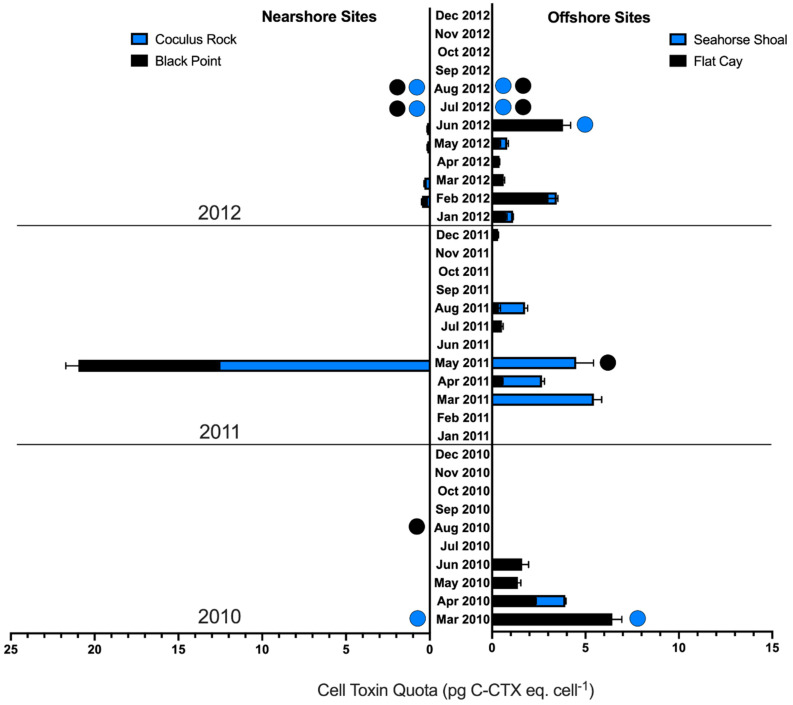
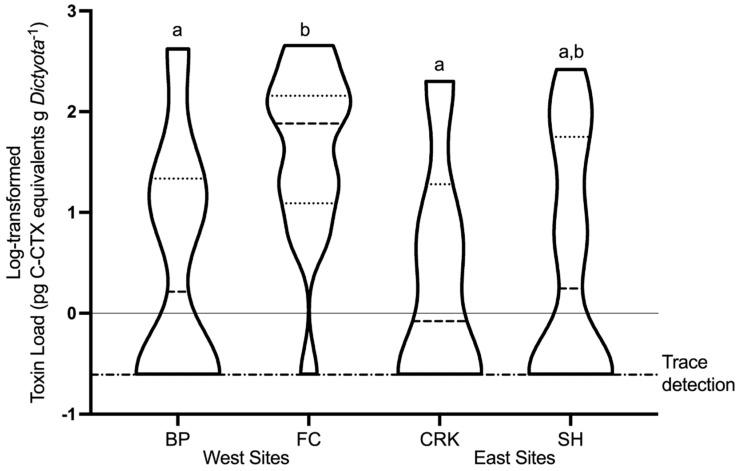
Ciguatera poisoning (CP) poses a significant threat to ecosystem services and fishery resources in coastal communities. The CP-causative ciguatoxins (CTXs) are produced by benthic dinoflagellates including Gambierdiscus and Fukuyoa spp., and enter reef food webs via grazing on macroalgal substrates. In this study, we report on a 3-year monthly time series in St. Thomas, US Virgin Islands where Gambierdiscus spp. abundance and Caribbean-CTX toxicity in benthic samples were compared to key environmental factors, including temperature, salinity, nutrients, benthic cover, and physical data. We found that peak Gambierdiscus abundance occurred in summer while CTX-specific toxicity peaked in cooler months (February-May) when the mean water temperatures were approximately 26-28 °C. These trends were most evident at deeper offshore sites where macroalgal cover was highest year-round. Other environmental parameters were not correlated with the CTX variability observed over time. The asynchrony between Gambierdiscus spp. abundance and toxicity reflects potential differences in toxin cell quotas among Gambierdiscus species with concomitant variability in their abundances throughout the year. These results have significant implications for monitoring and management of benthic harmful algal blooms and highlights potential seasonal and highly-localized pulses in reef toxin loads that may be transferred to higher trophic levels.
Keywords: Caribbean; Dictyota; Gambierdiscus; algal toxin; benthic algae; ciguatera poisoning; ciguatoxin; dinoflagellate; harmful algal bloom.
Conflict of interest statement
The authors declare no conflict of interest.
Figures
References
-
- Friedman M.A., Fernandez M., Backer L.C., Dickey R.W., Bernstein J., Schrank K., Kibler S., Stephan W., Gribble M.O., Bienfang P. An updated review of ciguatera fish poisoning: Clinical, epidemiological, environmental, and public health management. Mar. Drugs. 2017;15:72. doi: 10.3390/md15030072. - DOI - PMC - PubMed
-
- Parsons M.L., Aligizaki K., Bottein M.Y.D., Fraga S., Morton S.L., Penna A., Rhodes L. Gambierdiscus and Ostreopsis: Reassessment of the state of knowledge of their taxonomy, geography, ecophysiology, and toxicology. Harmful Algae. 2012;14:107–129. doi: 10.1016/j.hal.2011.10.017. - DOI
-
- Cruz-Rivera E., Villareal T.A. Macroalgal palatability and the flux of ciguatera toxins through marine food webs. Harmful Algae. 2006;5:497–525. doi: 10.1016/j.hal.2005.09.003. - DOI
-
- Kohler S.T., Kohler C.C. Dead bleached coral provides new surfaces for dinoflagellates implicated in ciguatera fish poisonings. Environ. Biol. Fishes. 1992;35:413–416. doi: 10.1007/BF00004993. - DOI
Publication types
MeSH terms
Substances
Grants and funding
- 1743802 and 1841811/National Science Foundation
- P01 ES028949/ES/NIEHS NIH HHS/United States
- NA11NOS4780028 and NA17NOS4780181/National Oceanic and Atmospheric Administration, Ecology and Oceanography of Harmful Algal Blooms Program
- 1P01ES028949-01/NH/NIH HHS/United States
- 2020GXNSFDA297001/Natural Science Foundation of Guangxi Province
LinkOut - more resources
Full Text Sources
Miscellaneous
