


Review
doi: 10.3390/cancers13122853.
Bispecific T Cell Engagers for the Treatment of Multiple Myeloma: Achievements and Challenges
Affiliations
- PMID: 34201007
- PMCID: PMC8228067
- DOI: 10.3390/cancers13122853
Item in Clipboard
Review
Bispecific T Cell Engagers for the Treatment of Multiple Myeloma: Achievements and Challenges
Cancers (Basel).
.
Abstract
MM is the second most common hematological malignancy and represents approximately 20% of deaths from hematopoietic cancers. The advent of novel agents has changed the therapeutic landscape of MM treatment; however, MM remains incurable. T cell-based immunotherapy such as BTCEs is a promising modality for the treatment of MM. This review article discusses the advancements and future directions of BTCE treatments for MM.
Keywords: bispecific T cell engagers; chimeric antigen receptor-T cells; multiple myeloma.
Conflict of interest statement
A.K.A. and K.A. have filed a patent with regards to the nanoBTCE technology described in this manuscript. Other authors state no conflict of interest.
Figures
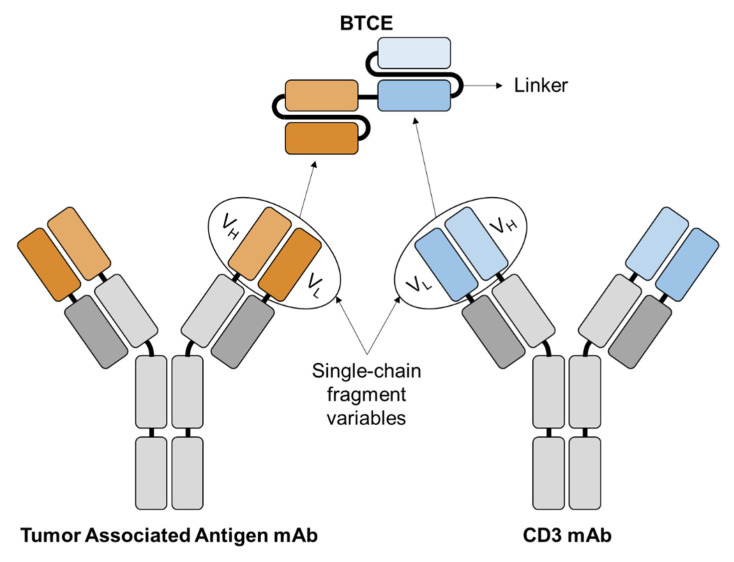
Creation of the BTCE using scFvs of two monoclonal antibodies (mAbs) linked together using a protein linker. The anti-tumor associated antigen scFv specifically recognizes the desired TAA on the tumor cell while the anti-CD3 scFv recognizes the CD3 molecule on the T cell. This enables a highly specific and bivalent system for T cell-based immunotherapy.
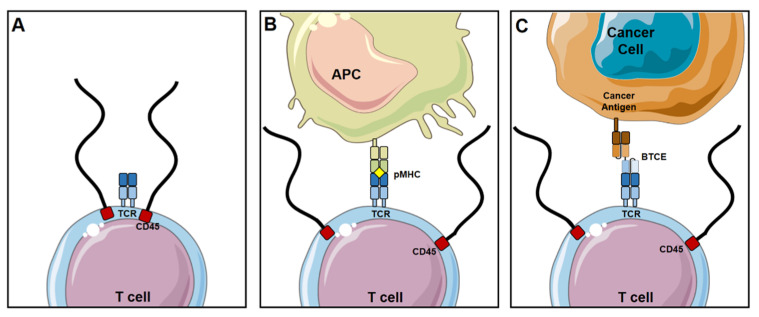
Molecular mechanism of BTCE-induced T cell activation. (A) The kinetic-segregation model proposes that the exclusion of CD45 is a prerequisite for T cell activation. (B) As the antigen presenting cell (APC) gets in proximity of the T cell, CD45 is subsequently excluded and the peptide major histocompatibility complex (pMHC) interacts with the T cell receptor (TCR) and enables activation. (C) For BTCE-induced T cell activation, the BTCE brings the tumor cell in proximity of the T cell to exclude CD45 from the close-contact zone and enable subsequent T cell activation.
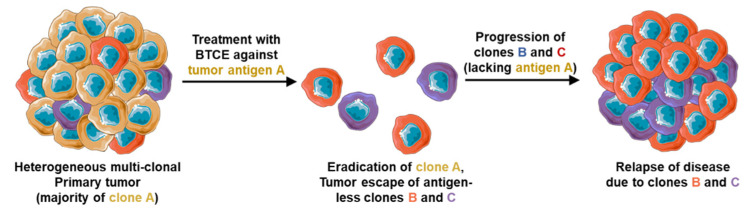
Mechanism of tumor escape and relapse after BTCE therapy targeting only one surface marker due to development of antigen-less clones.
References
-
- Richardson P.G., San Miguel J.F., Moreau P., Hajek R., Dimopoulos M.A., Laubach J.P., Palumbo A., Luptakova K., Romanus D., Skacel T., et al. Interpreting clinical trial data in multiple myeloma: Translating findings to the real-world setting. Blood Cancer J. 2018;8:109. doi: 10.1038/s41408-018-0141-0. - DOI - PMC - PubMed
Publication types
LinkOut - more resources
Full Text Sources
Other Literature Sources
