


The Effects of Work Characteristics Related to Work-Life Imbalance on Presenteeism among Female Workers in the Health and Social Work Sectors: Mediation Analysis of Psychological and Physical Health Problems
- PMID: 34201286
- PMCID: PMC8226831
- DOI: 10.3390/ijerph18126218
The Effects of Work Characteristics Related to Work-Life Imbalance on Presenteeism among Female Workers in the Health and Social Work Sectors: Mediation Analysis of Psychological and Physical Health Problems
Abstract
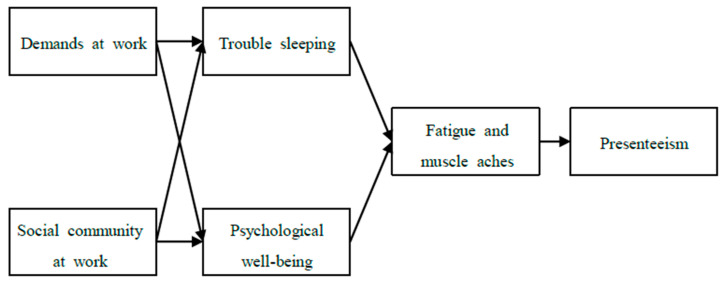
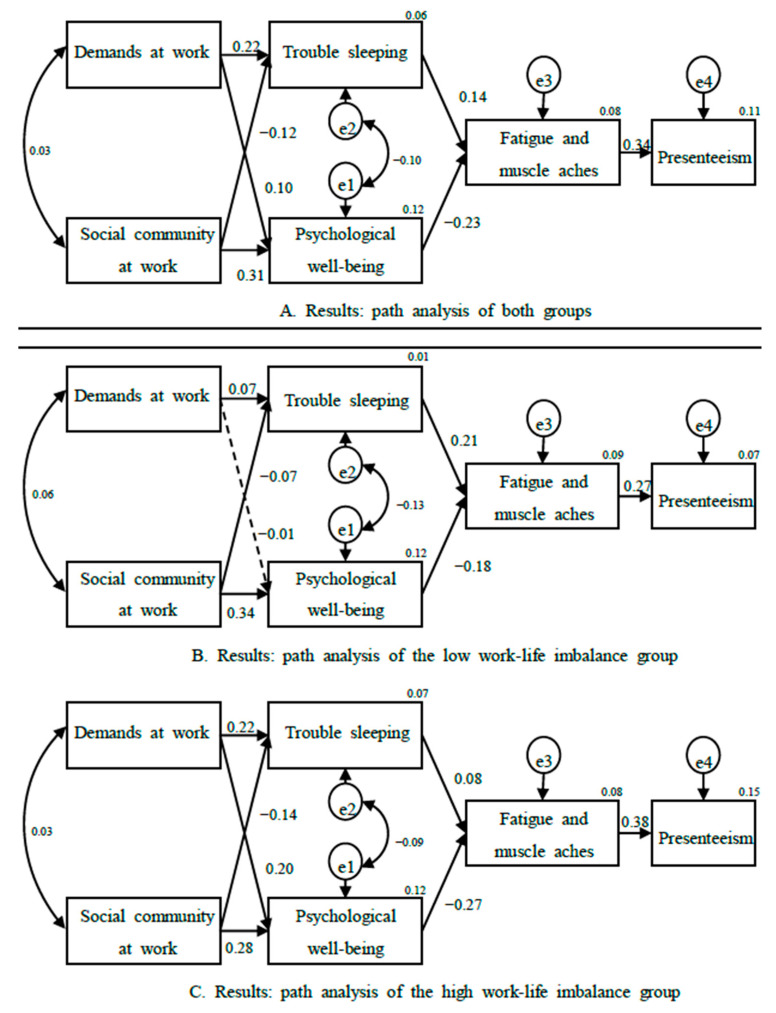
This study is a multigroup path analysis aiming to create a theoretical model of presenteeism among female workers in the health and social work sectors, assess the mediating effects of mental health problems (sleeping trouble and psychological wellbeing), and physical health problems (fatigue and muscle aches) on the relationship between work characteristics (demands at work and social community at work) and presenteeism, and identify the differences between the effects of variables on those who reported low work-life imbalance and high work-life imbalance. Raw data from the fifth Korean Working Conditions Survey (KWCS) were analyzed. From the total sample of 50,205 people, 2209 women in health and social work were included in the study sample. The results were as follows: the demands at work had a significant and positive indirect effect on presenteeism (B = 0.0023, p < 0.001), mediated by trouble sleeping, fatigue, and muscle aches, in that order. Demands at work were also found to have a significant and negative indirect effect on presenteeism (B = -0.0017, p < 0.001), mediated by psychological wellbeing, fatigue, and muscle aches, in descending order. Social community at work had a significant and negative indirect effect on presenteeism (B = -0.0022, p < 0.001), mediated by trouble sleeping, fatigue, and muscle aches, in that order. Social community at work also had a significant and negative effect on presenteeism, mediated by psychological wellbeing, fatigue, and muscle aches, in descending order (B = -0.0097, p < 0.001). Demands at work did not have a significant effect on psychological wellbeing in the low work-life imbalance group, whereas its effect was significant and positive (β = 0.198, p < 0.001) in the high work-life imbalance group. In conclusion, in the path model of the low work-life imbalance group, demands at work did not influence psychological wellbeing. Therefore, strategies to ameliorate work-life imbalance may be helpful components of interventions to reduce presenteeism.
Keywords: health and social work sectors; physical health issues; presenteeism; psychological health issues; work characteristics; work–life imbalance.
Conflict of interest statement
The authors declare no conflict of interest.
Figures
References
-
- Son D.M., Jung Y.-I. The Effect of Work–Life Balance on Job Satisfaction and Turnover Intention of Hospital Nurses: Compared to Female Wage Workers. Stress. 2019;27:268–276. doi: 10.17547/kjsr.2019.27.3.268. - DOI
-
- Cinamon R.G., Rich Y. Gender Differences in the Importance of Work and Family Roles: Implications for Work–Family Conflict. Sex Roles. 2002;47:531–541. doi: 10.1023/A:1022021804846. - DOI
-
- Shin H.J. What Makes Sick Workers Go To Work? A Study of Occupational Environment and Presenteeism. Korean J. Labor Stud. 2018;24:35–71.
-
- Kwon M.J., Choi E.S. Presenteeism in Clinical Nurses: An Integrative Literature Review. Korean J. Occup. Health Nurs. 2017;26:160–171.
MeSH terms
LinkOut - more resources
Full Text Sources
