


Antibacterial Residue Excretion via Urine as an Indicator for Therapeutical Treatment Choice and Farm Waste Treatment
- PMID: 34201627
- PMCID: PMC8300810
- DOI: 10.3390/antibiotics10070762
Antibacterial Residue Excretion via Urine as an Indicator for Therapeutical Treatment Choice and Farm Waste Treatment
Abstract
Many of the infectious diseases that affect livestock have bacteria as etiological agents. Thus, therapy is based on antimicrobials that leave the animal's tissues mainly via urine, reaching the environment through slurry and waste water. Once there, antimicrobial residues may lead to antibacterial resistance as well as toxicity for plants, animals, or humans. Hence, the objective was to describe the rate of antimicrobial excretion in urine in order to select the most appropriate molecule while reducing harmful effects. Thus, 62 pigs were treated with sulfamethoxypyridazine, oxytetracycline, and enrofloxacin. Urine was collected through the withdrawal period and analysed via LC-MS/MS. Oxytetracycline had the slowest rate of degradation (a half-life time of 4.18 days) and the most extended elimination period in urine (over 2 months), followed by enrofloxacin (a half-life time of 1.48 days, total urine elimination in ca. 3 weeks) and sulfamethoxypyridazine (a half-life time of 0.49 days, total urine elimination in ca. 1 week). Bacterial sensitivity and recommendations for responsible use are limiting when selecting the treatment. Nevertheless, with similar effectiveness, sulfamethoxypyridazine would be the choice, as waste treatment would only need to be implemented for 1 week after treatment. Thus, more in-depth knowledge regarding antibacterial elimination would improve resource management, while protecting animals and consumers' health.
Keywords: LC–MS/MS; antibiotic; excretion; quinolone; sulfonamide; urine.
Conflict of interest statement
The authors declare no conflict of interest.
Figures

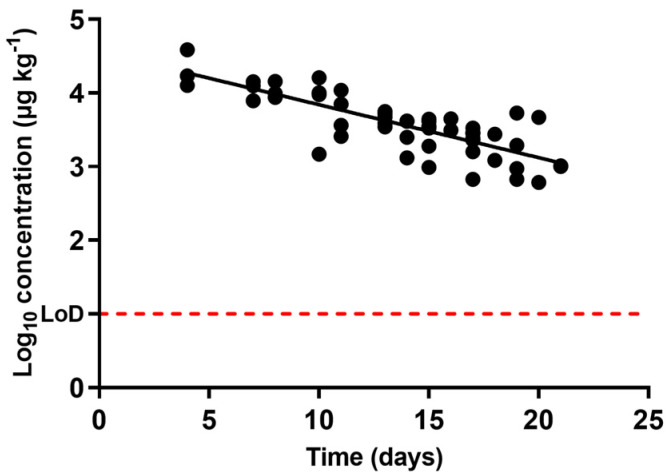


 ), oxytetracycline (
 ), and enrofloxacin (
 ) in urine after animal treatment within the withdrawal period. The LoD dotted line represents the detection limit of the analytical technique for sulfamethoxypyridazine, oxytetracycline, and enrofloxacin.
References
-
- O’Neill J. The Review on Antimicrobial Resistance. Wellcome Trust, HM Government; London, UK: 2015. [(accessed on 19 November 2020)]. Antimicrobials in agriculture and the environment: Reducing unnecessary use and waste; pp. 1–44. Available online: https://amr-review.org/sites/default/files/Antimicrobials%20in%20agricul....
-
- Tang K.L., Caffrey N.P., Nobrega D.B., Cork S.C., Ronksley P.E., Barkema H.W., Polachek A.J., Ganshron H., Sharma N., Kellner J.D., et al. Restricting the use of antibiotics in food-producing animals and its associations with antibiotic resistance in food-producing animals and human beings: A systematic review and meta-analysis. Lancet Planet Health. 2017;1:316–327. doi: 10.1016/S2542-5196(17)30141-9. - DOI - PMC - PubMed
Grants and funding
LinkOut - more resources
Full Text Sources
