Review
. 2021 Jun 23;10(7):1584.
doi: 10.3390/cells10071584.

The Impact of Obesity on Microglial Function: Immune, Metabolic and Endocrine Perspectives

Affiliations
Review

The Impact of Obesity on Microglial Function: Immune, Metabolic and Endocrine Perspectives

Vasileia Ismini Alexaki. Cells. .

Abstract

Increased life expectancy in combination with modern life style and high prevalence of obesity are important risk factors for development of neurodegenerative diseases. Neuroinflammation is a feature of neurodegenerative diseases, and microglia, the innate immune cells of the brain, are central players in it. The present review discusses the effects of obesity, chronic peripheral inflammation and obesity-associated metabolic and endocrine perturbations, including insulin resistance, dyslipidemia and increased glucocorticoid levels, on microglial function.

Keywords: adiponectin; cytokines; dyslipidemia; glucocorticoids; gut microbiome; insulin resistance; leptin; microglia; neurodegeneration; neuroinflammation; obesity; systemic inflammation.


Conflict of interest statement

The author has no conflict of interest to declare.

Figures
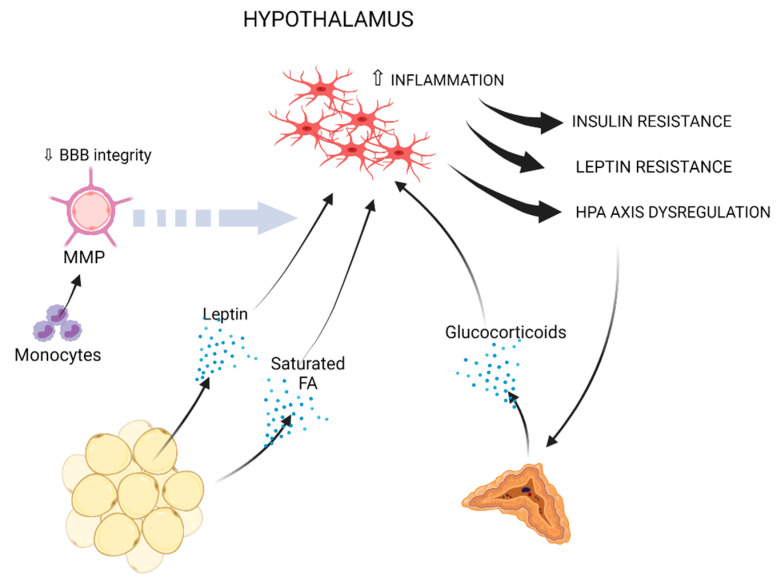
Figure 2
Figure 2
Obesity-induced peripheral immune, metabolic and endocrine factors, which may promote microglia-mediated inflammation in the hypothalamus. Fat-derived leptin and saturated fatty acids may promote neuroinflammation in the hypothalamus [212,256,257,259,260,264,266,267,268,269,277,278]. Circulating monocytes can drive BBB impairment through MMP production [269,279,280,281,282]. Hypothalamic neuroinflammation leads to insulin resistance, leptin resistance and HPA axis dysregulation [212,256,257,259,260,262,263,264,265,266,267,268,272,273]. Enhanced HPA axis activation drives increased glucocorticoid production by the adrenal gland, which may further sustain microglial inflammation [283,284].
Figure 1
Figure 1
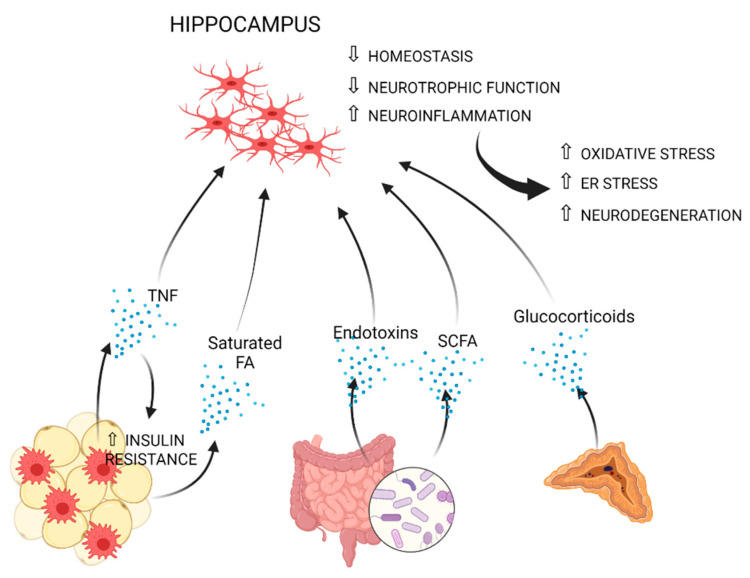
Peripheral immune, metabolic and endocrine routes, which may promote hippocampal microglial inflammation in obesity. Adipose-tissue-derived TNF and saturated fatty acids may exert microglial pro-inflammatory effects in the hippocampus. TNF promotes insulin resistance in the adipose tissue, which leads to enhanced lipolysis, further increasing the amount of saturated fatty acids in the circulation [10,88,89,140,188]. Gut microbiome-derived endotoxins and SCFA may also induce hippocampal neuroinflammation [189,190]. Chronically enhanced adrenocortical secretion of glucocorticoids may sustain microglia-mediated inflammation and neurodegeneration [191,192,193]. Collectively, these signals can lead to compromised homeostatic and neurotrophic function and sustained inflammatory activation of microglia, associated with oxidative stress, ER stress and neurodegeneration in the hippocampus [193,194,195,196,197,198,199,200,201,202,203,204].

References

    1. Bluher M. Obesity: Global epidemiology and pathogenesis. Nat. Rev. Endocrinol. 2019;15:288–298. doi: 10.1038/s41574-019-0176-8. - DOI - PubMed
    1. Heymsfield S.B., Wadden T.A. Mechanisms, pathophysiology, and management of obesity. N. Engl. J. Med. 2017;376:254–266. doi: 10.1056/NEJMra1514009. - DOI - PubMed
    1. Kivipelto M., Ngandu T., Fratiglioni L., Viitanen M., Kareholt I., Winblad B., Helkala E.L., Tuomilehto J., Soininen H., Nissinen A. Obesity and vascular risk factors at midlife and the risk of dementia and Alzheimer disease. Arch. Neurol. 2005;62:1556–1560. doi: 10.1001/archneur.62.10.1556. - DOI - PubMed
    1. Whitmer R.A., Gustafson D.R., Barrett-Connor E., Haan M.N., Gunderson E.P., Yaffe K. Central obesity and increased risk of dementia more than three decades later. Neurology. 2008;71:1057–1064. doi: 10.1212/01.wnl.0000306313.89165.ef. - DOI - PubMed
    1. Whitmer R.A., Gunderson E.P., Barrett-Connor E., Quesenberry C.P., Jr., Yaffe K. Obesity in middle age and future risk of dementia: A 27 year longitudinal population based study. BMJ. 2005;330:1360. doi: 10.1136/bmj.38446.466238.E0. - DOI - PMC - PubMed

Publication types