Review
. 2021 Jun 25;22(13):6823.
doi: 10.3390/ijms22136823.

RGS14 Regulation of Post-Synaptic Signaling and Spine Plasticity in Brain

Affiliations
Review

RGS14 Regulation of Post-Synaptic Signaling and Spine Plasticity in Brain

Nicholas H Harbin et al. Int J Mol Sci. .

Abstract

The regulator of G-protein signaling 14 (RGS14) is a multifunctional signaling protein that regulates post synaptic plasticity in neurons. RGS14 is expressed in the brain regions essential for learning, memory, emotion, and stimulus-induced behaviors, including the basal ganglia, limbic system, and cortex. Behaviorally, RGS14 regulates spatial and object memory, female-specific responses to cued fear conditioning, and environmental- and psychostimulant-induced locomotion. At the cellular level, RGS14 acts as a scaffolding protein that integrates G protein, Ras/ERK, and calcium/calmodulin signaling pathways essential for spine plasticity and cell signaling, allowing RGS14 to naturally suppress long-term potentiation (LTP) and structural plasticity in hippocampal area CA2 pyramidal cells. Recent proteomics findings indicate that RGS14 also engages the actomyosin system in the brain, perhaps to impact spine morphogenesis. Of note, RGS14 is also a nucleocytoplasmic shuttling protein, where its role in the nucleus remains uncertain. Balanced nuclear import/export and dendritic spine localization are likely essential for RGS14 neuronal functions as a regulator of synaptic plasticity. Supporting this idea, human genetic variants disrupting RGS14 localization also disrupt RGS14's effects on plasticity. This review will focus on the known and unexplored roles of RGS14 in cell signaling, physiology, disease and behavior.

Keywords: 14-3-3; G protein; H-Ras; RGS protein; RGS14; calcium; calmodulin; hippocampus; nucleocytoplasmic shuttling; synaptic plasticity.


Conflict of interest statement

The authors declare no conflict of interest.

Figures
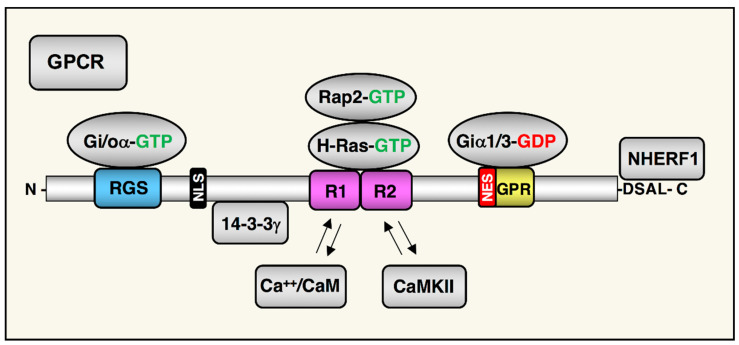
Figure 1
Figure 1
RGS14 structural organization and interacting partners. Regulator of G-protein signaling 14 (RGS14) is a ~62 kDa protein that contains three conserved domains and two motifs. The RGS domain serves as a GTPase activating protein (GAP) for active, GTP-bound Gαi/o proteins; the tandem Ras binding domains (R1/R2) enable interaction with H-Ras and Rap2; and the GoLoco/G protein regulatory motif (GPR) promotes binding to inactive, GDP-bound Gαi1/3 proteins and inhibits dissociation of GDP from Gαi1/3. RGS14 also contains a nuclear localization sequence (NLS) in the linker region between the RGS and R1/R2 domains and a nuclear export sequence (NES) embedded within the GPR motif. RGS14 interacts with 14-3-3 at phospho-Ser218 in the linker region between the RGS and R1/R2 domains, and also with calcium/calmodulin (Ca2+/CaM) and Ca2+/CaM kinase II (CaMKII) at undefined sites within the R1/R2 domain. Lastly, a PDZ-recognition motif (DSAL) is found at the C-terminus of human/primate (but not rodent) RGS14, which mediates RGS14 interactions with NHERF1.
Figure 2
Figure 2
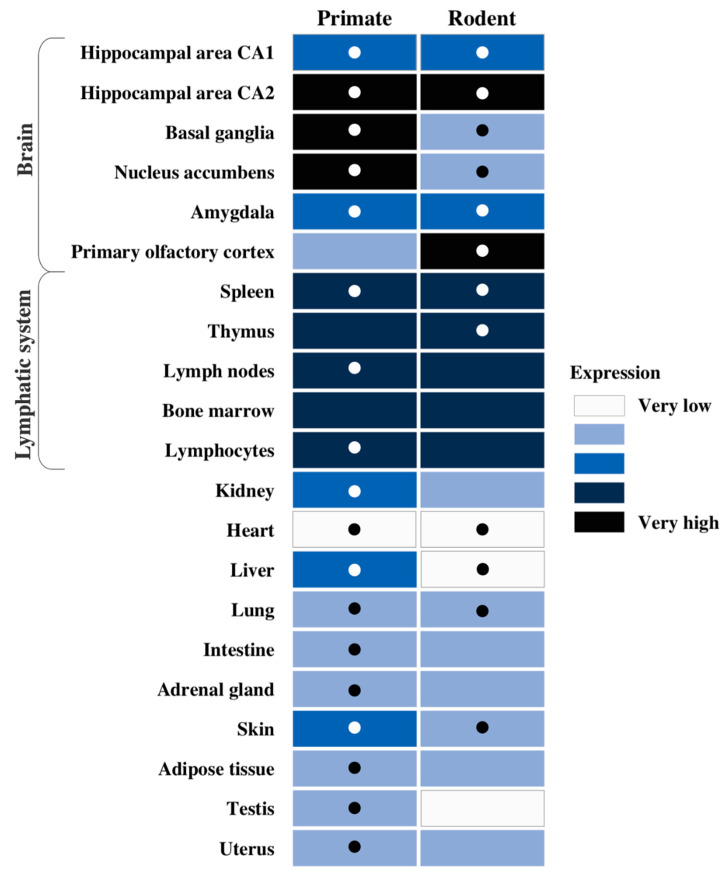
Reported tissue expression of RGS14 in adult primate and rodent. Cell shading indicates RGS14 mRNA expression across tissues. Dot indicates positive RGS14 protein expression data. Data were aggregated from the following sources: ProteomicsDB [49], Mouse Gene Expression Database (GXD) [50], Global Proteome Machine Database (GPMDB) [51], Allen Human Brain Atlas [52], Allen Mouse Brain Atlas [53], Human Protein Atlas [54], Ensembl [55], Evans et al. 2014 [27], Squires et al. 2018 [26], and Foster et al. 2021 [56]. Expression levels for mRNA were compiled from the sources cited above and defined in a relative manner from available data for each species (M. musculus and R. norvegicus for rodent, H. sapiens and M. mulatta for primate).
Figure 3
Figure 3
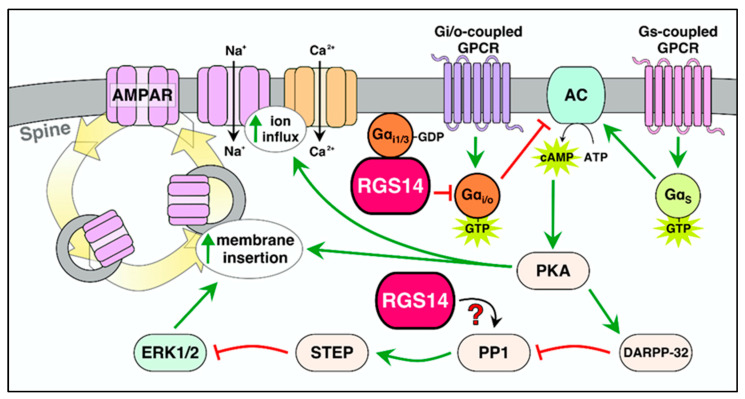
RGS14 modulation of G-protein-dependent signaling. RGS14 accelerates Gαi/o deactivation to limit GPCR–Gi/o signaling and disinhibit the adenylyl cyclase activity and downsteram cAMP signaling. Binding of inactive Gαi1/3–GDP localizes and anchors RGS14 to the plasma membrane, where it is optimally positioned to regulate the initial steps of intracellular post synaptic signal transduction. Likewise, it is possible that RGS14 modulation of GPCR signaling influences plastic processes such as AMPAR trafficking.
Figure 4
Figure 4
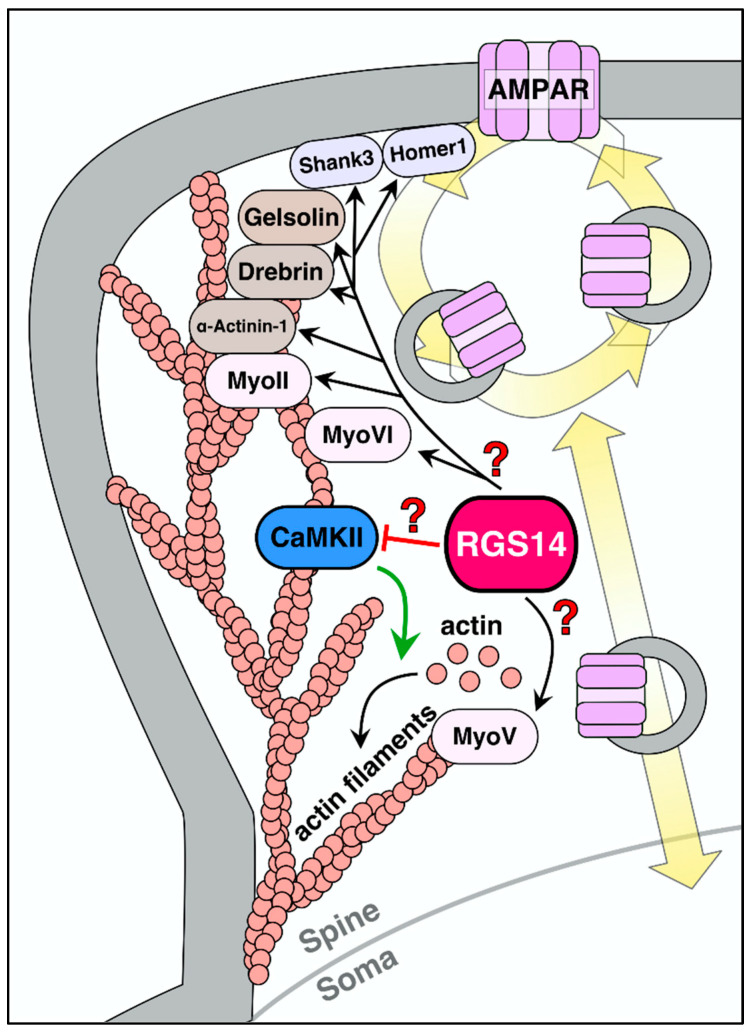
RGS14 potential regulation of dendritic spine morphogenesis. RGS14 exists in the brain as a high molecular weight complex with proteins associated with cytoskeletal architecture and dendritic spine morphogenesis, including actin-binding proteins (α-actinin-1, drebrin, gelsolin), myosins (MyoII, MyoV, MyoVI), and CaMKII. Myosins also mediate AMPAR trafficking between the plasma membrane and the soma. Additionally, human/primate RGS14 could possibly interact with postsynaptic density proteins (e.g., Homer1, Shank3) that link actin cytoskeleton to glutamate receptors and scaffold receptors to key signaling molecules.
Figure 5
Figure 5
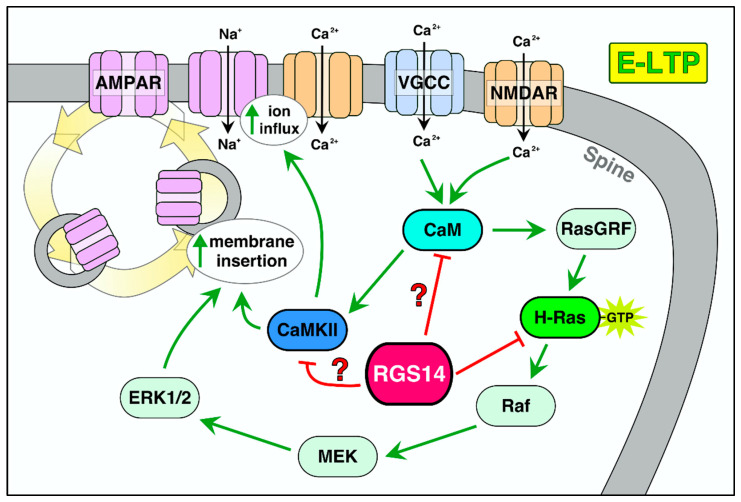
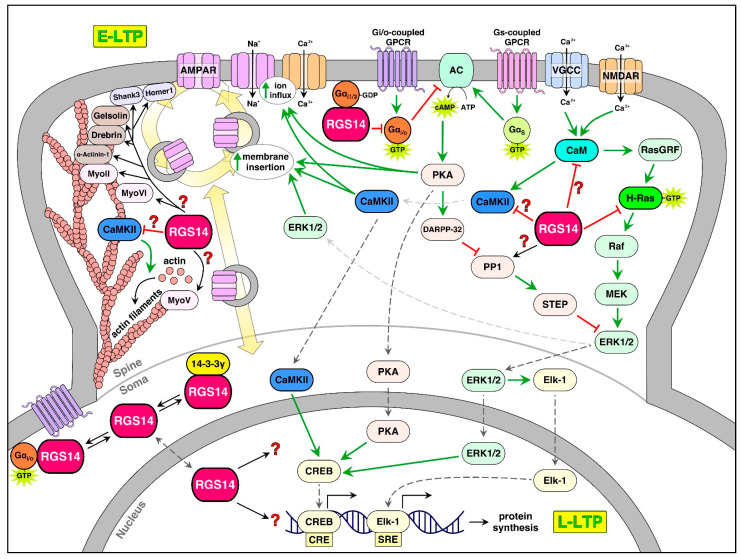
RGS14 regulation of early LTP. RGS14 limits Ca2+ signaling during LTP induction, potentially through direct interaction with Ca2+/CaM and/or CaMKII. RGS14 also directly binds activated H-Ras–GTP and Ca2+/CaM likely to dampen ERK/MAPK signaling. RGS14 inhibition of Ca2+ and MAPK signaling may curtail CaMKII- and ERK1/2-mediatied AMPAR membrane insertion and AMPAR and NMDAR channel potentiation to inhibit early long-term potentiation (E-LTP).
Figure 6
Figure 6
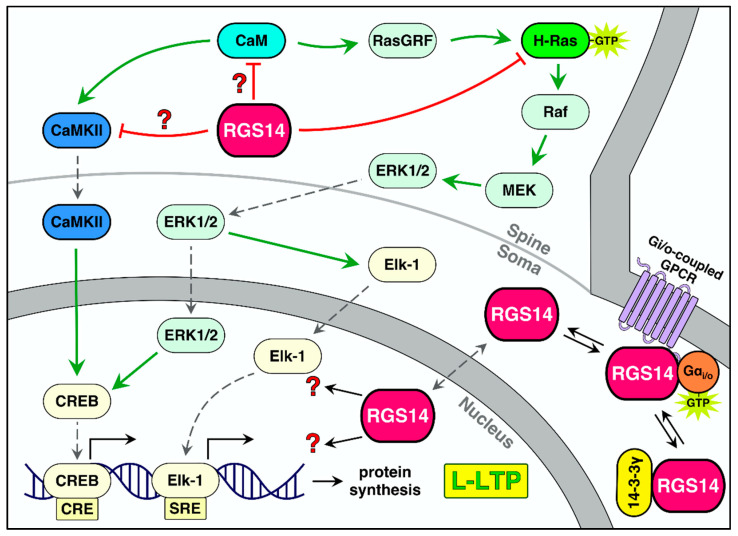
RGS14 regulation of late LTP outside and within the nucleus. RGS14 suppression of Ca2+ and MAPK signaling could potentially curb CaMKII- and/or ERK1/2-stimulated transcription from CRE and SRE sites, which drive expression of proteins that stabilize synaptic strengthening to effect late long-term potentiation (L-LTP). Cytoplasmic RGS14 shuttles in and out of the nucleus. In the nucleus, RGS14 localizes to both chromatin-rich and chromatin-poor subregions. The function of RGS14 in either subregion is not known, but nuclear RGS14 could potentially modulate L-LTP in some manner. The subcellular localization of RGS14 is in a dynamic balance influenced by available binding partners. Gαi/o-bound RGS14 is found at the plasma membrane, while 14-3-3γ binding blocks nuclear import and sequesters RGS14 in the cytoplasm.
Figure 7
Figure 7
RGS14 modulation of postsynaptic signaling and plasticity. RGS14 binds many protein partners, directly or indirectly, to regulate signaling events and plasticity in the post synaptic dendritic spine (top) and in the soma where it shuttles in/out of the nucleus (bottom). Key: green line with arrow = activation (increase if inside bubble), red line with T arrow = inhibition, black line with arrow = interaction or relationship (unspecified directionality), dashed gray line = movement, question mark = unknown or uncertain interaction. This key is also used in Figure 3, Figure 4, Figure 5 and Figure 6.

References

    1. Stewart A., Fisher R.A. Introduction: G Protein-coupled Receptors and RGS Proteins. Prog. Mol. Biol. Transl. Sci. 2015;133:1–11. doi: 10.1016/bs.pmbts.2015.03.002. - DOI - PubMed
    1. Kimple A.J., Bosch D.E., Giguere P.M., Siderovski D.P. Regulators of G-protein signaling and their Gα substrates: Promises and challenges in their use as drug discovery targets. Pharmacol. Rev. 2011;63:728–749. doi: 10.1124/pr.110.003038. - DOI - PMC - PubMed
    1. Hauser A.S., Attwood M.M., Rask-Andersen M., Schioth H.B., Gloriam D.E. Trends in GPCR drug discovery: New agents, targets and indications. Nat. Rev. Drug Discov. 2017;16:829–842. doi: 10.1038/nrd.2017.178. - DOI - PMC - PubMed
    1. Rosenbaum D.M., Rasmussen S.G., Kobilka B.K. The structure and function of G-protein-coupled receptors. Nature. 2009;459:356–363. doi: 10.1038/nature08144. - DOI - PMC - PubMed
    1. Hollinger S., Hepler J.R. Cellular regulation of RGS proteins: Modulators and integrators of G protein signaling. Pharmacol. Rev. 2002;54:527–559. doi: 10.1124/pr.54.3.527. - DOI - PubMed

LinkOut - more resources