


Potency- and Selectivity-Enhancing Mutations of Conotoxins for Nicotinic Acetylcholine Receptors Can Be Predicted Using Accurate Free-Energy Calculations
- PMID: 34202022
- PMCID: PMC8306581
- DOI: 10.3390/md19070367
Potency- and Selectivity-Enhancing Mutations of Conotoxins for Nicotinic Acetylcholine Receptors Can Be Predicted Using Accurate Free-Energy Calculations
Abstract
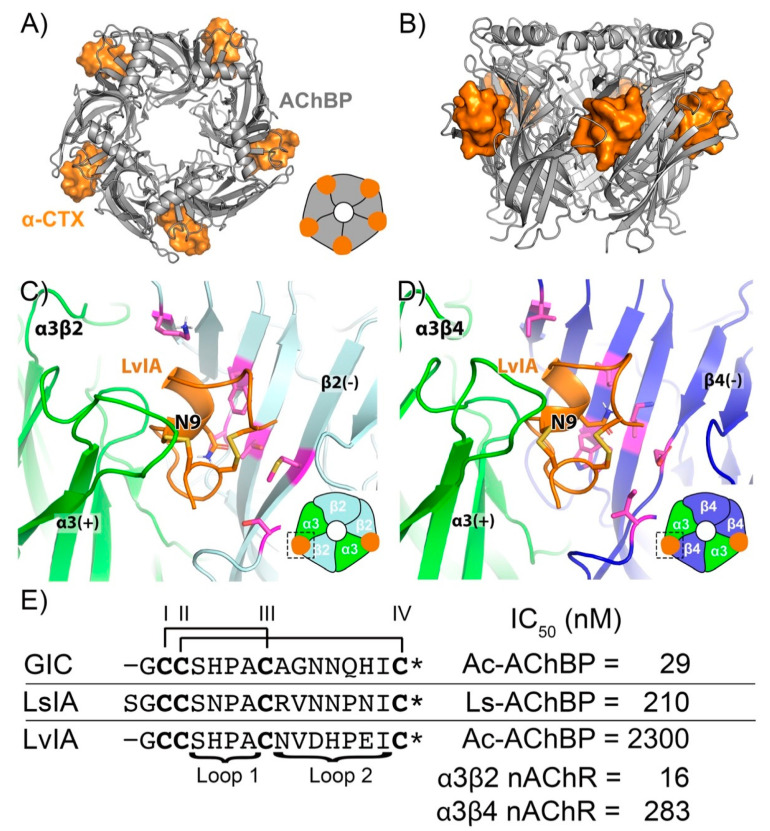
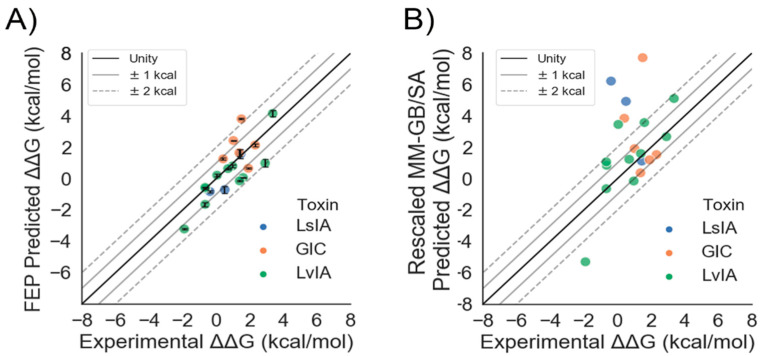
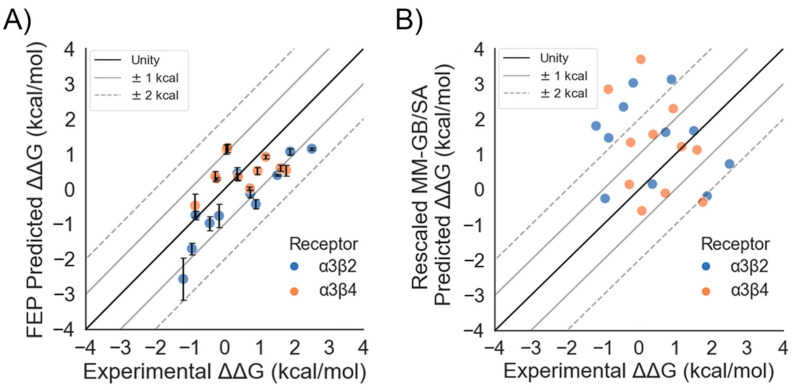
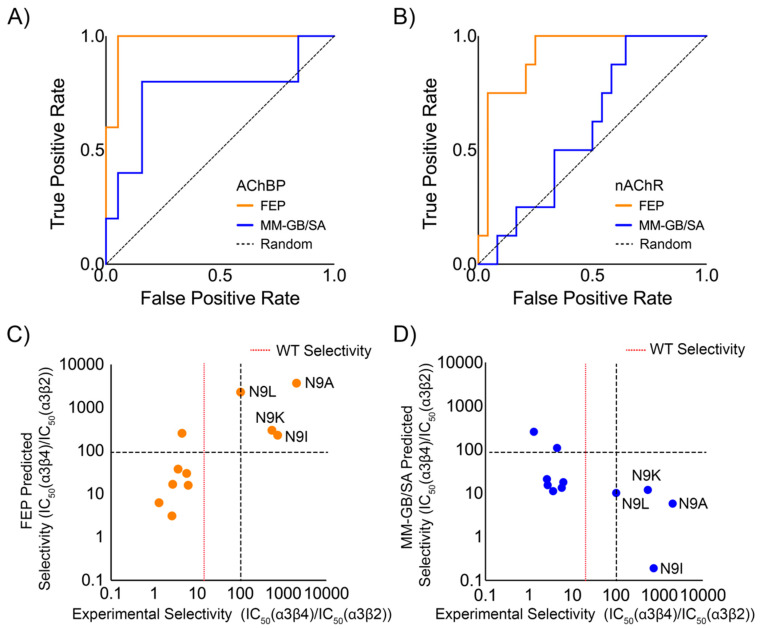
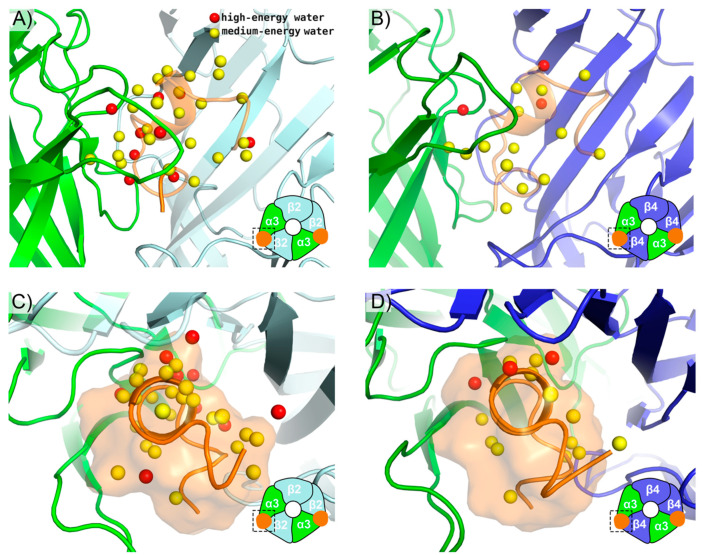
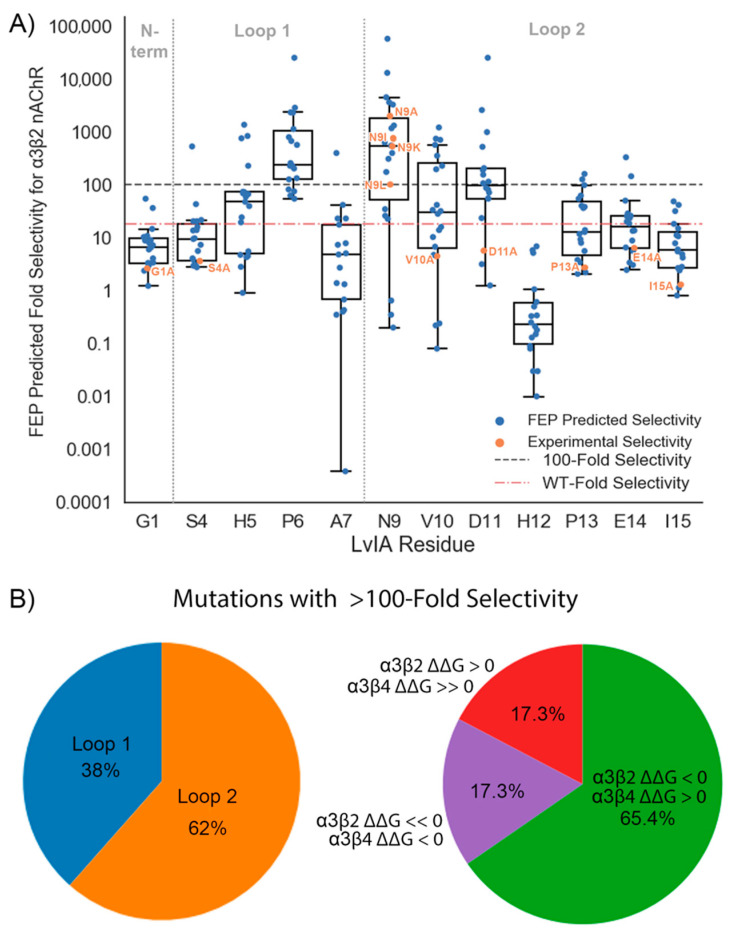
Nicotinic acetylcholine receptor (nAChR) subtypes are key drug targets, but it is challenging to pharmacologically differentiate between them because of their highly similar sequence identities. Furthermore, α-conotoxins (α-CTXs) are naturally selective and competitive antagonists for nAChRs and hold great potential for treating nAChR disorders. Identifying selectivity-enhancing mutations is the chief aim of most α-CTX mutagenesis studies, although doing so with traditional docking methods is difficult due to the lack of α-CTX/nAChR crystal structures. Here, we use homology modeling to predict the structures of α-CTXs bound to two nearly identical nAChR subtypes, α3β2 and α3β4, and use free-energy perturbation (FEP) to re-predict the relative potency and selectivity of α-CTX mutants at these subtypes. First, we use three available crystal structures of the nAChR homologue, acetylcholine-binding protein (AChBP), and re-predict the relative affinities of twenty point mutations made to the α-CTXs LvIA, LsIA, and GIC, with an overall root mean square error (RMSE) of 1.08 ± 0.15 kcal/mol and an R2 of 0.62, equivalent to experimental uncertainty. We then use AChBP as a template for α3β2 and α3β4 nAChR homology models bound to the α-CTX LvIA and re-predict the potencies of eleven point mutations at both subtypes, with an overall RMSE of 0.85 ± 0.08 kcal/mol and an R2 of 0.49. This is significantly better than the widely used molecular mechanics-generalized born/surface area (MM-GB/SA) method, which gives an RMSE of 1.96 ± 0.24 kcal/mol and an R2 of 0.06 on the same test set. Next, we demonstrate that FEP accurately classifies α3β2 nAChR selective LvIA mutants while MM-GB/SA does not. Finally, we use FEP to perform an exhaustive amino acid mutational scan of LvIA and predict fifty-two mutations of LvIA to have greater than 100X selectivity for the α3β2 nAChR. Our results demonstrate the FEP is well-suited to accurately predict potency- and selectivity-enhancing mutations of α-CTXs for nAChRs and to identify alternative strategies for developing selective α-CTXs.
Keywords: conotoxin; free-energy perturbation; nicotinic acetylcholine receptor; selectivity.
Conflict of interest statement
The authors declare no conflict of interest.
Figures
References
-
- Romero H.K., Christensen S.B., Di Cesare Mannelli L., Gajewiak J., Ramachandra R., Elmslie K.S., Vetter D.E., Ghelardini C., Iadonato S.P., Mercado J.L., et al. Inhibition of α9α10 nicotinic acetylcholine receptors prevents chemotherapy-induced neuropathic pain. Proc. Natl. Acad. Sci. USA. 2017;114:E1825–E1832. doi: 10.1073/pnas.1621433114. - DOI - PMC - PubMed
MeSH terms
Substances
LinkOut - more resources
Full Text Sources
