Review
. 2021 Jun 28;22(13):6965.
doi: 10.3390/ijms22136965.

Effects of Dietary n-3 and n-6 Polyunsaturated Fatty Acids in Inflammation and Cancerogenesis

Affiliations
Review

Effects of Dietary n-3 and n-6 Polyunsaturated Fatty Acids in Inflammation and Cancerogenesis

Kamila P Liput et al. Int J Mol Sci. .

Abstract

The dietary recommendation encourages reducing saturated fatty acids (SFA) in diet and replacing them with polyunsaturated fatty acids (PUFAs) n-3 (omega-3) and n-6 (omega-6) to decrease the risk of metabolic disturbances. Consequently, excessive n-6 PUFAs content and high n-6/n-3 ratio are found in Western-type diet. The importance of a dietary n-6/n-3 ratio to prevent chronic diseases is linked with anti-inflammatory functions of linolenic acid (ALA, 18:3n-3) and longer-chain n-3 PUFAs. Thus, this review provides an overview of the role of oxylipins derived from n-3 PUFAs and oxylipins formed from n-6 PUFAs on inflammation. Evidence of PUFAs' role in carcinogenesis was also discussed. In vitro studies, animal cancer models and epidemiological studies demonstrate that these two PUFA groups have different effects on the cell growth, proliferation and progression of neoplastic lesions.

Keywords: PUFA; cancerogenesis; inflammation; omega-3 fatty acids; omega-6 fatty acids; oxylipins.


Conflict of interest statement

The authors declare no conflict of interest.

Figures
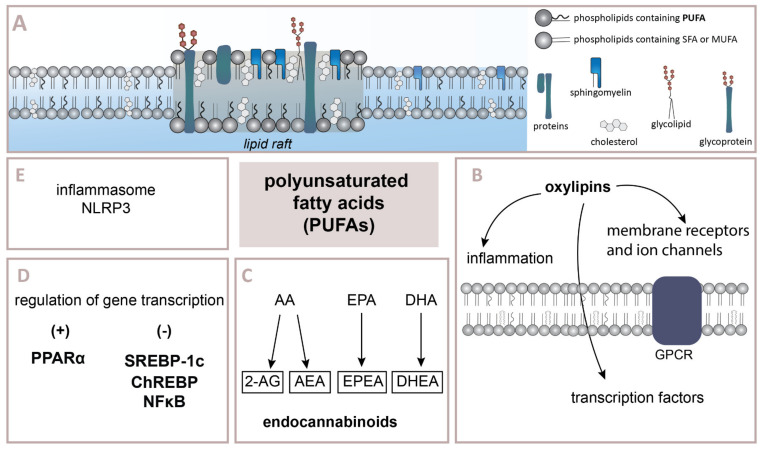
Figure 1
Figure 1
Roles of polyunsaturated fatty acids (PUFAs) in the cell biology: A) PUFAs are components of cell membranes and disk membranes of rod outer segment; B) PUFAs incorporated in phospholipids are sources of oxylipins—the lipid mediators, crucial in inflammation, gene transcription regulation and influence membrane G Protein-coupled receptors (GPCR) and ion channels; C) Endocannabinoids 2-arachidonoylglycerol (2-AG), anandamide (AEA), eicosapentaenoyl ethanolamide (EPEA) and docosahexanoyl ethanolamide (DHEA) derived from arachidonic acid (AA), eicosapentaenoic acid (EPA), docosahexaenoic acid (DHA), respectively, affect inflammation; D) PUFAs control gene transcription through regulation of transcription factors such as peroxisome proliferator-activated receptor α (PPARα) and sterol regulatory element binding protein-1c (SREBP-1c), carbohydrate-response element-binding protein (ChREBP), nuclear factor-κB (NFκB); E) N–3 PUFAs attenuate NLRP3 inflammasome activation. References: [60,61].
Figure 2
Figure 2
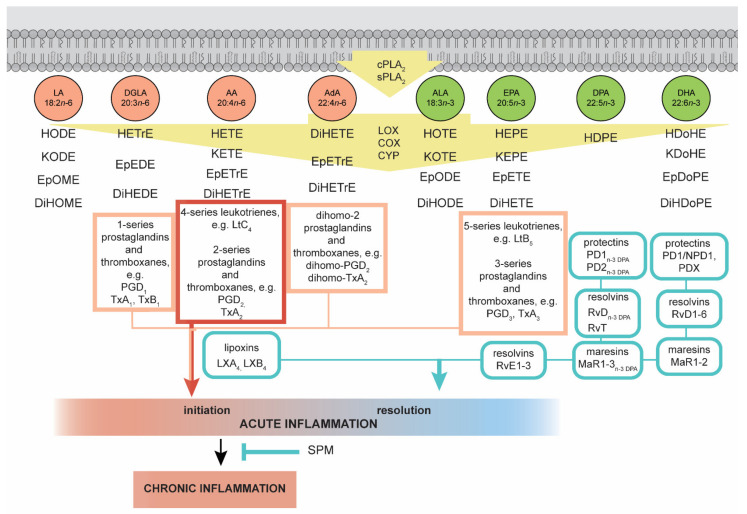
Lipid mediators enzymatically derived from n–3 and n–6 polyunsaturated fatty acids (PUFAs) and their role in inflammation. Acute inflammation response consists of three stages: initiation, development and resolution. In case of acute inflammation can lead to chronic inflammation. Polyunsaturated fatty acids released from phospholipids by cytosolic phospholipase A2 (cPLA2) and secreted phospholipase A2 (sPLA2) are converted by lipoxygenases (LOX), cyclooxygenases (COX) and cytochrome P450 (CYP) enzymes into bioactive oxylipins that act on inflammation. Specialized pro-resolving mediators (SPMs) can prevent the development of chronic inflammation. AA-derived oxylipins, such as prostaglandins, leukotrienes and thromboxanes, have pro-inflammatory proprieties. DGLA, AdA and EPA are precursors for less pro-inflammatory oxylipins. Major SPMs are synthesized from n–3 PUFAs. The blue marking indicates pro-resolving oxylipins. The red marking denotes pro-inflammatory lipid mediators. References: [67,72,73,79,80,81,82].
Figure 3
Figure 3
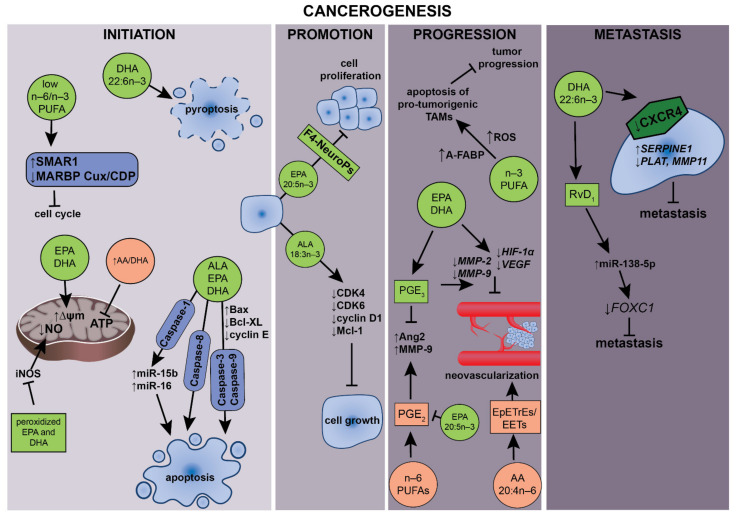
The effects of PUFAs related to the steps involved in the carcinogenic process. In the first stage of carcinogenesis, initiation: PUFAs regulate reactive oxygen species generation; EPA and DHA increase mitochondrial membrane potential (ΔΨm); Peroxidized EPA and DHA suppress iNOS followed by nitric oxide (NO) production; The increased AA to DHA ratio inhibits ATP production. In the second stage, n–3 PUFAs, including ALA, EPA and its derivatives such as F4-Neuroprostanes (F4-NeuroPs), are able to inhibit cancer cell growth and proliferation. During the progression stage: n–3 PUFAs and PGE3 influence tumor progression by inhibiting neovascularization by decreasing MMP, HIF-1α, VEGF and Ang2. Moreover, n–3 PUFAs are able to inhibit tumor progression through ROS-dependent apoptosis of pro-tumorigenic tumor-associated macrophages (TAMs). On the other hand, the n–6 PUFAs derivative, PGE2, increases Ang2 and metaloproteinaase-9 (MMP-9) expression, followed by inducing angiogenesis. Metastasis is also regulated by PUFAs by inducing apoptosis and pyroptosis by caspase pathway activation. The specialized pro-resolving mediator, RvD1, is able to inhibit metastasis.

References

    1. Nelson R.H. Hyperlipidemia as a Risk Factor for Cardiovascular Disease. Prim. Care Clin. Off. Pr. 2013;40:195–211. doi: 10.1016/j.pop.2012.11.003. - DOI - PMC - PubMed
    1. WHO . Noncommunicable Diseases Country Profiles 2018. WHO; Geneva, Switzerland: 2018.
    1. Lenighan Y.M., McNulty B.A., Roche H.M. Dietary fat composition: Replacement of saturated fatty acids with PUFA as a public health strategy, with an emphasis on α-linolenic acid. Proc. Nutr. Soc. 2019;78:234–245. doi: 10.1017/S0029665118002793. - DOI - PubMed
    1. Health.gov. U.S. Department of Health and Human Services. U.S. Department of Agriculture 2015–2020 Dietary Guidelines for Americans. [(accessed on 27 June 2021)]; Available online: https://health.gov/dietaryguidelines/2015/guidelines/
    1. Eilander A., Harika R.K., Zock P. Intake and sources of dietary fatty acids in Europe: Are current population intakes of fats aligned with dietary recommendations? Eur. J. Lipid Sci. Technol. 2015;117:1370–1377. doi: 10.1002/ejlt.201400513. - DOI - PMC - PubMed

LinkOut - more resources