Review
. 2021 Jun 15;22(12):6381.
doi: 10.3390/ijms22126381.

Potential of Naturally Derived Compounds in Telomerase and Telomere Modulation in Skin Senescence and Aging

Affiliations
Review

Potential of Naturally Derived Compounds in Telomerase and Telomere Modulation in Skin Senescence and Aging

Barbara Jacczak et al. Int J Mol Sci. .

Abstract

Proper functioning of cells-their ability to divide, differentiate, and regenerate-is dictated by genomic stability. The main factors contributing to this stability are the telomeric ends that cap chromosomes. Telomere biology and telomerase activity have been of interest to scientists in various medical science fields for years, including the study of both cancer and of senescence and aging. All these processes are accompanied by telomere-length modulation. Maintaining the key levels of telomerase component (hTERT) expression and telomerase activity that provide optimal telomere length as well as some nontelomeric functions represents a promising step in advanced anti-aging strategies, especially in dermocosmetics. Some known naturally derived compounds contribute significantly to telomere and telomerase metabolism. However, before they can be safely used, it is necessary to assess their mechanisms of action and potential side effects. This paper focuses on the metabolic potential of natural compounds to modulate telomerase and telomere biology and thus prevent senescence and skin aging.

Keywords: antioxidants; natural compounds; senescence; skin aging; telomerase; telomeres.


Conflict of interest statement

The authors declare no conflict of interest.

Figures
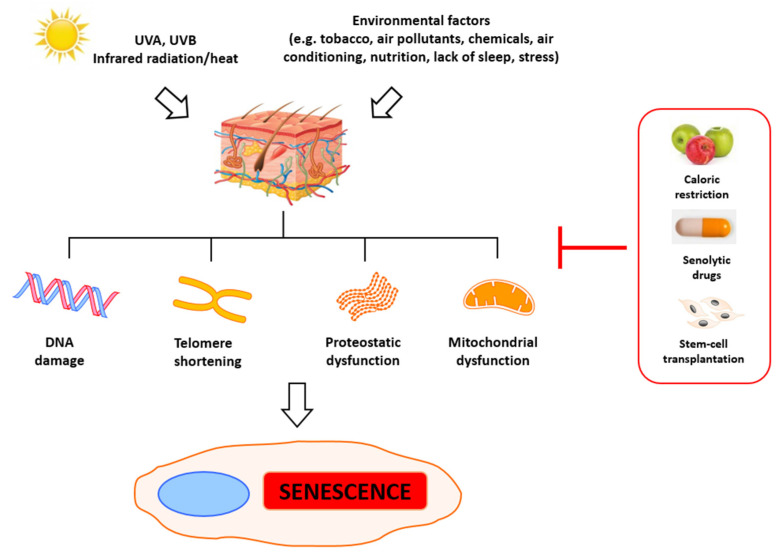
Figure 1
Figure 1
Key senescence drivers. Physical, chemical, and biological factors (e.g., tobacco, air pollution, chemicals, air conditioning, nutrition, sleep deprivation, stress, heat, UVA, and UVB) induce DNA damage, telomere erosion, oxidative stress, and proteostatic dysfunction, and consequently lead to cell senescence. Caloric restriction, senolytic drugs, and stem-cell transplantation constitute promising antisenescence strategies.
Figure 2
Figure 2
The layers of human skin. The general structure of the skin involves the epidermis (telomerase positive), dermis (telomerase low/negative), and hypodermis (telomerase low/negative). (Figure obtained from https://biorender.com).
Figure 3
Figure 3
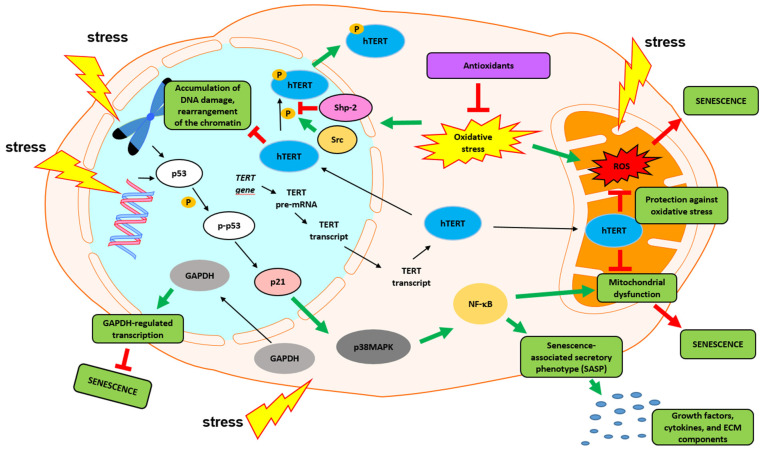
Contribution of hTERT to metabolic pathways under stress. The senescence program can be activated by different stress stimuli, such as infrared radiation, UVA, UVB, heat, chemotherapeutic drugs, replicative stress, and environmental factors, e.g., tobacco, air pollutants, chemicals, and nutrition. The main molecular effects triggered by this process are anti-apoptotic response, cell-cycle arrest, metabolic changes in mitochondria, accumulation of DNA damage, and rearrangement of the chromatin. In response to changes in the nucleus, most of the senescent cells induce the p53/p21/p38MAPK/NF-κB signaling pathway. Consequently, senescence-associated secretory phenotype (SASP) is activated and numerous growth factors, cytokines, and ECM components (e.g., EGF, IL1, IL6, MMP2, MMP3) are secreted. All of these elements play an important role in autocrine and/or paracrine signaling. Under stress conditions, hTERT is distributed between the nucleus, the cytoplasm, and the mitochondria, and plays protective roles in these organelles. In the nucleus, hTERT is required to maintain telomeres and genomic stability. It can also affect chromatin structure and modulate the DNA damage response. hTERT protects mitochondria from oxidative stress (and DNA damage) by decreasing ROS levels and binding to mitochondrial DNA (mtDNA).

References

    1. Quan C., Cho M.K., Perry D., Quan T. Age-associated reduction of cell spreading induces mitochondrial DNA common deletion by oxidative stress in human skin dermal fibroblasts: Implication for human skin connective tissue aging. J. Biomed. Sci. 2015;22:62. doi: 10.1186/s12929-015-0167-6. - DOI - PMC - PubMed
    1. De Lange T. Shelterin-Mediated Telomere Protection. Annu. Rev. Genet. 2018;52:223–247. doi: 10.1146/annurev-genet-032918-021921. - DOI - PubMed
    1. Shay J.W., Wright W.E. Telomeres and telomerase: Three decades of progress. Nat. Rev. Genet. 2019;20:299–309. doi: 10.1038/s41576-019-0099-1. - DOI - PubMed
    1. Attia E.A.S., Seada L.S., El-Sayed M.H., El-Shiemy S.M. Study of telomerase reverse transcriptase (hTERT) expression in normal, aged, and photo-aged skin. Int. J. Dermatol. 2010;49:886–893. doi: 10.1111/j.1365-4632.2009.04374.x. - DOI - PubMed
    1. Liu J.-P., Wang L., Wang Z. Roles of Telomere Biology in Cell Senescence, Replicative and Chronological Ageing. Cells. 2019;8:54. doi: 10.3390/cells8010054. - DOI - PMC - PubMed