


Dietary Patterns in Early Childhood and the Risk of Childhood Overweight: The GECKO Drenthe Birth Cohort
- PMID: 34203797
- PMCID: PMC8232591
- DOI: 10.3390/nu13062046
Dietary Patterns in Early Childhood and the Risk of Childhood Overweight: The GECKO Drenthe Birth Cohort
Abstract
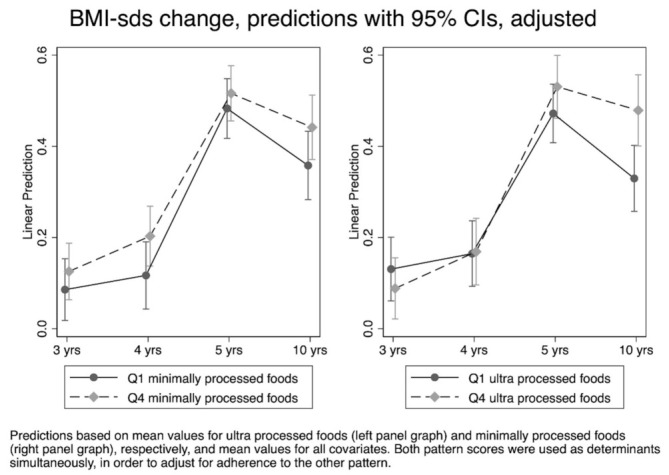
Limited and inconsistent evidence exists on the associations between dietary patterns and overweight during childhood. The present study describes dietary patterns of three-year-old Dutch children and associations between childhood overweight and body mass index (BMI) development between 3 and 10 years. In the GECKO Drenthe birth cohort (N = 1306), body height and weight were measured around the age of 3, 4, 5, and 10 years, and overweight was defined according to Cole and Lobstein. A validated food frequency questionnaire (FFQ) was used to measure diet at 3 years. Dietary patterns were derived using principal components analysis (PCA). Using logistic regression analyses, pattern scores were related to overweight at 3 and 10 years. A linear mixed-effect model was used to estimate BMI-SDS development between 3 to 10 years according to quartiles of adherence to the pattern scores. Two dietary patterns were identified: (1) 'minimally processed foods', indicating high intakes of vegetables/sauces/savory dishes, and (2) 'ultra-processed foods', indicating high intakes of white bread/crisps/sugary drinks. A 1 SD increase in the 'ultra-processed foods' pattern score increased the odds of overweight at 10 years (adjusted OR: 1.30; 95%CI: 1.08, 1.57; p = 0.006). The 'minimally processed foods' pattern was not associated with overweight. Although a high adherence to both dietary patterns was associated with a higher BMI-SDS up to 10 years of age, a stronger association for the 'ultra-processed foods' pattern was observed (p < 0.001). A dietary pattern high in energy-dense and low-fiber ultra-processed foods at 3 years is associated with overweight and a high BMI-SDS later in childhood.
Keywords: childhood; diet; dietary pattern; overweight.
Conflict of interest statement
O.S. and M.A-B. are employees of Danone Nutricia Research. The other authors declare no conflict of interest.
Figures
References
MeSH terms
LinkOut - more resources
Full Text Sources
Medical
