


Benefits of Ginger and Its Constituent 6-Shogaol in Inhibiting Inflammatory Processes
- PMID: 34203813
- PMCID: PMC8232759
- DOI: 10.3390/ph14060571
Benefits of Ginger and Its Constituent 6-Shogaol in Inhibiting Inflammatory Processes
Abstract
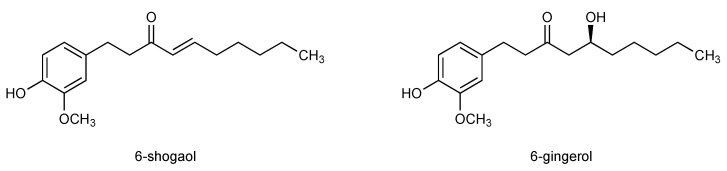
Ginger (Zingiber officinale Roscoe) is widely used as medicinal plant. According to the Committee on Herbal Medicinal Products (HMPC), dried powdered ginger rhizome can be applied for the prevention of nausea and vomiting in motion sickness (well-established use). Beyond this, a plethora of pre-clinical studies demonstrated anti-cancer, anti-oxidative, or anti-inflammatory actions. 6-Shogaol is formed from 6-gingerol by dehydration and represents one of the main bioactive principles in dried ginger rhizomes. 6-Shogaol is characterized by a Michael acceptor moiety being reactive with nucleophiles. This review intends to compile important findings on the actions of 6-shogaol as an anti-inflammatory compound: in vivo, 6-shogaol inhibited leukocyte infiltration into inflamed tissue accompanied with reduction of edema swelling. In vitro and in vivo, 6-shogaol reduced inflammatory mediator systems such as COX-2 or iNOS, affected NFκB and MAPK signaling, and increased levels of cytoprotective HO-1. Interestingly, certain in vitro studies provided deeper mechanistic insights demonstrating the involvement of PPAR-γ, JNK/Nrf2, p38/HO-1, and NFκB in the anti-inflammatory actions of the compound. Although these studies provide promising evidence that 6-shogaol can be classified as an anti-inflammatory substance, the exact mechanism of action remains to be elucidated. Moreover, conclusive clinical data for anti-inflammatory actions of 6-shogaol are largely lacking.
Keywords: 6-shogaol; Zingiber officinale Roscoe; extract; inflammation.
Conflict of interest statement
The authors declare no conflict of interest. The funders had no role in the design of the study; in the collection, analyses, or interpretation of data; in the writing of the manuscript, or in the decision to publish the results.
Figures
References
-
- Bode A.M., Dong Z. The amazing and mighty ginger. In: Benzie I.F.F., Wachtel-Galor S., editors. Herbal Medicine: Biomolecular and Clinical Aspects. 2nd ed. CRC Press; Boca Raton, FL, USA: 2011. - PubMed
-
- Assessment Report on Zingiber Officinale Roscoe. [(accessed on 26 May 2021)]; Available online: https://www.ema.europa.eu/en/documents/herbal-report/draft-assessment-re....
Publication types
Grants and funding
LinkOut - more resources
Full Text Sources
Research Materials
