


Finding a Balance in the Vaginal Microbiome: How Do We Treat and Prevent the Occurrence of Bacterial Vaginosis?
- PMID: 34203908
- PMCID: PMC8232816
- DOI: 10.3390/antibiotics10060719
Finding a Balance in the Vaginal Microbiome: How Do We Treat and Prevent the Occurrence of Bacterial Vaginosis?
Abstract
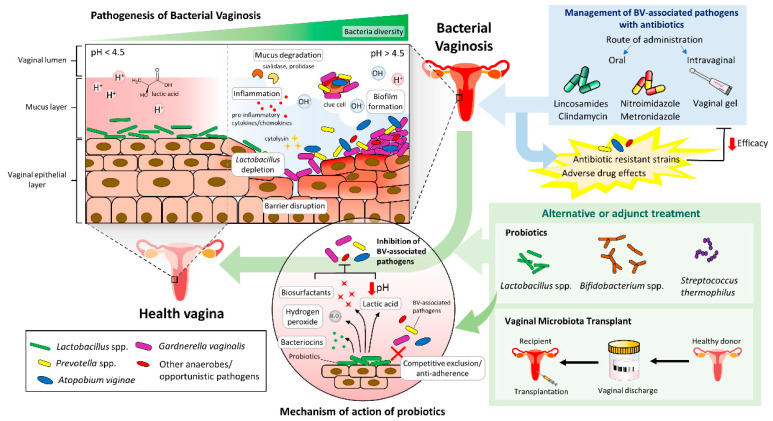
Bacterial vaginosis (BV) has been reported in one-third of women worldwide at different life stages, due to the complex balance in the ecology of the vaginal microbiota. It is a common cause of abnormal vaginal discharge and is associated with other health issues. Since the first description of anaerobic microbes associated with BV like Gardnerella vaginalis in the 1950s, researchers have stepped up the game by incorporating advanced molecular tools to monitor and evaluate the extent of dysbiosis within the vaginal microbiome, particularly on how specific microbial population changes compared to a healthy state. Moreover, treatment failure and BV recurrence rate remain high despite the standard antibiotic treatment. Consequently, researchers have been probing into alternative or adjunct treatments, including probiotics or even vaginal microbiota transplants, to ensure successful treatment outcomes and reduce the colonization by pathogenic microbes of the female reproductive tract. The current review summarizes the latest findings in probiotics use for BV and explores the potential of vaginal microbiota transplants in restoring vaginal health.
Keywords: Gardnerella; Lactobacillus; VMT; bacterial vaginosis; microbiome; probiotics.
Conflict of interest statement
The authors declare no conflict of interest.
Figures
References
-
- Dominguez-Bello M.G., Costello E.K., Contreras M., Magris M., Hidalgo G., Fierer N., Knight R. Delivery mode shapes the acquisition and structure of the initial microbiota across multiple body habitats in newborns. Proc. Natl. Acad. Sci. USA. 2010;107:11971–11975. doi: 10.1073/pnas.1002601107. - DOI - PMC - PubMed
-
- Lau A.W.Y., Tan L.T.-H., Ab Mutalib N.-S., Wong S.H., Letchumanan V., Lee L.-H. The chemistry of gut microbiome in health and diseases. Prog. Microbes Mol. Biol. 2021;4:a0000175. doi: 10.36877/pmmb.a0000175. - DOI
Publication types
Grants and funding
LinkOut - more resources
Full Text Sources
