


Current Status of Rabies and Its Eradication in Eastern and Southeastern Europe
- PMID: 34204652
- PMCID: PMC8231232
- DOI: 10.3390/pathogens10060742
Current Status of Rabies and Its Eradication in Eastern and Southeastern Europe
Abstract
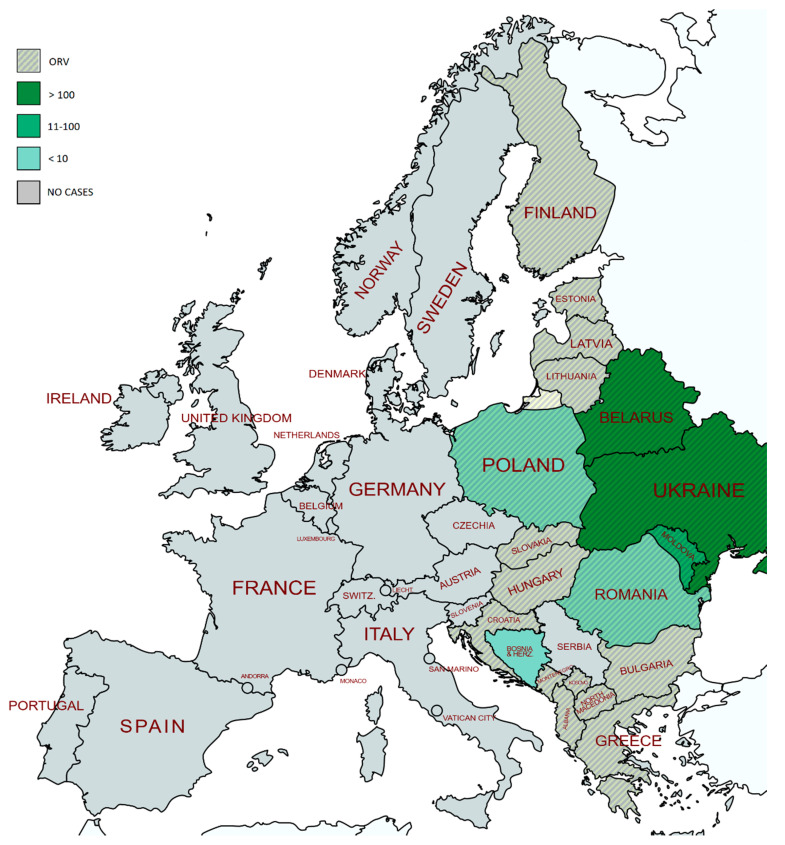
The objective of this paper is to provide an overview of the current status of rabies in Europe, with special emphasis on Croatia and Southeast and East Europe. Due to the systematic implementation of a rabies eradication program by oral vaccination of wild animals, by the end of the 20th century, most West and Central European countries were rabies-free. The EU goal was to eradicate rabies in wildlife and domestic animals by 2020. No matter how achievable the goal seemed to be, the disease is still present in the eastern part of the EU, as was notified in 2020 by two member states-Poland and Romania. Croatia has been rabies-free for the last seven years but given that it borders a non-EU country in which a case of rabies was confirmed in 2020, it will continue to contribute to the maintenance of the rabies-free region. A rabies-free EU can only be achieved by continuous oral vaccination, coordination and a regional approach. The prevention of reintroductions from bordering countries in which rabies has not been eradicated yet, and the support for the eradication efforts made by these countries, are goals still pending.
Keywords: Croatia; Southeast Europe; bat rabies; oral rabies vaccination (ORV); sylvatic rabies.
Conflict of interest statement
The authors declare no conflict of interest.
Figures

References
-
- WHO/Department of Control of Neglected Tropical Diseases Zero by 30: The Global Strategic Plan to End Human Deaths from Dog-Mediated Rabies by 2030. [(accessed on 28 May 2020)];2018 Available online: http://www.who.int/rabies/resources/9789241513838/en/
-
- European Commission (EC) Overview on Current EU Situation in Relation to EU Co-Funded Veterinary Programmes and Proposals as Regards Founding Priorities for 2018–2020. European Commission; Brussels, Belgium: 2016. p. 31.
-
- Aubert M.F.A., Cliquet F., Smak J.A., Brochier B., Schon J., Kappeler A., King A.A., Fooks A.R., Wandeler A.I. Rabies in France, the Netherlands, Belgium, Luxembourg and Switzerland. In: King A., Fooks A.R., Aubert M., Wandeler A.I., editors. Historical Perspective of Rabies in Europe and the Mediterranean Basin. O.I.E.; Paris, France: 2004. pp. 129–145.
Publication types
LinkOut - more resources
Full Text Sources
