Review
. 2021 Jun 3;11(6):521.
doi: 10.3390/life11060521.

Altered Bone Status in Rett Syndrome

Affiliations
Review

Altered Bone Status in Rett Syndrome

Alessandra Pecorelli et al. Life (Basel). .

Abstract

Rett syndrome (RTT) is a monogenic neurodevelopmental disorder primarily caused by mutations in X-linked MECP2 gene, encoding for methyl-CpG binding protein 2 (MeCP2), a multifaceted modulator of gene expression and chromatin organization. Based on the type of mutation, RTT patients exhibit a broad spectrum of clinical phenotypes with various degrees of severity. In addition, as a complex multisystem disease, RTT shows several clinical manifestations ranging from neurological to non-neurological symptoms. The most common non-neurological comorbidities include, among others, orthopedic complications, mainly scoliosis but also early osteopenia/osteoporosis and a high frequency of fractures. A characteristic low bone mineral density dependent on a slow rate of bone formation due to dysfunctional osteoblast activity rather than an increase in bone resorption is at the root of these complications. Evidence from human and animal studies supports the idea that MECP2 mutation could be associated with altered epigenetic regulation of bone-related factors and signaling pathways, including SFRP4/WNT/β-catenin axis and RANKL/RANK/OPG system. More research is needed to better understand the role of MeCP2 in bone homeostasis. Indeed, uncovering the molecular mechanisms underlying RTT bone problems could reveal new potential pharmacological targets for the treatment of these complications that adversely affect the quality of life of RTT patients for whom the only therapeutic approaches currently available include bisphosphonates, dietary supplements, and physical activity.

Keywords: MeCP2; WNT pathway; bone metabolism; bone mineral density; osteoblast.


Conflict of interest statement

The authors declare no conflict of interest.

Figures
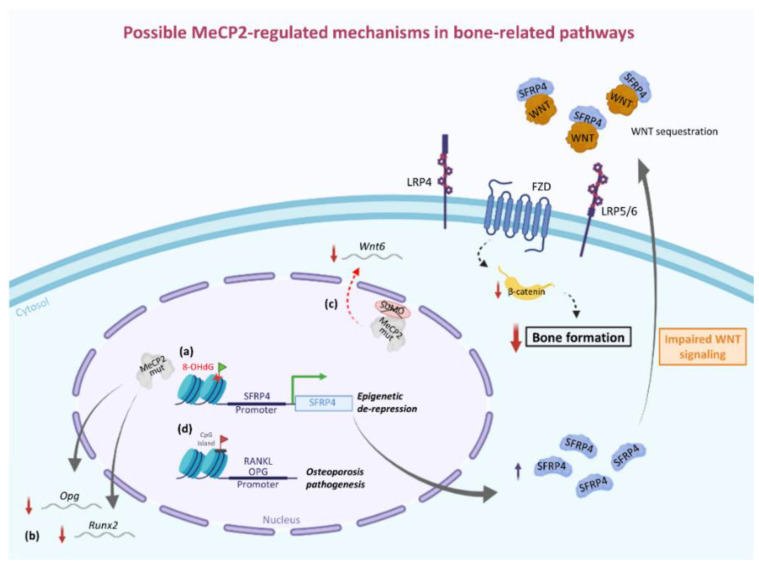
Figure 1
Figure 1
Possible insights on MeCP2 epigenetic regulation in bone-related pathways. During the canonical WNT signaling pathway, WNT ligands interact with FZD receptors and LRP co-receptors, activating the canonical WNT/β-catenin signaling cascade and leading to the transcription of WNT-responsive genes and to bone formation. SFRP4, an inhibitor of the WNT/β-catenin cascade, is epigenetically repressed by MeCP2. Thus, loss of MeCP2 or the presence of 8-OHdG-mutated nucleotide in CpG islands adjacent to the SFRP4 promoter region may induce an epigenetic de-repression of the SFRP4 gene, with consequent impairment of WNT signaling and reduction in bone formation (a). MeCP2 loss is even involved in gene downregulation of Runx2 (an essential factor for osteoblast differentiation and a direct target of canonical WNT pathway) and Opg (an important element in bone metabolism) (b). Decreased levels of MeCP2 SUMOylation, an important post-translational modification, are related to reduced Wnt6 mRNA levels (c). Then, an altered methylation status of CpG island (indicated with red flag) in the promoter region of Opg and Rankl genes has been shown to be implicated in osteoporosis pathogenesis (d). MeCP2 mut, mutated methyl-CpG binding protein 2; MeCP2 WT, wild-type methyl-CpG binding protein 2; FZD, family of frizzled receptors; LRP, low-density lipoprotein receptor-related proteins; SFRP, secreted frizzle-related protein; Runx2, Runt-related transcription factor 2; OPG, osteoprotegerin; RANKL, RANK ligand.

References

    1. Leonard H., Bower C., English D. The Prevalence and Incidence of Rett Syndrome in Australia. Eur. Child Adolesc. Psychiatry. 1997;6:8–10. - PubMed
    1. Laurvick C.L., de Klerk N., Bower C., Christodoulou J., Ravine D., Ellaway C., Williamson S., Leonard H. Rett Syndrome in Australia: A Review of the Epidemiology. J. Pediatr. 2006;148:347–352. doi: 10.1016/j.jpeds.2005.10.037. - DOI - PubMed
    1. Wong V.C.N., Li S.Y.H. Rett Syndrome: Prevalence among Chinese and a Comparison of MECP2 Mutations of Classic Rett Syndrome with Other Neurodevelopmental Disorders. J. Child Neurol. 2007;22:1397–1400. doi: 10.1177/0883073807307091. - DOI - PubMed
    1. Fehr S., Bebbington A., Nassar N., Downs J., Ronen G.M., de Klerk N., Leonard H. Trends in the Diagnosis of Rett Syndrome in Australia. Pediatr. Res. 2011;70:313–319. doi: 10.1203/PDR.0b013e3182242461. - DOI - PMC - PubMed
    1. Anderson A., Wong K., Jacoby P., Downs J., Leonard H. Twenty Years of Surveillance in Rett Syndrome: What Does This Tell Us? Orphanet J. Rare Dis. 2014;9:87. doi: 10.1186/1750-1172-9-87. - DOI - PMC - PubMed

LinkOut - more resources
