


Degradation of Polyvinyl Alcohol in US Wastewater Treatment Plants and Subsequent Nationwide Emission Estimate
- PMID: 34205161
- PMCID: PMC8199957
- DOI: 10.3390/ijerph18116027
Degradation of Polyvinyl Alcohol in US Wastewater Treatment Plants and Subsequent Nationwide Emission Estimate
Abstract
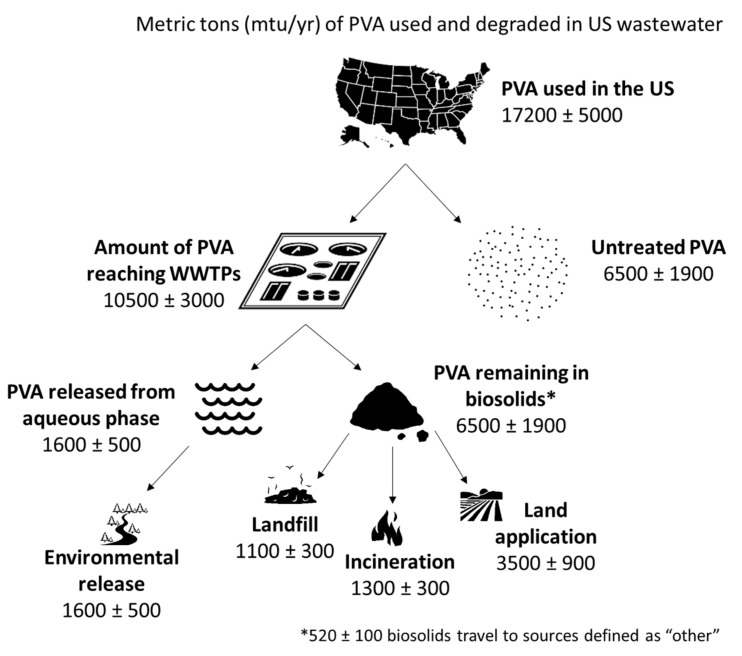
Polyvinyl alcohol (PVA) is a water-soluble plastic commercially used in laundry and dish detergent pods (LDPs) for which a complete understanding of its fate in the environment and subsequent consequences is lacking. The objective of this study was to estimate the US nationwide emissions of PVA resulting from domestic use of LDPs, corroborated by a nationwide, online consumer survey and a literature review of its fate within conventional wastewater treatment plants (WWTPs). Peer-reviewed publications focusing on the degradation of PVA in critical processes of WWTPs were shortlisted as a part of the literature review, and subsequent degradation data was extracted and applied to a model with a set of assumptions. Survey and model results estimated that approximately 17,200 ± 5000 metric ton units per year (mtu/yr) of PVA are used from LDPs in the US, with 10,500 ± 3000 mtu/yr reaching WWTPs. Literature review data, when incorporated into our model, resulted in ~61% of PVA ending up in the environment via the sludge route and ~15.7% via the aqueous phase. PVA presence in the environment, regardless of its matrix, is a threat to the ecosystem due to the potential mobilization of heavy metals and other hydrophilic contaminants.
Keywords: biodegradation; dish detergent; laundry; mass loads; microbes; polyvinyl alcohol; wastewater.
Conflict of interest statement
The funders had no role in the design of the study; collection, analyses, or interpretation of data; writing of the manuscript; or decision to publish the results.
Figures
References
-
- Xu S., Malik M.A., Qi Z., Huang B., Li Q., Sarkar M. Influence of the PVA fibers and SiO2 NPs on the structural properties of fly ash based sustainable geopolymer. Constr. Build. Mater. 2018;164:238–245. doi: 10.1016/j.conbuildmat.2017.12.227. - DOI
-
- GlobeNewsWire . Polyvinyl Alcohol (PVA) Market Size Worth $1.76 Bn by 2023 Witnessing a CAGR of 4.09% during 2018 to 2023—Market Research Future. GlobeNewsWire; Los Angeles, CA, USA: 2018.
Publication types
MeSH terms
Substances
LinkOut - more resources
Full Text Sources
Other Literature Sources
Miscellaneous
