


Wide Genetic Diversity of Blastocystis in White-Tailed Deer (Odocoileus virginianus) from Maryland, USA
- PMID: 34205799
- PMCID: PMC8233720
- DOI: 10.3390/microorganisms9061343
Wide Genetic Diversity of Blastocystis in White-Tailed Deer (Odocoileus virginianus) from Maryland, USA
Abstract
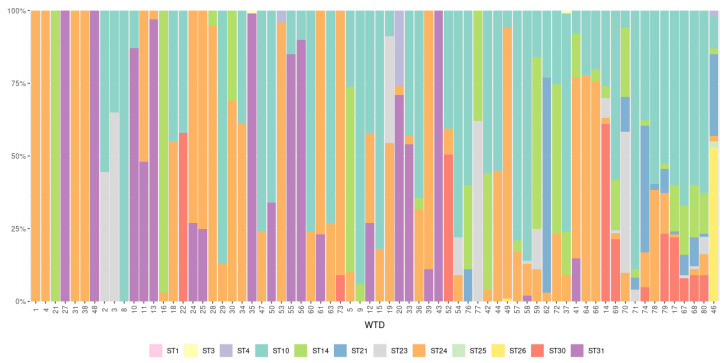
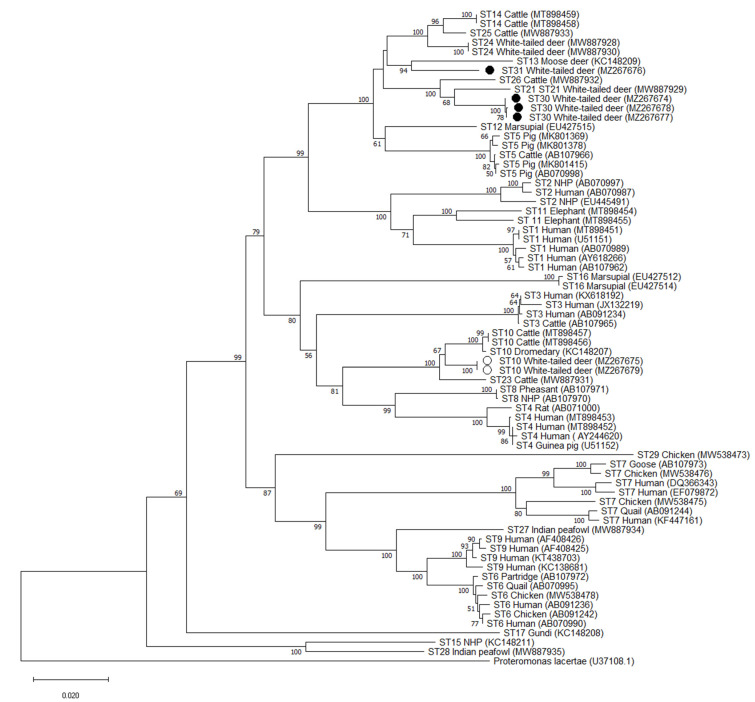
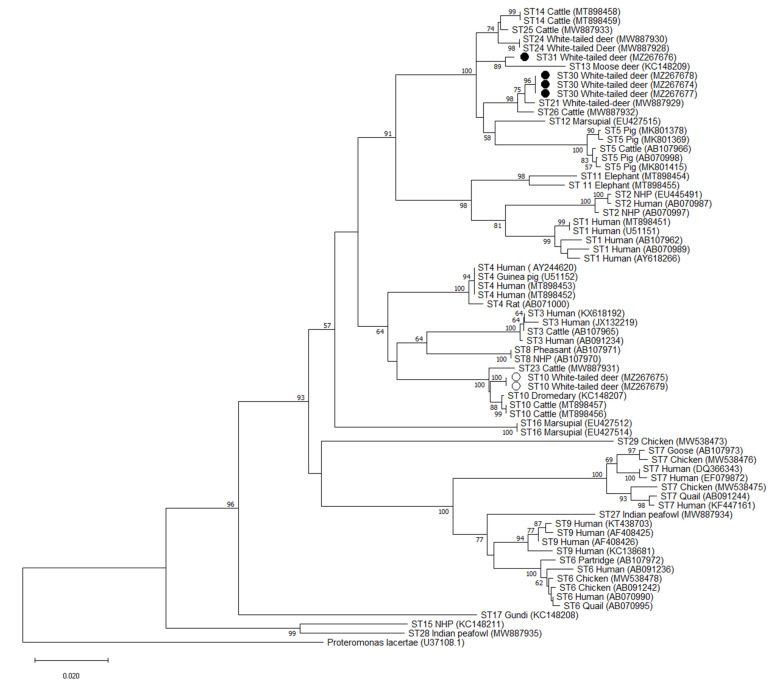
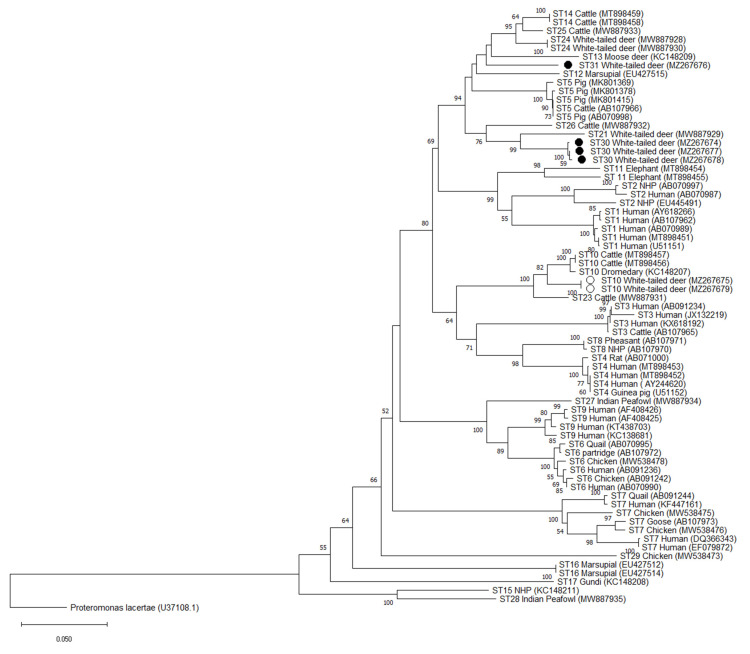
Blastocystis is a gastrointestinal protist frequently reported in humans and animals worldwide. Wildlife populations, including deer, may serve as reservoirs of parasitic diseases for both humans and domestic animals, either through direct contact or through contamination of food or water resources. However, no studies of the occurrence and subtype distribution of Blastocystis in wildlife populations have been conducted in the United States. PCR and next generation amplicon sequencing were used to determine the occurrence and subtypes of Blastocystis in white-tailed deer (Odocoileus virginianus). Blastocystis was common, with 88.8% (71/80) of samples found to be positive. Twelve subtypes were identified, ten previously reported (ST1, ST3, ST4, ST10, ST14, ST21, and ST23-ST26) and two novel subtypes (ST30 and ST31). To confirm the validity of ST30 and ST31, MinION sequencing was used to obtain full-length SSU rRNA gene sequences, and phylogenetic and pairwise distance analyses were performed. ST10, ST14, and ST24 were the most commonly observed subtypes. Potentially zoonotic subtypes ST1, ST3, or ST4 were present in 8.5% of Blastocystis-positives. Mixed subtype infections were common (90.1% of Blastocystis-positives). This study is the first to subtype Blastocystis in white-tailed deer. White-tailed deer were found to be commonly infected/colonized with a wide diversity of subtypes, including two novel subtypes, zoonotic subtypes, and subtypes frequently reported in domestic animals. More studies in wildlife are needed to better understand their role in the transmission of Blastocystis.
Keywords: Blastocystis; MinION; NGS; USA; ribosomal RNA; subtypes; white-tailed deer.
Conflict of interest statement
The authors declare no conflict of interest.
Figures
References
-
- El Safadi D., Cian A., Nourrisson C., Pereira B., Morelle C., Bastien P., Bellanger A.P., Botterel F., Candolfi E., Desoubeaux G., et al. Prevalence, risk factors for infection and subtype distribution of the intestinal parasite Blastocystis sp. from a large-scale multi-center study in France. BMC Infect. Dis. 2016;16:451. doi: 10.1186/s12879-016-1776-8. - DOI - PMC - PubMed
-
- Tito R.Y., Chaffron S., Caenepeel C., Lima-Mendez G., Wang J., Vieira-Silva S., Falony G., Hildebrand F., Darzi Y., Rymenans L., et al. Population-level analysis of Blastocystis subtype prevalence and variation in the human gut microbiota. Gut. 2019;68:1180–1189. doi: 10.1136/gutjnl-2018-316106. - DOI - PMC - PubMed
Grants and funding
LinkOut - more resources
Full Text Sources
Other Literature Sources
