


Role of 1q21 in Multiple Myeloma: From Pathogenesis to Possible Therapeutic Targets
- PMID: 34205916
- PMCID: PMC8227721
- DOI: 10.3390/cells10061360
Role of 1q21 in Multiple Myeloma: From Pathogenesis to Possible Therapeutic Targets
Abstract
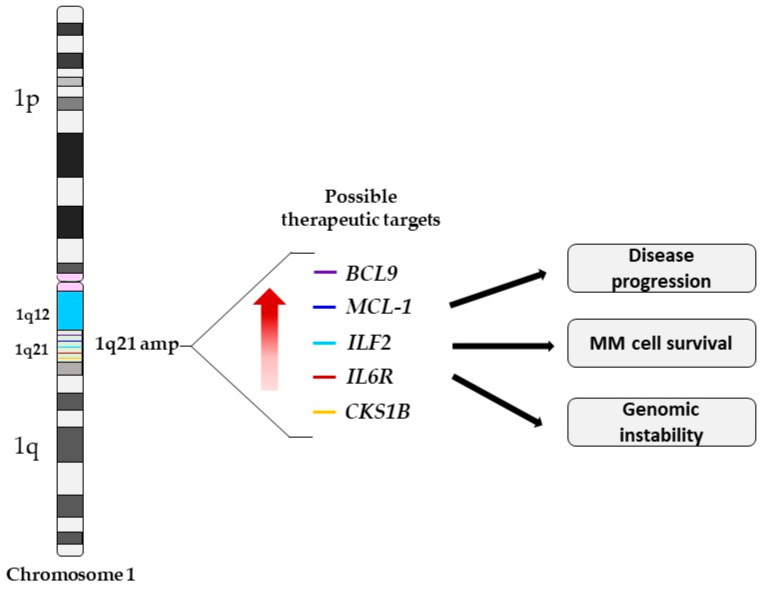
Multiple myeloma (MM) is characterized by an accumulation of malignant plasma cells (PCs) in the bone marrow (BM). The amplification of 1q21 is one of the most common cytogenetic abnormalities occurring in around 40% of de novo patients and 70% of relapsed/refractory MM. Patients with this unfavorable cytogenetic abnormality are considered to be high risk with a poor response to standard therapies. The gene(s) driving amplification of the 1q21 amplicon has not been fully studied. A number of clear candidates are under investigation, and some of them (IL6R, ILF2, MCL-1, CKS1B and BCL9) have been recently proposed to be potential drivers of this region. However, much remains to be learned about the biology of the genes driving the disease progression in MM patients with 1q21 amp. Understanding the mechanisms of these genes is important for the development of effective targeted therapeutic approaches to treat these patients for whom effective therapies are currently lacking. In this paper, we review the current knowledge about the pathological features, the mechanism of 1q21 amplification, and the signal pathway of the most relevant candidate genes that have been suggested as possible therapeutic targets for the 1q21 amplicon.
Keywords: 1q21; BCL9; CKS1B; IL6R; ILF2; MCL-1; amplification; chromosome aberrations; multiple myeloma.
Conflict of interest statement
N.G. received research funding and honoraria from Amgen, Bristol Mayers Squibb, Celgene, Millenium Pharmaceutical, and Janssen Pharmaceutical. The other authors declare no competing financial interests.
Figures
References
-
- Cavo M., Tacchetti P., Patriarca F., Petrucci M.T., Pantani L., Galli M., Di Raimondo F., Crippa C., Zamagni E., Palumbo A., et al. Bortezomib with thalidomide plus dexamethasone compared with thalidomide plus dexamethasone as induction therapy before, and consolidation therapy after, double autologous stem-cell transplantation in newly diagnosed multiple myeloma: A randomised phase 3 study. Lancet. 2010;376:2075–2085. doi: 10.1016/S0140-6736(10)61424-9. - DOI - PubMed
-
- Hillengass J., Usmani S., Rajkumar S.V., Durie B.G.M., Mateos M.V., Lonial S., Joao C., Anderson K.C., Garcia-Sanz R., Riva E., et al. International myeloma working group consensus recommendations on imaging in monoclonal plasma cell disorders. Lancet Oncol. 2019;20:e302–e312. doi: 10.1016/S1470-2045(19)30309-2. - DOI - PubMed
-
- Avet-Loiseau H., Attal M., Campion L., Caillot D., Hulin C., Marit G., Stoppa A.M., Voillat L., Wetterwald M., Pegourie B., et al. Long-term analysis of the IFM 99 trials for myeloma: Cytogenetic abnormalities [t(4;14), del(17p), 1q gains] play a major role in defining long-term survival. J. Clin. Oncol. 2012;30:1949–1952. doi: 10.1200/JCO.2011.36.5726. - DOI - PubMed
-
- Perrot A., Lauwers-Cances V., Tournay E., Hulin C., Chretien M.L., Royer B., Dib M., Decaux O., Jaccard A., Belhadj K., et al. Development and Validation of a Cytogenetic Prognostic Index Predicting Survival in Multiple Myeloma. J. Clin. Oncol. 2019;37:1657–1665. doi: 10.1200/JCO.18.00776. - DOI - PMC - PubMed
Publication types
MeSH terms
Substances
Grants and funding
LinkOut - more resources
Full Text Sources
Medical
Research Materials
Miscellaneous
