Review
. 2021 Jun 18;12(6):928.
doi: 10.3390/genes12060928.

The Crazy Ovary

Affiliations
Review

The Crazy Ovary

Philippe Monget et al. Genes (Basel). .

Abstract

From fetal life until senescence, the ovary is an extremely active tissue undergoing continuous structural and functional changes. These ever-changing events are best summarized by a quotation attributed to Plato when describing motion in space and time-'nothing ever is but is always becoming…'. With respect to the ovary, these changes include, at the beginning, the processes of follicular formation and thereafter those of follicular growth and atresia, steroidogenesis, oocyte maturation, and decisions relating to the number of mature oocytes that are ovulated for fertilization and the role of the corpus luteum. The aims of this review are to offer some examples of these complex and hitherto unknown processes. The ones herein have been elucidated from studies undertaken in vitro or from normal in vivo events, natural genetic mutations or after experimental inactivation of gene function. Specifically, this review offers insights concerning the initiation of follicular growth, pathologies relating to poly-ovular follicles, the consequences of premature loss of germ cells or oocytes loss, the roles of AMH (anti-Müllerian hormone) and BMP (bone morphogenetic protein) genes in regulating follicular growth and ovulation rate together with species differences in maintaining luteal function during pregnancy. Collectively, the evidence suggests that the oocyte is a key organizer of normal ovarian function. It has been shown to influence the phenotype of the adjacent somatic cells, the growth and maturation of the follicle, and to determine the ovulation rate. When germ cells or oocytes are lost prematurely, the ovary becomes disorganized and a wide range of pathologies may arise.

Keywords: crazy; folliculogenesis; ovary; ovulation rate; primordial follicles; reactivation; steroidogenesis; unexpected.


Conflict of interest statement

The authors declare no conflict of interest.

Figures
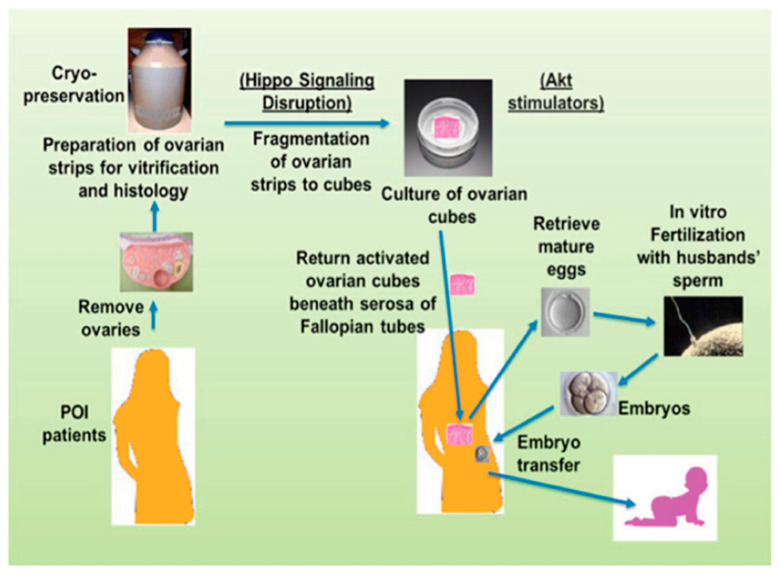
Figure 1
Figure 1
Ovarian fragmentation, in vitro Akt stimulation and auto-grafting promoted follicle growth in POI (premature ovarian insufficiency) patients and generated mature oocytes are able to be fertilized in vitro leading to a pregnancy and a baby after embryo transfer. Ovaries removed under laparoscopic were cut into strips, the latter being vitrified. After thawing, strips were fragmented into small cubes (1–2 mm3) that disrupted the Hippo signaling pathway, and treated with Akt stimulators (bpV (hopic) and 740YP). Forty-eight hours later, cubes were autografted under laparoscopic surgery beneath serosa of Fallopian tubes. After detection of antral follicles via transvaginal ultrasound, patients were treated with gonadotrophins, and mature oocytes were subjected to IVF (in vitro fertilization) before cryopreservation of four-cell stage embryos. Patients then received hormonal treatments to prepare the endometrium for implantation followed by transferring of thawed embryos. Several babies have been born using this technique around the world ([3], with permission).
Figure 2
Figure 2
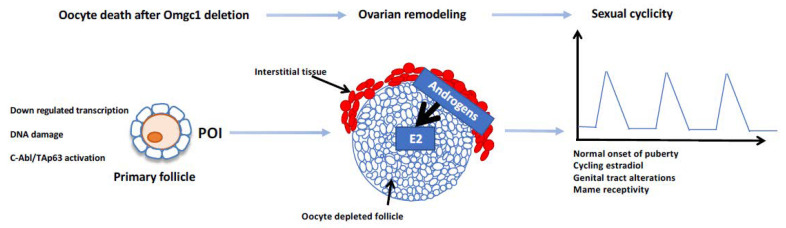
Summary of the ovarian and reproductive features of Omcg1ocKo females. Oocyte death and arrest of folliculogenesis at the primary follicle stage, leading to a kind of premature ovarian insufficiency (POI), were observed in Omcg1ocKo females. The ovarian somatic compartment was remodeled, allowing the production of oestradiol (E2), which might occur along a two-cell compartment scheme similar to what is found between theca cells and granulosa cells in preovulatory follicles. Surprisingly, despite the absence of cyclic follicular growth and then of preovulatory follicles, Omcg1ocKo females displayed features of sexual cyclicity as wild-type mice (adapted from [4]).
Figure 3
Figure 3
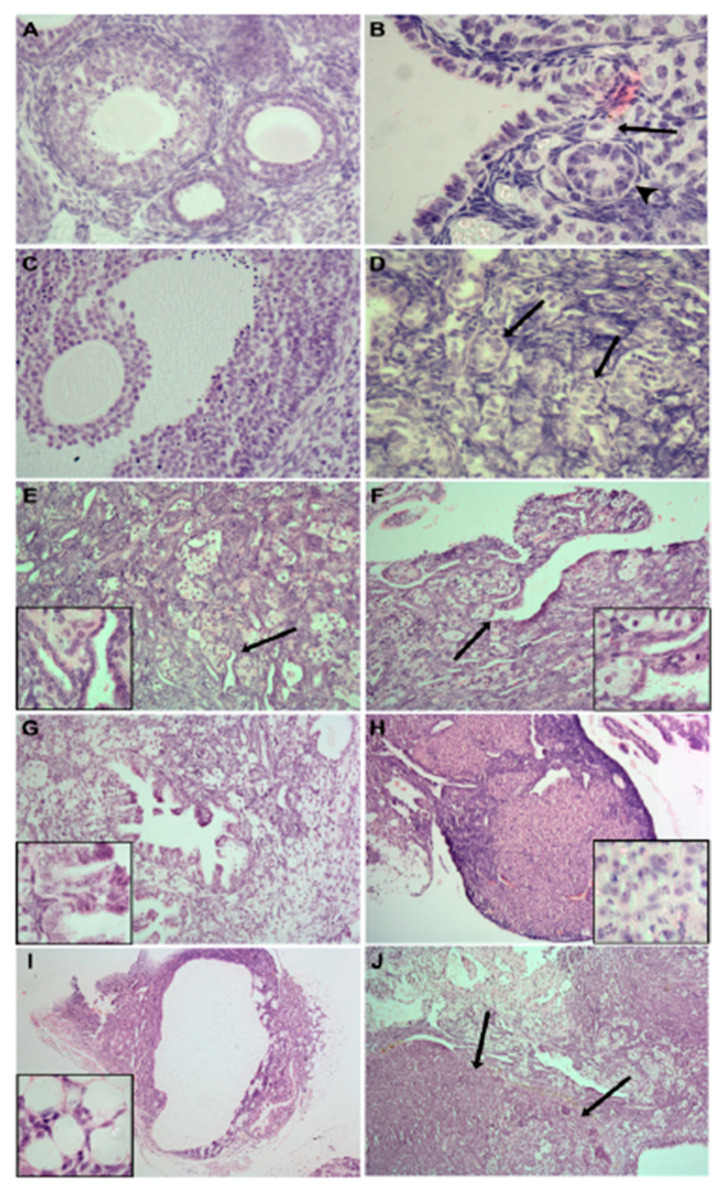
Representative micrographs of ovary sections from Fancd2-WT (A) and Fancd2-KO (BJ) mice at 2.5 (AC), 5–9 (DI) and 12 (J) months of age after birth. Note the appearance of primordial (arrow) (B), preantral (arrowhead) (B) and antral (C) follicles in ovaries of Fancd2-KO mice similar to that in WT mice (A). Common abnormal ovarian phenotypes in Fancd2-KO mince include: the formation of numerous sex cords (arrows) (D); tubules (high magnification inset, arrow) (E); invagination of ovarian surface epithelium (high magnification inset, arrow) (F); cystic papillary hyperplasia (high magnification inset, (G); luteomas containing large areas of cells of spongy appearance (high magnification inset, (H); cystadenocarcinoma whereby mitotically-active cells are invading extraovarian fat cells High magnification inset, (I) and; large areas containing numerous tumour phenotypes of epithelial origin, including adenocarcinomas (arrows) (J). Reproduced with permission from UPV/EHU Press from [9].
Figure 4
Figure 4
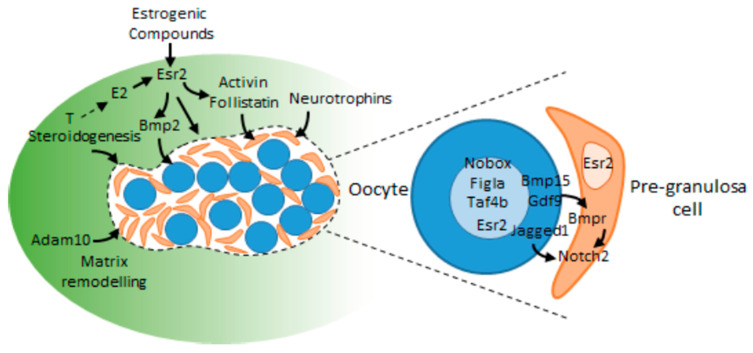
Schematic representation of some mechanisms currently known to regulate germ cell cyst breakdown and follicle assembly in the fetal or neonatal ovary. A germ cell cyst is represented (delineated by a dotted line), containing oocytes (blue round cells) and pre-granulosa cells (small pink cells). Some known interactions between germ and somatic cells participating to these processes are zoomed in the right part of the figure (adapted from [32]).
Figure 5
Figure 5
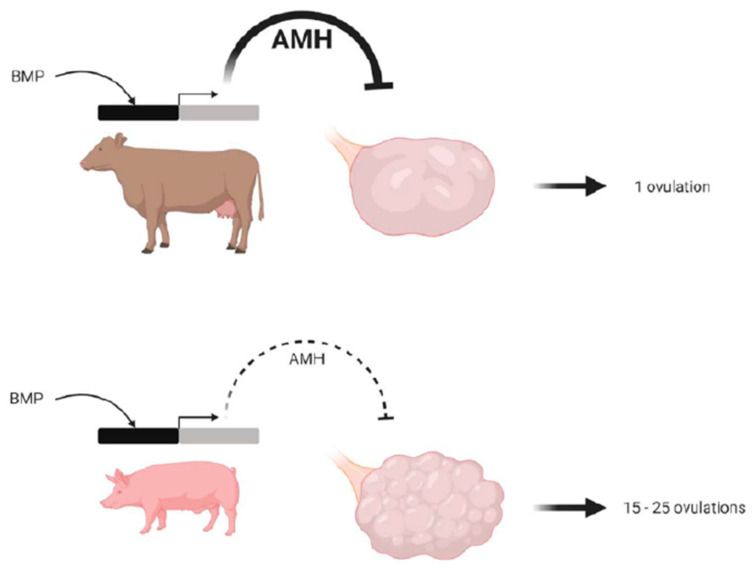
Differences between the bovine and porcine species in terms of anti-Müllerian hormone (AMH) production that could explain the regulation of ovulation number. We propose this model to explain a potential role of AMH in the regulation of the ovulation rate in porcine compared to bovine ovaries. Porcine AMH promoter and porcine granulosa cells are less sensitive to bone morphogenetic protein (BMP) stimulation, leading to a low production of AMH by porcine compared to bovine growing antral follicles. As AMH is known to be an inhibitor primordial follicle activation, this low level of AMH in the pig would lead to a huge number of growing follicles in the porcine compared to the bovine species. The reduced BMP sensitivity of granulosa cells and the low intra-follicular AMH concentrations of antral follicles could contribute to sensitizing granulosa cells to FSH (follicle stimulating hormone), resulting in a high follicular survival rate in the cohort of terminally developing follicles and a higher ovulation rate in the porcine, compared to the bovine species (from [45], with permission).
Figure 6
Figure 6
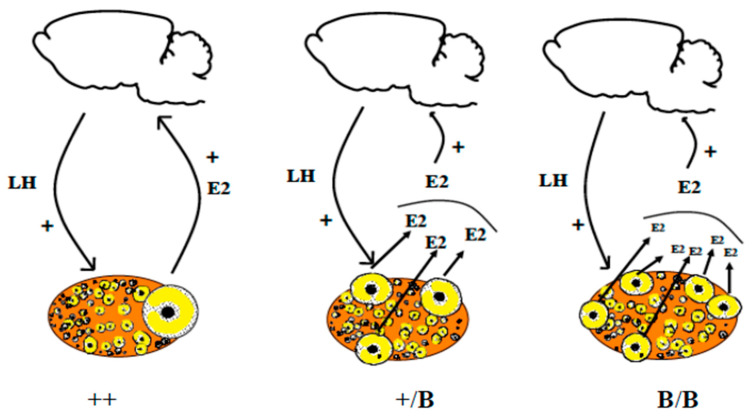
Poly-ovulation in ewes carrying loss of function mutations in the ovarian BMP system. It seems that BMP15 and GDF9 determine the stage at which follicular maturation occurs. In the case of loss of function, one can consider these mutations as having “brake-release” functions, thereby resulting in follicles ready to ovulate at smaller diameters. Additionally, as these mutations have no consequences on the capacity of oestradiol secretion by granulosa cells ([52] for Booroola mutants; [53] for heterozygous BMP15 mutant), we can hypothesize that the increase in the ovulation rate is due to the need to have a sufficient number of granulosa cells to secrete enough oestradiol necessary for the induction of the GnRH surge [54].
Figure 7
Figure 7
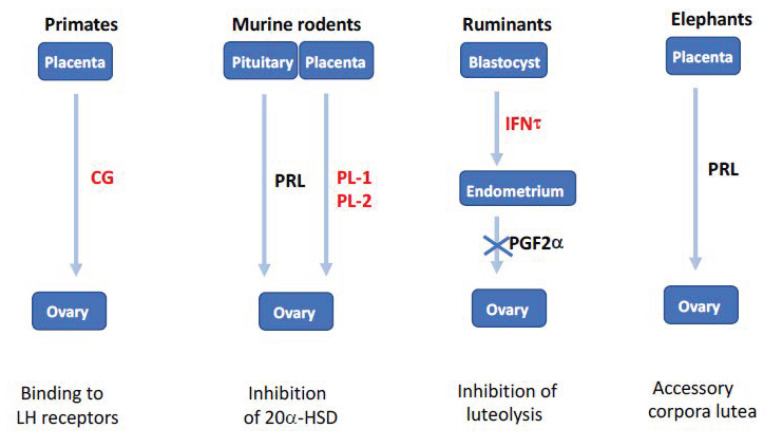
Evolution and diversity of non-steroidal luteotrophic factors in eutherians. In primates, duplication of the luteinizing hormone (LH) gene generated chorionic gonadotropins (CG), which are expressed by trophoblast and impair corpus luteum lysis in the first months of pregnancy. In rodents, pituitary prolactin (PRL) released in response to coitus inhibits 20-hydroxysteroid dehydrogenase (20α-HSD), this function being subsequently assumed by placental lactogens (PL-1 and PL-2). In ruminants, duplication of the IFNW gene generated interferon-τ (IFNT) secreted by the blastocyst and acting on the endometrium to inhibit the prostaglandin F2α (PGF2α) luteolytic signal. In elephants, the PRL gene expressed in the placenta is responsible for pregnancy maintenance by accessory corpora lutea. In red, proteins born after gene duplication (adapted from [58]).

References

    1. Sawyer H.R., Smith P., Heath D.A., Juengel J.L., Wakefield S.J., McNatty K.P. Formation of ovarian follicles during fetal development in sheep. Biol. Reprod. 2002;66:1134–1150. doi: 10.1095/biolreprod66.4.1134. - DOI - PubMed
    1. Peters H., Byskov A.G., Himelstein-Braw R., Faber M. Follicular growth: The basic event in the mouse and human ovary. J. Reprod. Fertil. 1975;45:559–566. doi: 10.1530/jrf.0.0450559. - DOI - PubMed
    1. Kawamura K., Cheng Y., Suzuki N., Deguchi M., Sato Y., Takae S., Ho C.H., Kawamura N., Tamura M., Hashimoto S., et al. Hippo signaling disruption and Akt stimulation of ovarian follicles for infertility treatment. Proc. Natl. Acad. Sci. USA. 2013;110:17474–17479. doi: 10.1073/pnas.1312830110. - DOI - PMC - PubMed
    1. Vandormael-Pournin S., Guigon C.J., Ishaq M., Coudouel N., Ave P., Huerre M., Magre S., Cohen-Tannoudji J., Cohen-Tannoudji M. Oocyte-specific inactivation of Omcg1 leads to DNA damage and c-Abl/TAp63-dependent oocyte death associated with dramatic remodeling of ovarian somatic cells. Cell Death Differ. 2015;22:108–117. doi: 10.1038/cdd.2014.122. - DOI - PMC - PubMed
    1. Mork L., Maatouk D.M., McMahon J.A., Guo J.J., Zhang P., McMahon A.P., Capel B. Temporal differences in granulosa cell specification in the ovary reflect distinct follicle fates in mice. Biol. Reprod. 2012;86:37. doi: 10.1095/biolreprod.111.095208. - DOI - PMC - PubMed

LinkOut - more resources