


Cis-Segregation of c.1171C>T Stop Codon (p.R391*) in SERPINC1 Gene and c.1691G>A Transition (p.R506Q) in F5 Gene and Selected GWAS Multilocus Approach in Inherited Thrombophilia
- PMID: 34207366
- PMCID: PMC8234447
- DOI: 10.3390/genes12060934
Cis-Segregation of c.1171C>T Stop Codon (p.R391*) in SERPINC1 Gene and c.1691G>A Transition (p.R506Q) in F5 Gene and Selected GWAS Multilocus Approach in Inherited Thrombophilia
Abstract
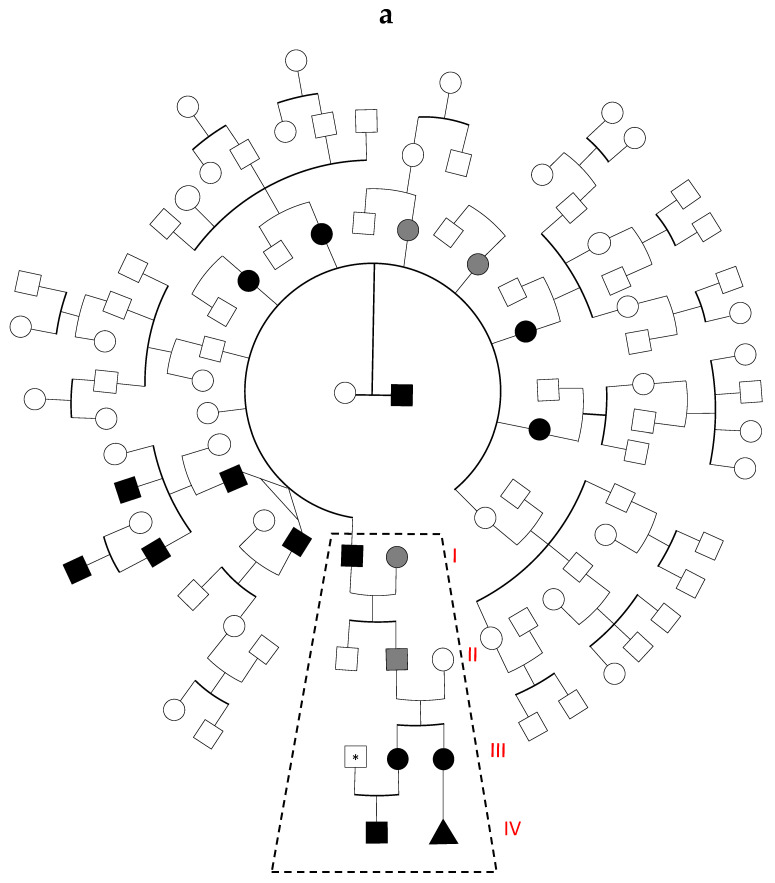
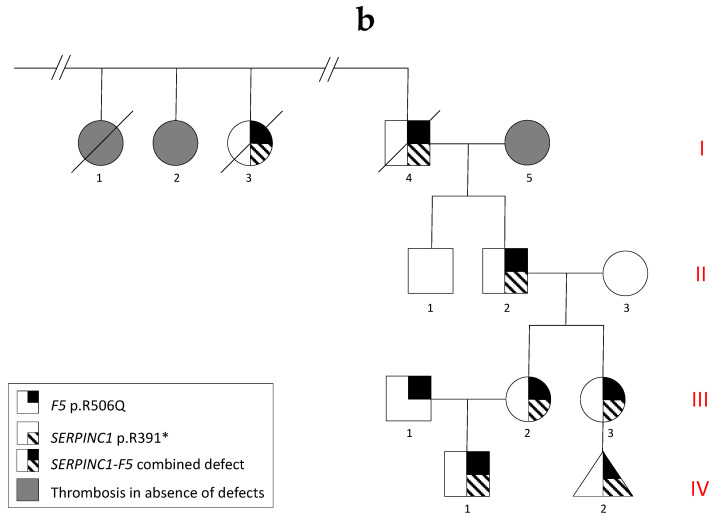
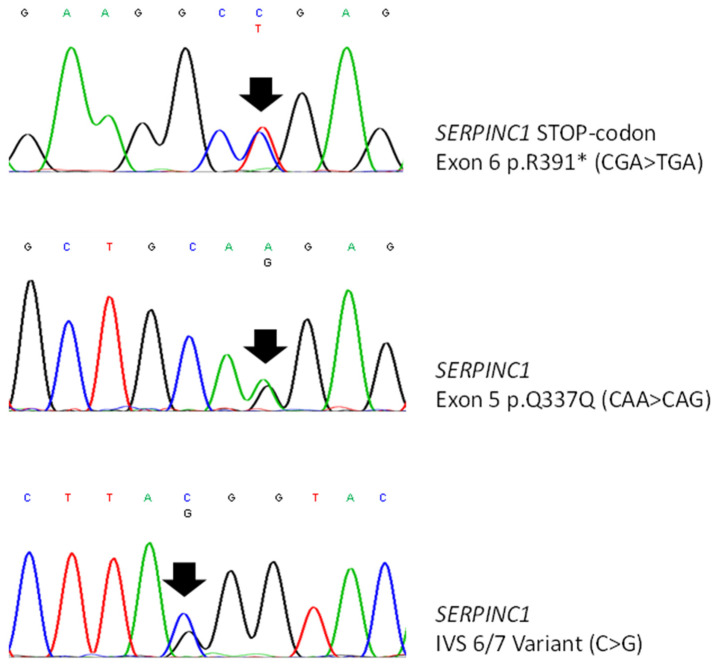
Inherited thrombophilia (e.g., venous thromboembolism, VTE) is due to rare loss-of-function mutations in anticoagulant factors genes (i.e., SERPINC1, PROC, PROS1), common gain-of-function mutations in procoagulant factors genes (i.e., F5, F2), and acquired risk conditions. Genome Wide Association Studies (GWAS) recently recognized several genes associated with VTE though gene defects may unpredictably remain asymptomatic, so calculating the individual genetic predisposition is a challenging task. We investigated a large family with severe, recurrent, early-onset VTE in which two sisters experienced VTE during pregnancies characterized by a perinatal in-utero thrombosis in the newborn and a life-saving pregnancy-interruption because of massive VTE, respectively. A nonsense mutation (CGA > TGA) generating a premature stop-codon (c.1171C>T; p.R391*) in the exon 6 of SERPINC1 gene (1q25.1) causing Antithrombin (AT) deficiency and the common missense mutation (c.1691G>A; p.R506Q) in the exon 10 of F5 gene (1q24.2) (i.e., FV Leiden; rs6025) were coinherited in all the symptomatic members investigated suspecting a cis-segregation further confirmed by STR-linkage-analyses [i.e., SERPINC1 IVS5 (ATT)5-18, F5 IVS2 (AT)6-33 and F5 IVS11 (GT)12-16] and SERPINC1 intragenic variants (i.e., rs5878 and rs677). A multilocus investigation of blood-coagulation balance genes detected the coexistence of FV Leiden (rs6025) in trans with FV HR2-haplotype (p.H1299R; rs1800595) in the aborted fetus, and F11 rs2289252, F12 rs1801020, F13A1 rs5985, and KNG1 rs710446 in the newborn and other members. Common selected gene variants may strongly synergize with less common mutations tuning potential life-threatening conditions when combined with rare severest mutations. Merging classic and newly GWAS-identified gene markers in at risk families is mandatory for VTE risk estimation in the clinical practice, avoiding partial risk score evaluation in unrecognized at risk patients.
Keywords: F5; FV Leiden; GWAS; SERPINC1; cis-segregation; crossing-over; inherited thrombophilia.
Conflict of interest statement
The authors declare no conflict of interest.
Figures
References
-
- Ordonez A., de Cos C., Minano A., Rodriguez J., Hernandez-Espinosa D., Munoz J.A., Gonzalez-Conejero R., Vicente V., Corral J. Coexistence of three genetic risk factors in a Spanish thrombophilic family: Factor V Leiden, prothrombin 20210 and a new type I antithrombin deficiency. Thromb. Haemost. 2007;97:153–155. doi: 10.1160/TH06-08-0440. - DOI - PubMed
-
- Gemmati D., Serino M.L., Tognazzo S., Ongaro A., Moratelli S., Gilli G., Forini E., De Mattei M., Scapoli G.L. The reduced sensitivity of the ProC Global test in protein S deficient subjects reflects a reduction in the associated thrombotic risk. Blood Coagul. Fibrinolysis. 2001;12:691–697. doi: 10.1097/00001721-200112000-00011. - DOI - PubMed
-
- Gemmati D., Serino M.L., Moratelli S., Tognazzo S., Ongaro A., Scapoli G.L. Coexistence of factor V G1691A and factor II G20210A gene mutations in a thrombotic family is associated with recurrence and early onset of venous thrombosis. Haemostasis. 2001;31:99–105. doi: 10.1159/000048050. - DOI - PubMed
Publication types
MeSH terms
Substances
LinkOut - more resources
Full Text Sources
Research Materials
Miscellaneous
